Aryaka Launches SASE 2.0 Platform with Enhanced AI Security and Zero Trust Features


2 Sources
[1]
Aryaka launches Unified SASE as a Service 2.0 to secure remote work and AI adoption - SiliconANGLE
Aryaka launches Unified SASE as a Service 2.0 to secure remote work and AI adoption Secure access service edge provider Aryaka Networks Inc. today announced the launch of Aryaka Unified SASE as a Service 2.0, a new platform that incorporates several major new features to accommodate the boom in
[2]
Aryaka Unified SASE as a Service 2.0: Now With More AI Security, Universal ZTNA
Unified SASE as a Service 2.0, which as of this year is available via a consumption-based buying model, offers customers and partners a highly attractive one-platform approach to networking and security, with an 'immediate, near-term upsell opportunity' for partners with the addition of Universal
Share
Copy Link
Aryaka Networks unveils its Unified SASE as a Service 2.0 platform, introducing AI-specific security capabilities and universal zero trust network access to address the growing demands of remote work and AI adoption in enterprise environments.
Aryaka Unveils Enhanced SASE Platform for AI Era
Aryaka Networks has announced the launch of its Unified SASE as a Service 2.0 platform, introducing significant enhancements designed to address the evolving security challenges posed by widespread AI adoption and remote work environments
1
. The upgraded platform represents a major evolution from the company's original SASE offering, incorporating customer feedback to deliver more comprehensive security and networking capabilities.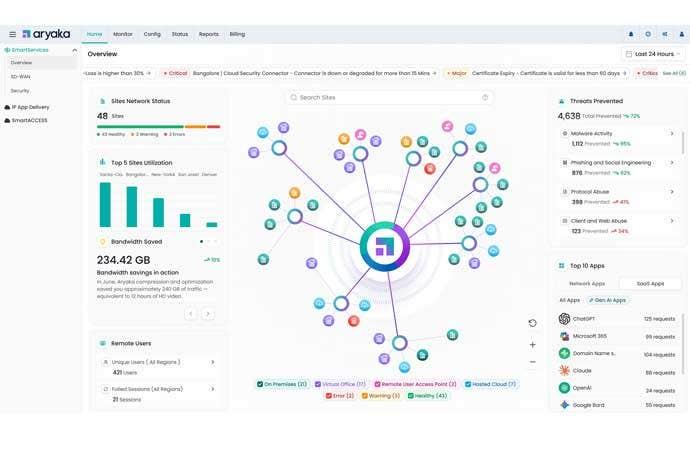
Source: CRN
New AI Security Capabilities
The centerpiece of the 2.0 platform is Aryaka AI>Secure, a specialized security service designed to protect enterprises as they navigate generative AI adoption. This feature addresses the dual challenge organizations face: wanting to leverage AI productivity gains while managing new security risks
2
. AI>Secure provides protection against prompt injections, token flooding, malicious code, URL attacks, and jailbreaks, while enforcing content-safety and sentiment controls through centralized policy enforcement and real-time monitoring1
.The service helps enterprises identify and eliminate Shadow AI usage, protect against knowledge leakage, and maintain compliance in an evolving threat landscape. According to Scott Fanning, Aryaka's vice president of security product management, the goal is to enable "safe usage of AI by their users, by allowing certain types of controls and governance around them"
2
.Universal Zero Trust Network Access
Another major addition to the platform is Aryaka Universal Zero Trust Network Access (ZTNA), which became available in November 2024. This capability enables zero-trust access to any application from anywhere, enforcing consistent, identity and posture-based access control across all edges of Aryaka's Zero Trust WAN
1
. The feature provides enterprises with full visibility and control over application access while reducing reliance on legacy VPNs and minimizing risks from lateral movement.Related Stories

Advanced Data Protection
The platform also incorporates Next-Gen Data Loss Prevention (DLP), which leverages AI-powered natural language processing, granular policy tuning, and contextual pattern recognition to protect data in motion between networks, applications, locations, and users
1
. This feature ensures comprehensive data protection across all generative AI traffic flows, whether they involve software-as-a-service, cloud AI services, or legacy applications.Market Response and Channel Strategy
The platform addresses significant market demands, with Nick Alagna, Aryaka's vice president of global channels, noting that partners are experiencing "fatigue with vendor sprawl, multiple tools, multiple dashboards [and] solutions that are hard to manage"
2
. The unified approach offers channel partners what Alagna describes as an "immediate, near-term upsell opportunity" through the addition of Universal ZTNA capabilities.Renuka Nadkarni, chief product officer at Aryaka, emphasized that customer feedback drove the platform's development, revealing two key organizational needs: expanding secure, high-performance network connectivity to hybrid workforces globally and safeguarding generative AI applications and services
1
.References
Summarized by

Navi
[1]
Related Stories
Aryaka Enhances SASE Platform with AI-Powered Observability and Simplified Pricing
20 Feb 2025•Technology

Palo Alto Networks Unveils Prisma SASE 4.0: AI-Driven Security for the Modern Enterprise
05 Sept 2025•Technology

Taiwan's Semiconductor Industry Faces Challenges Amid Global Economic Slowdown
16 Jul 2024

Recent Highlights
1
Microsoft and Nvidia Launch Surface Laptop Ultra: A $2,599 AI-Ready PC With RTX Spark Chip
Technology

2
OpenAI Releases 722 AI-Generated Math Papers on GitHub, Igniting Fury Among Mathematicians
Science and Research

3
Trump Consulted Grok AI Before Ordering Venezuela Invasion and Capture of Nicolás Maduro
Policy and Regulation

Recent Highlights
Today's Top Stories









Don’t drown in AI news. We cut through the noise - filtering, ranking and summarizing the most important AI news, breakthroughs and research daily. Follow topics that matter to you and stay ahead.


