2 Sources
[1]
Augmodo raises $21M to push its spatial AI beyond just retail toward the broader physical workforce
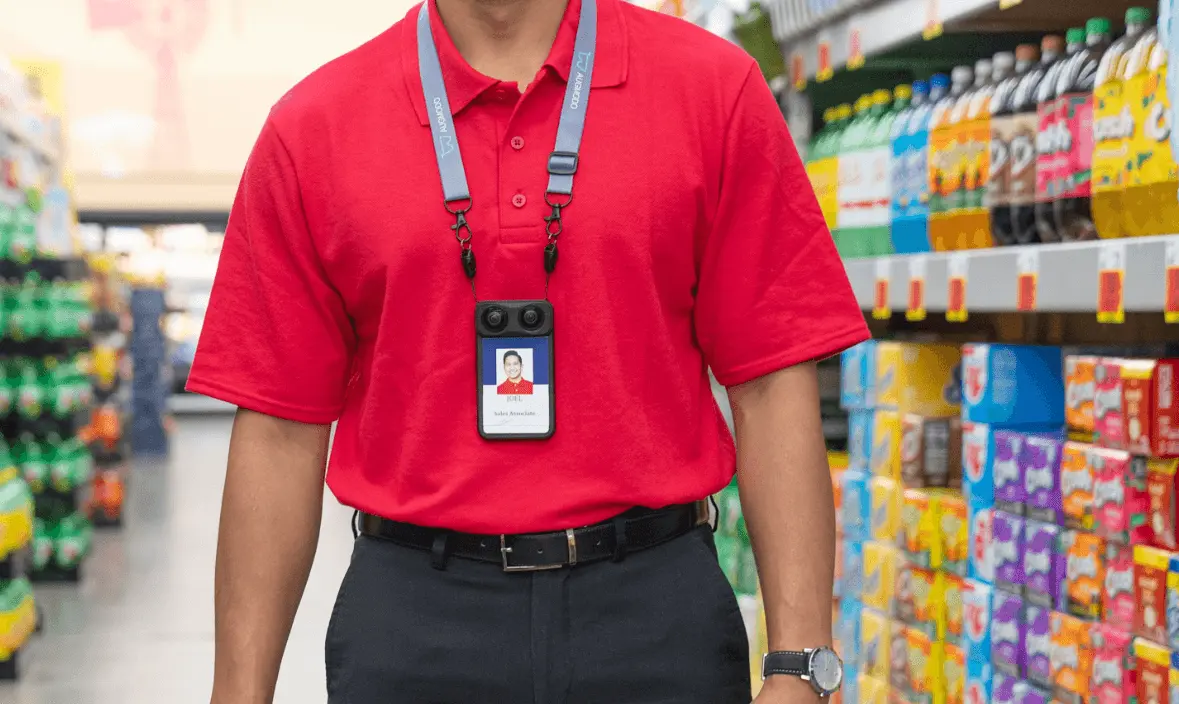
Augmodo, the Seattle startup that straps AI-powered cameras onto retail workers to track store shelves, has raised $21 million as it pushes its technology beyond grocery aisles and into warehouses, factories, and other physical workplaces. The new funding, led by existing investor TQ Ventures, values Augmodo at $350 million. CEO Ross Finman, who told GeekWire he wasn't even looking to raise fresh capital, said he was motivated by interest in the startup's technology from customers beyond retail, including automotive settings and hospitals. "Fundamentally, someone grabbing a wrench at an automotive factory isn't that different from someone grabbing a Cheerios box," Finman said. "Turns out the algorithms work pretty well across all of those." Founded in 2023, Augmodo builds AI-powered "Smartbadges" -- lightweight wearable devices with dual cameras -- that store employees wear passively as they move through aisles. The badges use computer vision, 3D mapping, and spatial computing to track shelf inventory in real time, building what the company calls a digital "Realogram" of each store. Augmodo raised $37.5 million a year ago in a round that came after Australian pharmacy chain Chemist Warehouse -- the startup's first big customer -- moved from a pilot to a full contract and validated the technology at scale. Now others want in on the action. "Our whole mission statement is AI systems for the physical workforce," Finman said. "Everyone's focused on the 20% of the workforce that's knowledge work, and we're focused on the 80% of the workforce that's physical work." That demand has pulled Augmodo into warehouses, facility maintenance, delivery operations, and even employee training -- verticals the company didn't originally set out to serve. Existing retail customers, Finman said, kept expanding their contracts to cover new parts of their operations, from auditing warehouse pallets to logging maintenance work like HVAC repairs. The Smartbadge itself has evolved, too. Finman said it's now lighter than an iPhone Air and has grown into what he calls an "everything device," adding walkie-talkie capabilities, an opt-in panic button, and a digital ID display, on top of its original inventory-tracking function. "That's actually become a really big selling point," Finman said. "You don't need to buy five or six different devices, you buy one at cost, and then here's all the different features that you can get out of it." The company says it has grown 10x in revenue over the past year and now maps more than 186 million square feet of retail space monthly -- a figure it expects to cross 1 billion square feet per month by year's end. Augmodo is adding 50 to 100 new store locations a month. The company's headcount has grown 5x over the past year to more than 50 employees, including new CTO Bradford Snow, who joined in January after previous stints at Axon, Meta, Amazon and Microsoft. Augmodo is ranked No. 145 on the GeekWire 200 list of top Pacific Northwest startups and was a finalist in the Hardware, Robotics, and Physical AI of the Year category at the 2026 GeekWire Awards. Beyond TQ Ventures, backers include Lerer Hippeau, Jefferson River Capital, Arena Holdings, Chemist Warehouse, New Fare, Interlace, and Webb Investment Network. Andrew Marks, co-founding partner at TQ, called Finman an "exceptional" leader and said every board meeting reinforced that demand for Augmodo's tech was outpacing the team's ability to serve it. "When you pair a truly special founder with customers lining up around the door and pulling you into new markets, it was obvious we should propose putting more fuel on the fire," Marks said. Augmodo said it plans to use the new capital to expand its global enterprise footprint, invest further in its core AI models, and grow its engineering team -- with a particular focus on hiring for computer vision and machine learning roles as the company scales its data processing beyond retail.
[2]
Spatial AI startup Augmodo raises $21M to expand beyond retail stores
Spatial AI startup Augmodo raises $21M to expand beyond retail stores Spatial artificial intelligence startup Augmodo Inc. said today it has raised $21 million in an impromptu funding round that lifts its valuation to $350 million. TQ Ventures served as the lead investors, with participation from Lerer Hippeau, Jefferson River Capital, Arena Holdings, Chemist Warehouse, New Fare, Interlace and Webb Investment Network The Seattle-based startup is led by its Chief Executive Ross Finman, who told GeekWire in an interview that the company was never even planning to raise additional capital. But with so many investors showing an interest in applying the company's technology in new applications, it decided to accept their money and put it to use expanding the usefulness of its platform. Augmodo originally built its technology for grocery stores. It consists of a small device known as a Smartbadge that's worn by employees as they walk around the store performing their work. The devices are programmed to constantly scan the store's shelves without interrupting the worker in order to help managers keep track of their inventory. It also creates a real-time store layout that the startup calls a "Realogram," and this is what allows store managers to ensure they never run out of stock for a particular item. However, it turns out that the same technology can be applied to many other applications besides store inventory management, and it's now rapidly being deployed in alternative environments, including warehouses, manufacturing plants, hospitals, automotive environments and for maintenance work. Finman told GeekWire that the company has only had to make a few alterations to its technology to adapt to these different use cases. "Fundamentally, someone grabbing a wrench in an automotive factory isn't that different from someone grabbing a Cheerios box," he said. "It turns out that the algorithms work pretty well across all of those." Having realized the larger potential for vision AI technology, Finman said Augmodo has pivoted and now sees itself as a physical AI company. "Our whole mission statement is AI system for the physical workforce," he insisted. "Everyone's focused on the 20% of the workforce that's knowledge work, and we're focused on the 80% of the workforce that's physical work." Augmodo has witnessed rapid growth over the last year, with revenue increasing tenfold over that period. According to Finman, the platform now maps over 186 million square feet of new retail spaces every month, and he believes that figure can reach one billion square feet monthly by the end of the year. At the same time, many of the startup's existing clients have started deploying the technology in their warehouses and for applications such as facility maintenance and operational audits. That's helping to drive growth at a rate of between 50 and 100 new store locations per month. The technology is evolving, too. The Smartbadge has been made much lighter than before and given more functionality. For instance, it can be used as a walkie-talkie, a digital identity display for employees and even has an optional panic button. With these new additions, it means employees no longer have to carry around multiple devices, Finman said. Going forward, Augmodo will use the funds to enhance its computer vision and machine learning capabilities and hire more engineers so it can process much larger volumes of data from different industries. The company is also determined to expand its global footprint and sell its tech in different markets. TQ Ventures Managing Partner Andrew Marks said Augmodo is effectively modernizing what is one of the largest labor workforces in the world. "Our strong retail relationships combined with Augmodo's innovative tech results in a dynamic and strategic partnership," he said. "It helps retailers and customers provide immediate value today, solving out of stocks, inventory visibility and in-store tasks, while layering in the spatial data groundwork for the future of retail."
Share
Copy Link
Seattle-based Augmodo has raised $21 million in an unplanned funding round, now valued at $350 million. The startup, known for AI-powered Smartbadges that track retail inventory, is expanding into warehouses, factories, and hospitals. With 10x revenue growth and mapping 186 million square feet monthly, Augmodo is positioning itself as a physical AI company serving the 80% of workers in physical jobs.
Augmodo, the Seattle-based startup that pioneered AI-powered wearable devices for retail inventory tracking, has raised $21M funding in what CEO Ross Finman describes as an impromptu round
1
. Led by existing investor TQ Ventures, the funding values the company at $350 million and marks a strategic shift as Augmodo positions itself to expand beyond retail into warehouses, factories, hospitals, and automotive environments2
. Finman told GeekWire he wasn't even seeking fresh capital, but investor interest in applying the company's technology to new markets changed his calculus. The round included participation from Lerer Hippeau, Jefferson River Capital, Arena Holdings, Chemist Warehouse, New Fare, Interlace, and Webb Investment Network1
.
Source: SiliconANGLE
Founded in 2023, Augmodo builds Smartbadges—lightweight wearable devices with dual cameras that employees wear passively as they work. Using computer vision and machine learning, spatial AI, and 3D mapping, these devices track inventory and create what the company calls a Realogram, a digital representation that provides a real-time store layout
1
. What started as a retail-focused solution has proven remarkably adaptable. "Fundamentally, someone grabbing a wrench at an automotive factory isn't that different from someone grabbing a Cheerios box," Finman explained. "Turns out the algorithms work pretty well across all of those"1
. This versatility has pulled Augmodo into facility maintenance, delivery operations, employee training, and warehouse auditing—verticals the company didn't originally target but that existing customers demanded as they expanded their contracts2
.Augmodo has reframed its mission around serving the physical workforce, a deliberate contrast to the knowledge work focus dominating AI development. "Our whole mission statement is AI systems for the physical workforce," Finman said. "Everyone's focused on the 20% of the workforce that's knowledge work, and we're focused on the 80% of the workforce that's physical work"
1
. This positioning as a physical AI company reflects both market demand and the technology's proven ability to handle diverse use cases with minimal modifications2
. The Smartbadge itself has evolved into what Finman calls an "everything device," now lighter than an iPhone Air and equipped with walkie-talkie capabilities, an opt-in panic button, and digital ID display alongside its core inventory management function. "You don't need to buy five or six different devices, you buy one at cost, and then here's all the different features that you can get out of it," he noted1
.Related Stories

Source: GeekWire
The company has demonstrated remarkable traction, reporting 10x revenue growth over the past year while now mapping more than 186 million square feet of retail space monthly—a figure Augmodo expects to surpass one billion square feet per month by year's end
1
. The startup is adding 50 to 100 new store locations monthly, and its headcount has grown fivefold to more than 50 employees1
. In January, the company brought on Bradford Snow as CTO, who previously worked at Axon, Meta, Amazon, and Microsoft1
. Andrew Marks, co-founding partner at TQ Ventures, called Finman an "exceptional" leader and said demand for AI-powered spatial computing technology was outpacing the team's ability to serve it. "When you pair a truly special founder with customers lining up around the door and pulling you into new markets, it was obvious we should propose putting more fuel on the fire," Marks said1
. Augmodo plans to use the new capital to expand its global enterprise footprint, invest in core AI models, and grow its engineering team with particular focus on computer vision and machine learning roles as it scales data processing beyond retail1
.Summarized by
Navi
[1]
05 Sept 2025•Startups

09 Feb 2026•Startups

24 Oct 2024•Business and Economy

1
Technology

2
Policy and Regulation

3
Business and Economy