Australia's official line on AI and graduate jobs just changed


2 Sources
[1]
AI is set to change the graduate job market. Here's how unis can respond
Globally, there have been concerns about the likelihood of artificial intelligence (AI) taking people's jobs and reducing job opportunities for university graduates. AI software companies, such as OpenAI, Google DeepMind and Anthropic are pursuing AI systems capable of matching or exceeding human
[2]
AI is set to change the graduate job market. Here's how universities can respond
Globally, there have been concerns about the likelihood of artificial intelligence (AI) taking people's jobs and reducing job opportunities for college graduates. AI software companies, such as OpenAI, Google DeepMind and Anthropic, are pursuing AI systems capable of matching or exceeding human
Share
Copy Link
As of February, per a federal government report, AI had not significantly affected Australia's job market, graduate opportunities included
1
2
. This month, the Reserve Bank of Australia has flagged early signs that younger workers in AI-exposed industries are struggling to find work1
2
. It is the first official signal that the February picture may be shifting.What the official picture says
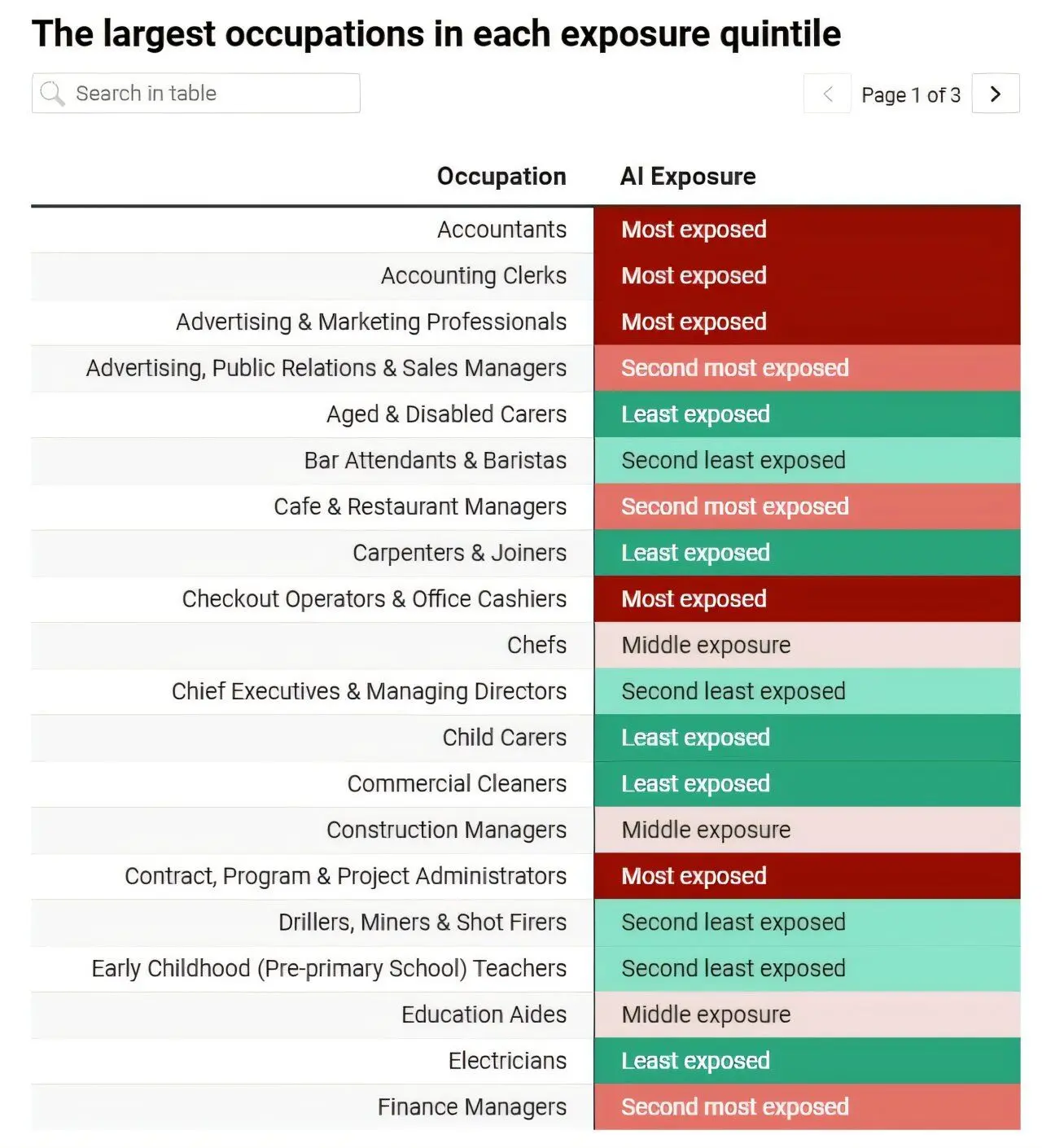
The July report drew a clear line between kinds of work. Jobs built on cognitive tasks, such as accountants, clerks and receptionists, were rated most exposed to AI automation. Physical work, including trades, care work and truck driving, was rated least exposed
1
2
.
Source: Phys.org
Employer behaviour is already moving in the report's direction. Some law firms have cut graduate positions and shifted low-level tasks to AI. Some consulting firms have trimmed graduate roles in recent years too, but they say AI is not the cause. In the week before publication, Qantas said it will shift 850 jobs to India and put more money into AI
1
2
.The evidence so far amounts to some early signs, not a confirmed trend
1
2
.The machines are getting better at the work
The author of the articles, an academic who ran the criminal law exam studies, reports that AI's average score on university criminal law exams climbed from 52.5% in 2023 to 76.3% by 2025. On that one test set, the 2025 models on average outperformed an average university student on critical thinking
1
2
.The author points to independent work too. In one 2024 study comparing human and AI reasoning on trick puzzles, earlier AI systems did worse than humans; newer models did better
1
2
. An OpenAI model has also recently disproved a geometry conjecture dating from 19461
2
. These were specific tests, the author notes, and they do not prove AI could take over a whole profession1
[2](https://phys.org/news/2026-11-ai-job-universities.html].Related Stories

What universities are being told to do
If AI can do the routine intellectual work, the remaining value of a graduate lies in what AI still cannot do unaided. In one 2026 pilot study, health workers, most of them nurses, accepted half of the deliberately wrong AI recommendations and turned down about one in six correct ones
1
2
. A UK study found members of the public sometimes leave out important details when asking chatbots for medical advice, producing answers that mix useful suggestions with misleading ones1
2
.The author argues the answer may be to teach both: full disciplinary knowledge and the ability to judge, direct and improve what AI produces
1
2
. The physical side of the labour market buys some time. Robotaxis, delivery robots and autonomous excavators already operate in a growing number of cities and sites. How soon robots could do a tradesperson's work is unclear, so vocational pathways currently carry lower AI-disruption risk1
2
. Per the author's argument, an employer may have little economic reason to keep a worker who cannot improve on what the AI produces.
Source: The Conversation
References
Summarized by

Navi
[1]
Related Stories
AI Job Market Shows Mixed Impact on Recent Graduates as Computer Science Grads Face 7.1% Unemployment
19 Sept 2026•Business and Economy

AI's Impact on Entry-Level Jobs: Challenges and Opportunities for Gen Z
09 Jul 2025•Business and Economy

Young Workers Land High-Paying AI Jobs as Workplace Debate Intensifies Over Junior Employee Usage
14 Aug 2026•Business and Economy

Recent Highlights


Recent Highlights
Today's Top Stories










Don’t drown in AI news. We cut through the noise - filtering, ranking and summarizing the most important AI news, breakthroughs and research daily. Follow topics that matter to you and stay ahead.


