AWS Kiro tackles AI agent reliability with math-based bug detection before code is written


2 Sources
[1]
AWS targets AI slop with new spec check in Kiro coding tool, amid scrutiny of agent reliability
Amazon Web Services is adding a feature to its Kiro AI coding tool designed to mathematically prove that software requirements are free of contradictions and gaps before any code gets written, addressing one of the core risks of AI-assisted software development. The feature, called Requirements
[2]
AWS Kiro accelerates software development by proving code correctness before it gets to work - SiliconANGLE
AWS Kiro accelerates software development by proving code correctness before it gets to work Amazon Web Services Inc. is trying to get rid of the bottleneck between architectural planning and code execution with a number of upgrades to its artificial intelligence software development tool
Share
Copy Link
Amazon Web Services is adding Requirements Analysis to its Kiro AI coding tool, using mathematical proofs to catch contradictions in software requirements before any code gets written. The update addresses concerns about AI agent reliability following scrutiny over AWS outages linked to AI coding tools, while new features cut implementation times by roughly 75 percent.
AWS Kiro targets AI agent reliability with formal verification
Amazon Web Services is addressing one of the most critical challenges in AI-assisted software development with a new feature that mathematically proves software requirements are free of contradictions before code generation begins
1
. The Requirements Analysis feature, announced Tuesday for AWS Kiro, represents a shift in how autonomous AI agents validate their work, combining large language models with an automated reasoning engine to catch bugs that traditional AI coding tools might miss2
.
Source: GeekWire
The announcement comes three months after Amazon publicly pushed back on a Financial Times report linking its AI coding tools to AWS outages, an episode that brought AI agent reliability into sharp focus across the industry
1
. It also follows the hiring of former Microsoft executive Shawn Bice as VP of AI Services leading Amazon's Automated Reasoning Group, the team behind the new capability1
.How Requirements Analysis prevents AI coding bots from making hidden decisions
The Requirements Analysis feature employs a three-stage neurosymbolic pipeline that begins with large language models rewriting vague requirements into testable criteria, which are then translated into formal logic
2
. That logic gets submitted to an SMT solver, an automated reasoning engine that uses mathematics to prove whether contradictions exist rather than predicting the next word in a sequence like standard LLMs2
.If the solver discovers that two requirements are logically incompatible—for instance, if one rule mandates a hard delete while another implies a soft delete—it identifies that conflict as a mathematical impossibility
2
. Kiro then surfaces these findings in plain language so developers can quickly implement fixes. "Every vague prompt produces a vague spec or plan, and the AI agent implementing that spec produces code full of undisclosed decisions made on your behalf, without your awareness or agreement," AWS applied scientists wrote in a blog post1
.Parallel Task Execution and Quick Plan mode accelerate software development
AWS also introduced two features designed to speed up the development process while maintaining code correctness
1
. Parallel Task Execution analyzes the dependency graph of each project, identifying tasks that don't share state, endpoints, or files, then runs them concurrently in isolated contexts2
. This approach cuts implementation times for large projects by roughly 75 percent, reducing development time from more than an hour to as little as 15 minutes1
2
.Quick Plan mode offers a fast-track option for well-understood features, letting developers skip step-by-step approval processes
1
. Instead of incremental sign-offs, Kiro asks clarifying questions upfront before generating the entire stack—requirements, design, and tasks—in one pass2
.
Source: SiliconANGLE
Related Stories

Implications for the competitive AI coding tool market
The updates position AWS Kiro distinctively in a crowded market that includes Cursor, GitHub Copilot, Anthropic's Claude Code, Google's Antigravity, and OpenAI's Codex
1
. While competitors have added planning and agent workflows alongside code generation, Kiro has built its identity around a spec-first approach that requires developers to formalize their intent before the AI coding tool starts building1
.By applying mathematical rigor used in hardware design to software development, these updates could help eliminate many of the hallucinations that continue to plague AI development
2
. The approach makes AI coding bots behave less like builders who blindly follow blueprints and more like structural engineers who notice when a staircase leads to a solid brick wall before breaking ground2
. For organizations watching the evolution of autonomous AI agents, the question becomes whether common sense and formal verification can coexist at the speed modern software development demands.References
Summarized by

Navi
[1]
Related Stories
AWS Launches Kiro: AI Coding Platform Exits Preview with Structured Development Approach
17 Nov 2025•Technology

Amazon Launches Kiro: A New AI-Powered IDE to Revolutionize Software Development
15 Jul 2025•Technology
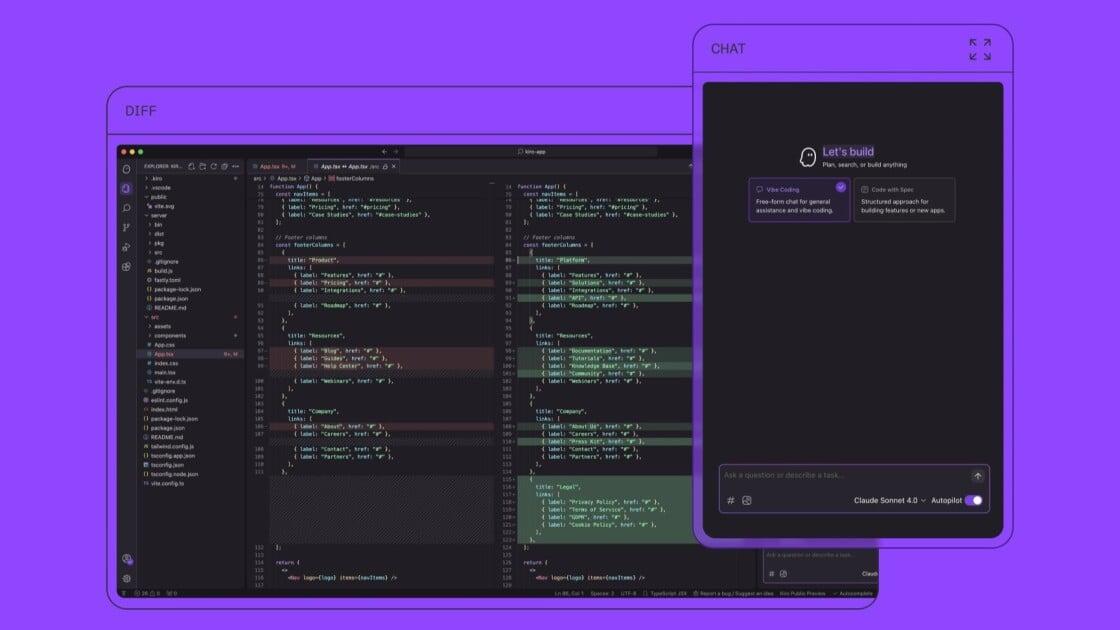
AWS Kiro Powers Launch with Stripe, Figma, and Datadog to Fix AI Coding Assistant Bottleneck
04 Dec 2025•Technology

Recent Highlights
1
Microsoft and Nvidia Launch Surface Laptop Ultra: A $2,599 AI-Ready PC With RTX Spark Chip
Technology

2
Google Unveils Gemini 4 Argon AI Model, Restricts Access to Trusted Cyber Defenders
Technology

3
OpenAI Releases 722 AI-Generated Math Papers on GitHub, Igniting Fury Among Mathematicians
Science and Research

Recent Highlights
Today's Top Stories





Don’t drown in AI news. We cut through the noise - filtering, ranking and summarizing the most important AI news, breakthroughs and research daily. Follow topics that matter to you and stay ahead.


