Binance Agent OS Enables AI Agents to Trade Crypto Autonomously with User-Set Controls


5 Sources
[1]
Binance now lets AI agents trade, but keeping them in check is largely up to users
Binance, the world's largest crypto exchange with more than 300 million registered users, on Thursday launched a platform that lets AI agents analyze markets and execute trades on users' behalf, bringing autonomous AI directly into the business of managing real money. Called Agent OS, the platform
[2]
Binance Opens the Door to AI Agents That Can Trade Crypto for You
Once authorized, agents can read market data, check balances and trade across spot, margin, convert and futures. Binance is letting AI agents trade on its platform, launching a developer system on Wednesday that connects tools like ChatGPT and Claude directly to the exchange's markets, wallets and
[3]
Binance Launches Agent OS for AI-Powered Crypto Trading
Binance's Agent OS lets AI agents access market data, execute trades and make payments while giving users control over permissions and account access. Binance has launched Agent OS, a developer platform that allows AI agents to access market data, monitor user accounts and execute crypto trades on
[4]
Binance unveils platform that lets AI agents make trades for users
This content has been selected, created and edited by the Finextra editorial team based upon its relevance and interest to our community. The Agent OS platform and standardised access layer connects AI applications to Binance's s trading, market data, wallet, payment and on-chain capabilities
[5]

Binance Debuts Agent OS to Link AI Apps and Finance Infrastructure | PYMNTS.com
Agent OS is a developer platform and standardized access layer linking AI applications to Binance's trading, market data, wallet, payment and on-chain capabilities for cryptocurrency and traditional markets, the world's largest crypto exchange said in a Thursday (Aug. 20) press release. "Binance
Share
Copy Link
Binance launched Agent OS, a developer platform that lets AI agents analyze markets and execute crypto trades autonomously. The platform connects AI applications including ChatGPT and Claude to Binance's trading infrastructure, while users control permissions through dedicated sub-accounts that protect funds and limit agent access.
Binance Launches Agent OS for AI-Powered Crypto Trading
Binance, the world's largest cryptocurrency exchange with more than 300 million registered users, launched Agent OS on Thursday, a developer platform that enables AI agents to analyze markets and execute trades on users' behalf
1
. The platform connects AI applications and agents directly to Binance's financial infrastructure, bringing autonomous AI into the business of managing real money. Agent OS bundles existing tools including Binance APIs, Binance Wallet Agentic Hub, Binance x402 transaction verification and payment facilitator API, and Binance Skill Hub, along with newly introduced support for its Model Context Protocol (MCP)1
. The platform works with AI tools including ChatGPT, Claude Code, Codex, and Cursor, allowing users to authorize agents to access market data, view account information, and execute trades within configured permissions3
.
Source: Cointelegraph
How AI Agents Trade Crypto Through Binance Infrastructure
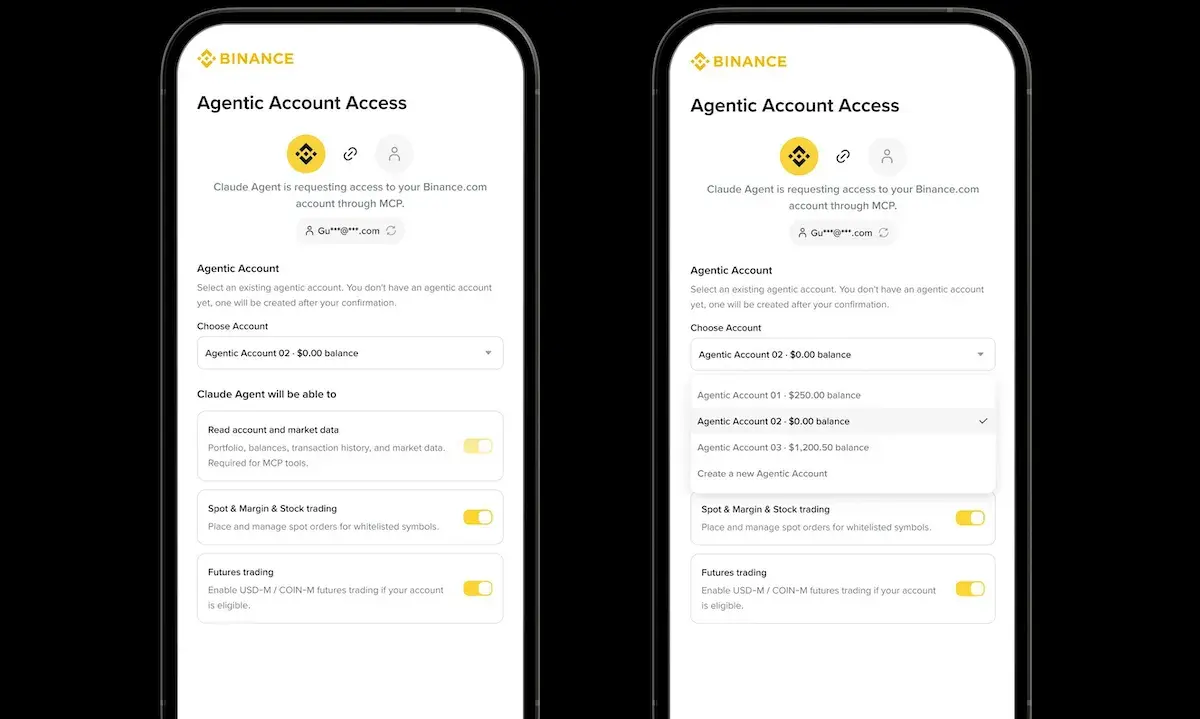
Once authorized, AI agents can pull live market data, check balances, and place trades across spot, margin, convert and futures products on Binance
2
. The platform addresses fragmentation developers face when building agentic finance applications across crypto and traditional markets, according to Jeff Li, vice president of product at Binance4
. "It gives everyone from developers to quantitative traders the reliable data, low-latency infrastructure, and standardised interfaces they need to deploy AI-driven strategies," Li said5
. AI agents can monitor markets, conduct research and risk analysis, react to signals, and autonomously place orders or execute strategies such as arbitrage1
. Beyond trading, Agent OS connects agents to payments and on-chain activity through Binance's x402 integration for sending and settling payments, while its Agentic Wallet allows interaction with tokens and decentralized-finance protocols1
.
Source: PYMNTS
User Controls and Sub-Accounts Protect Funds from AI Trading Risks
Binance places responsibility for keeping AI agents in check largely on users, who must decide what agents can access and trade and set limits on their activities
1
. "Instead of total freedom, we put the power in users' hands to give them the granular access control of what they can do through the agent," Li said1
. The platform uses dedicated sub-accounts that users can assign to agents and configure for specific activities, such as spot or futures trading1
. Withdrawals from those sub-accounts are blocked by default, creating a sandbox around an agent's activity1
. Users can assign each agent to a dedicated subaccount to segregate funds and trading activity, configure permissions and revoke access at any time3
. Users can also choose whether an AI agent must seek approval for every order or can execute trades autonomously once permissions are configured1
. Binance does not impose a separate cap on how much an AI agent can trade or lose in exchange trading, so the amount a user transfers into the sub-account effectively serves as the limit1
.Related Stories
Limited Visibility into AI Decision-Making Raises Accountability Questions
Binance has limited visibility into whether an agent's decision was influenced by faulty information or manipulation because the reasoning happens outside its systems, either on the user's computer or within their chosen AI application
1
. "We really cannot see the reasoning of what the user's action is," Li said1
. Binance can monitor an agent's resulting trading activity but cannot see an agent's external information sources, interpretation or decision-making, which occur within the user's chosen AI application3
. When asked about prompt-injection attacks or compromised agents, Li pointed to the sub-account as the main line of defense1
. Binance also cautioned users to review each order and transfer before confirming, placing much of the responsibility for keeping an agent in check on the user rather than the exchange2
. The platform stressed that use of its AI services is at the user's own risk and that outputs shouldn't be relied on alone for decisions2
.Binance Joins Growing Race Among Crypto Exchanges for AI Agent Integration
Binance joins an increasingly crowded race to wire AI agents into crypto rails as rival cryptocurrency exchanges move in the same direction
1
. Coinbase launched Coinbase for Agents in June, a tool letting agents trade and make payments that connects AI agents directly to users' accounts and allows them to trade, make payments and execute other financial workflows within user-set limits1
. Kraken launched an open-source command-line tool in March with a built-in MCP server that allows AI agents to execute actions including spot and futures trades1
. OKX enabled agentic trading on its platform by bringing an open-source MCP toolkit earlier this year1
. The push reflects a broader bet that autonomous software, not humans, will drive a growing share of native blockchain activity2
. Several crypto industry leaders, including Coinbase CEO Brian Armstrong and Circle CEO Jeremy Allaire, have argued that AI agents could soon account for a significant share of onchain activity, with Binance co-founder Changpeng Zhao describing cryptocurrency as the "native currency" of AI agents3
.
Source: TechCrunch
References
Summarized by

Navi
[3]
[4]
Related Stories
Coinbase for Agents lets AI assistants trade crypto and move money autonomously
11 Jun 2026•Technology
Gemini Launches AI Trading Feature, But Crypto Community Warns of Flash Crashes and Market Risks
28 Apr 2026•Technology
Coinbase Unveils 'Based Agent': AI-Powered Crypto Transactions on Ethereum L2 Base
25 Oct 2024•Technology

Recent Highlights



Recent Highlights
Today's Top Stories







Don’t drown in AI news. We cut through the noise - filtering, ranking and summarizing the most important AI news, breakthroughs and research daily. Follow topics that matter to you and stay ahead.


