3 Sources
3 Sources
[1]
Canva Leans Into AI to Defend Its $42 Billion Empire
As orchestras go, it was eclectic. Wearing plastic gold crowns, colored capes and wielding instruments that included a rubber duck, some of Canva's top engineering staff belted out their version of Ode to Joy. Watching and encouraging in the Sydney auditorium were co-founders and married couple Melanie Perkins and Cliff Obrecht. The early April event marked the culmination of a product reboot that executives hope will safeguard the $42 billion design platform in the rapidly evolving AI era. Dubbed Canva AI 2.0, the new tools released Thursday, include a different way for its 265 million monthly users to generate visuals. Instead of starting with a templated design, customers can describe in conversational language what they want -- a colorful, 12-page planning deck for a trip to Morocco, for example -- and the AI agent will build and iterate it. Along with other workflow tools, the rebuild is Canva's attempt to position the company not as a target amidst the growing angst about AI's ability to destroy software company's business models, but as one of the tech firms doing the disruption. "Sometimes there's the things that you have to do," said Perkins in an interview on the AI push. "It doesn't matter how long it takes and it doesn't matter what it costs." The success of this release is a critical test for the company, which since its launch in Perth, Australia, in 2013 has grown into a competitive rival to Photoshop maker Adobe Inc. It's edging closer to a potential blockbuster public offering just as investors have wiped billions of dollars off the value of software firms globally amid concerns new technology like Anthropic's Claude will cannibalize their business. Those market nerves set a high bar for Canva, which has a massive price tag to defend. After hitting a $40 billion high in 2021, the company's valuation tumbled to roughly $26 billion a year later during a broader tech selloff, driven by internal markdowns from investors. Recent secondary sales however, have pushed its worth back to $42 billion in August, setting up a crucial test of whether public investors will agree with that premium. What's Behind the 'SaaSpocalypse' Stock Plunge?: QuickTake Still, Obrecht, the company's chief operating officer, said while there is no deadline for a listing, the tough backdrop doesn't deter him. "Now we're at the scale where being public's inevitable," he said in an interview. "I would be surprised if we didn't IPO by the end of next year." Beyond the general concerns about fast-evolving AI tools, Canva is also facing competition from a new wave of startups offering glitzy features such as turning a selfie into a social video or spinning up entire studio photoshoots from one image. Global tech giants are also squeezing from above: Google is pushing into design with tools like Pomelli, which can learn a brand's identity and produce campaign assets from a single website link, while Microsoft Inc. is embedding image generation into its enterprise workspaces. Canva's bet is that 13 years of accumulated user behavior, templates and design patterns give it a proprietary edge no general-purpose AI can match. "No one else understands design and the complex layering involved, the interplay between font choice, color layout, imagery, illustrations, and even videos," said co-founder and Chief Product Officer Cameron Adams. "No one else has that insight." To try and become the operating system for AI-native design, rather than just another prompt box in a crowded field, costs money and Canva is pouring hundreds of millions of dollars into AI, including through acquisitions. One indication of the scale of its AI usage even before the latest reboot is its use of tokens -- units of AI computing. The platform has processed more than 50 trillion tokens in the past year and over 10 trillion in March alone, according to Danny Wu, Canva's head of AI products. That's substantial -- and expensive -- even if it pales in comparison to the 15 billion tokens a minute processed by ChatGPT operator OpenAI. The company does have cash to spend: it has more than a billion US dollars in the bank, and has been cash flow positive for every year since 2018. That financial engine relies on a tiered subscription model, using a widely popular free version to funnel users into its 31 million paid premium and enterprise contracts. However, its net losses at its Australian entity widened to $242 million in 2024, up from $230 million the year before. (The figures do not include its full global operations, and numbers for 2025 are not available.) Stephen Yiu, chief investment officer of Blue Whale Growth Fund with more than $3 billion in assets, once held about 30% of his portfolio in stocks like Adobe, Microsoft and Intuit Inc. He has since slashed that exposure. "We are in a corporate Wild West right now," Yiu said, adding that new artificial intelligence technology is progressing so exponentially that there are too many variables for investors to weigh. "Even among the AI companies doing the disrupting, it is difficult to pick a winner. It is even harder to find winners among software stocks that are being disrupted." Still many of Canva's stakeholders are bullish about its prospects, even if they acknowledge the difficult backdrop. Canva "deserves to be a multi-hundred billion dollar business, and they're well on their way," said Byron Deeter, a partner at Bessemer Venture Partners, an investor in Canva. "This is going to be a separation year, and when you look at the public SaaS and cloud companies, most of them are now guilty until proven innocent," said Deeter. "The market is saying, show me that this is real. I don't want to hear some marketing BS about AI. I want to see products." On the living-room themed stage in Sydney, Perkins sits on a pastel-blue sofa, framed by giant rainbow arches. Kicking off the event, she gestured to a Venn diagram on a screen -- the same one she has drawn since Canva's earliest days. One circle reads "scared." The other: "excited." The overlap, she tells the room, is where worthwhile goals live. "I'm right smack bang in the middle of that Venn diagram," Perkins said later in an interview. "This has been years in the making." Before Canva was launched, and long before ChatGPT, Perkins was dreaming of the sort of design process where users could simply describe what they wanted. In 2011, one early startup competition pitch deck had a mockup where users type requests into a box and appear like ingredients in a dish. In 2017, the hope was that Canva users could query the platform to make anything -- an old-school Facebook post with a motivational quote and frangipanis, for instance -- and have it built for them, rather than hunting through a library of pre-made templates. "This is the future, future, future," she wrote in an internal document at the time. For years, though, Silicon Valley viewed Canva as a lightweight tool for high schoolers making presentations or small businesses designing templates. That perception began to change in 2021, when Canva acquired Kaleido, an AI-powered image background remover, and started integrating sophisticated generative models into its platform. A spree of acquisitions followed, including Affinity, a professional-grade design suite, in 2024, helping Canva snag lucrative corporate contracts and win over power users from Adobe. The turning point came in late 2022. Wu, Canva's head of AI products, got access to OpenAI's developer playground -- a raw version of what would soon become ChatGPT -- and he showed it to Perkins. "I played with it and I was like, 'Oh my gosh, this is the future,'" she recalled. Perkins and her team first embedded it in a copywriting tool, but as they pushed further and asked the models to create presentations, match brand colors and format marketing layouts, they hit a wall: early generative AI simply didn't understand design. Wu said he regularly chatted with OpenAI researchers and fed them web-design code and public pages on color theory just to help their GPT-3.5 understand basic design principles. "We realized it's never good enough to just be an API wrapper," Wu said. "But we didn't start with a hundred million dollars training run. We started with really small, small steps." All those small steps formed the building blocks of Canva's new AI suite. Its own foundational model, built specifically for design, can edit individual objects in a photo or generate posters that can be split into multiple layers. It can also tap into Canva's massive template library to customize pitch decks, social media posts and campaigns, while gathering information from the web and remembering context as users refine their work. The business plan is a layered one. Canva has several subscription tiers largely meant to prevent the massive computing costs from eroding its profitability. Each Canva user gets AI-powered access. Free users, still the vast majority, receive a smaller allowance compared to paid subscribers. Enterprise clients, who generate $500 million in annual recurring revenue, get the most extensive access. A unified credit system gauges usage limits -- for instance, generating an interactive website burns more credits than a social media post. There are plan upgrades available, with an "AI pass" at $100 a month unlocking a larger AI quota. And it's even pushing beyond design altogether. Atop its suite of productivity tools, Canva's new AI agents can scan Slack messages and Google Calendar, and users can train them to handle memos and tasks in the background -- a play that puts the company in competition not just with Adobe but with Microsoft and Google Workspace. "Our dreams today are so much bigger than where we are right now and what we want to do," said Perkins. There are though significant risks for Canva in its rush to embrace AI, beyond financial. Many creative-types harbor a deep suspicion about the expansion of AI into their realm, with such creations not-infrequently dismissed as 'AI slop', raising questions about whether users even want the tools the company is spending so much effort on. To Obrecht, such criticism is reminiscent of Canva's early days when it came under fire from professional designers who dismissed its creative output as shoddy. "Ultimately the goal has always been to empower the world to design," he said, adding he believes what most customers really care about is if Canva's tools can help them get their job done "faster, quicker, better." That includes people like Nicholas Putz, a freelance marketing consultant in Milwaukee who started on Adobe's Photoshop 1.0 more than 30 years ago. Putz recently used Canva's existing tools to create a short-form video ad in 30 minutes -- a task that would have taken several hours or days through an external agency. "My opinion has just completely changed," he said, adding that the shift to AI tools has "dramatically pulled us away from Adobe's suite of products." There's caution though among some of Canva's enterprise users. Billy Bohan Chinique, vice president of marketing and digital innovation at US-based cruise line Virgin Voyages, said AI prompts don't always produce results strong enough for flagship campaigns, which must meet the company's strict visual standards. Still, Chinique sees Canva as "the front door to getting started with creative in an easy way that just works." Such habitual usage is something that could help Canva retain its edge. The platform has jostled its way into the modern marketer's identity, like MacBooks, black turtlenecks or iced oat lattes have. That ubiquity is fueled by a sprawling community of evangelists, some paid, some organic, keeping Canva visible on social media and inside workplaces. The company's education and philanthropic initiatives expand that footprint further, introducing millions of students to the platform before they ever encounter other options. Reputation, in other words, matters. There are further risks here in the embrace of generative AI, such as the potential for a proliferation of undesirable visuals, whether that be nonconsensual sexual content or political deepfakes. Canva says it has automated filters that block such imagery and permanently bans users who try to bypass them. It also lets creators opt out of having their designs used to train its models, and promises to cover the legal bills for enterprise customers should they get sued over copyright claims. And then there is also the issue of jobs. Canva, along with Atlassian, is one of the jewels in Australia's tech crown. Both are feted locally as proof a global software company can be built thousands of miles from Silicon Valley. Stand in Canva's rooftop garden and you'll see the scaffolding of Atlassian's new 39-story headquarters, a massive timber-and-glass tower now taking shape on the city skyline. In recent years though, some of the shine has come off Atlassian, the designer of office tools such as Trello, with the advent of AI and a broader post-Covid industry slowdown. Its shares have plummeted about 60% this year, and last month, it laid off 1,600 workers, roughly 10% of its workforce, citing the need to direct more resources towards AI. Canva in 2025 shocked the local market by making a small number of layoffs in its technical writing team, leaving some on edge about whether more job losses are in the pipeline. Chief People Officer Jennie Rogerson said that's unlikely. "We were very intentional with every hire that we brought in, and that's meant we're in a really fortunate position to not need to be thinking about layoffs now," said Rogerson. Sitting in Canva's Sydney campus, which spans six buildings in Surry Hills, a trendy neighborhood that has transformed from a gritty rag-trade district into a tech and hipster hub, Perkins said the last two years have felt like a "long dark tunnel" -- where she was deep in work, unsure if it will land. The coming months will test whether that grueling overhaul can secure Canva's future against Silicon Valley's deepest pockets. "The world is shifting," she said. Generative AI, "is the biggest change in all of our lifetime."
[2]
Canva debuts a new suite of agentic tools, as the design app quietly becomes one of the world's most used AI services | Fortune
Canva, the Australian startup that's won over 265 million users with its design software, is launching a new suite of tools that combine visual creation and workflow automation, run by AI agents that respond to conversational prompts Dubbed "Canva AI 2.0," the new platform of services lets users create and alter designs using natural language, and connects to other services like Gmail, Slack, and Zoom in order to generate new content. The new platform also boasts persistent memory, allowing Canva to learn how people work, and can automatically update designs as brand imagery gets tweaked. "We had to rearchitect the whole Canva platform," Cliff Olbrecht, Canva's co-founder and chief operating officer, tells Fortune. Canva, founded in 2012, integrated generative AI functions onto its platform in early 2023, just a few months after ChatGPT's release. (At the time, Fortune noted that the startup was wary of using the term "AI" to advertise its services, preferring the term "magic" instead) Olbrecht describes Canva's previous AI services -- generating images and video, or generating a whole presentation -- as "a design platform with AI services built on top." With these new services, Canva hopes to go beyond design to offer more coworking capabilities for users. For example, the new Canva can crawl the web for breaking tech news overnight, determine what's trending, then create -- and even schedule -- social media posts on its own. "It can help you complete your whole job," Olbrecht says. Canva has quietly become one of the world's most used consumer AI apps. Canva is the world's third most used generative AI web product by monthly active users, behind Google Gemini and ahead of China's DeepSeek chatbot, according to an analysis by VC firm a16z. Canva's massive user base has pushed the company to think carefully about how to offer AI services without blowing a hole in its budget. "There's only so long you can fund your user base with VC-funded dollars," he says. "With 265 million users on a monthly basis hammering our services, we have to own our models and we have to own infrastructure that serves our models." Canva has acquired several other AI startups in recent years, including Leonardo AI, an image generating platform, in 2024. Just last week, Canva acquired Simtheory, a platform for building agents, and Ortto, a marketing automation company. These investments have helped Canva produce its own foundational AI models, rather than solely relying on models from third parties. The startup claims that its AI services are seven times faster and 30 times cheaper than "comparable" frontier models. Obrecht adds that Canva is also trying to explore how to tap device processing power for AI, rather than go into the cloud. Canva will offer multiple tiers for pricing. Free users will get access to Canva's basic AI, with a small number of credits for premium models. Pricing then escalates through different tiers all the up to $100 a month, which Olbrecht describes as "almost all-you-can-eat" -- even if there are still some limits on Canva's most powerful models. Software-as-a-service companies have been hit hard in recent months by investor fears about competition from AI developers like OpenAI, Google and Anthropic. Design software developers are particularly threatened by AI, as ChatGPT and Claude increasingly take on the ability to generate video and images. Shares in Adobe, which makes Photoshop and other design and publishing software, are down by over 30% over the past 12 months. Shares in design startup Figma have performed even worse, losing almost 85% of their value since the company's $1.2 billion IPO. Canva, which is still privately held, claims it generated $3.5 billion in revenue last year. Obrecht, in an interview with Bloomberg last November, suggested an IPO was "probably imminent in the next couple of years." Olbrecht notes that, despite the so-called AI scare trade, Canva's shares are still trading at its last valuation of $42 billion, reached during an employee stock sale last year. "We've fortunately avoided being hit by that SaaS apocalypse," he adds. But he's aware that rapidly changing technology can pose a threat to Canva if executives aren't careful. "If we're not going to disrupt ourselves, then we're going to be disrupted," he says.
[3]
Canva places a make-or-break bet on AI future - and its IPO
Los Angeles: Canva co-founder Cliff Obrecht says the Australian private tech giant's shift from being a software maker to an artificial intelligence firm is the most significant change in its history, as it makes a crucial pitch to customers and investors that could make or break its drawn-out plans to go public. Speaking in Los Angeles, where the $60 billion company is holding an investor and customer conference on Friday (Australian time) in front of a 6000-strong crowd, Obrecht said fears Canva was vulnerable to the AI-induced public market sell-off of software stocks were overblown.
Share
Share
Copy Link
Canva launched its AI 2.0 platform featuring agentic design tools and workflow automation for 265 million monthly users. The Australian design platform is repositioning itself as an artificial intelligence firm to defend its $42 billion valuation amid widespread investor fears about AI disruption to software stocks, with co-founder Cliff Obrecht signaling an IPO could arrive by the end of 2027.
Canva has launched Canva AI 2.0, a comprehensive suite of AI tools that fundamentally transforms how its 265 million monthly users create visual content
1
. The Australian design platform now allows customers to describe what they want in conversational languageβsuch as a colorful, 12-page planning deck for a trip to Moroccoβand AI agents will build and iterate the design automatically1
. This marks a strategic shift from being a template-based design platform to becoming an artificial intelligence firm capable of handling complete workflow automation.
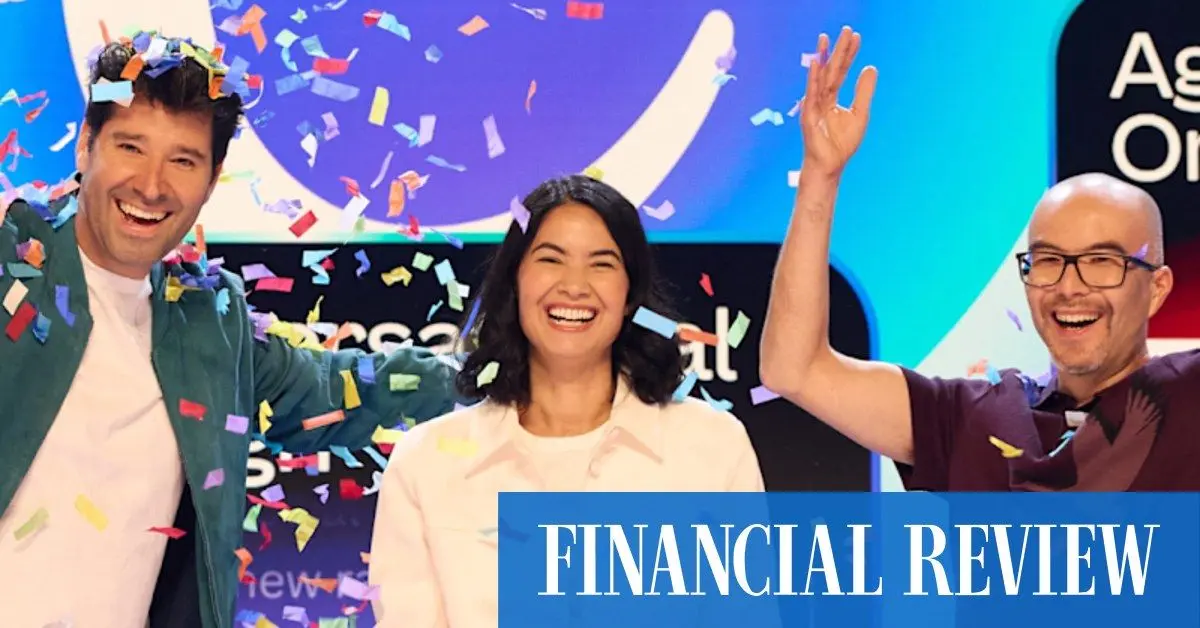
Source: Financial Review
The new platform integrates with services like Gmail, Slack, and Zoom to generate content across multiple channels
2
. These agentic tools can crawl the web for breaking tech news overnight, determine what's trending, then create and even schedule social media posts autonomously2
. Co-founder and Chief Operating Officer Cliff Obrecht told Fortune that the new platform can "help you complete your whole job," extending Canva's reach beyond design into broader coworking capabilities2
.
Source: Fortune
Canva has poured hundreds of millions of dollars into AI development, including strategic acquisitions of Leonardo AI in 2024, and more recently Simtheory and Ortto
1
2
. The platform processed more than 50 trillion tokens in the past year and over 10 trillion in March alone, according to Danny Wu, Canva's head of AI products1
. While substantial, this usage remains smaller than OpenAI's ChatGPT, which processes 15 billion tokens per minute.Co-founder Melanie Perkins emphasized the existential nature of this transformation: "Sometimes there's the things that you have to do. It doesn't matter how long it takes and it doesn't matter what it costs". The company has developed its own foundational AI models rather than relying solely on third parties, claiming its AI services are seven times faster and 30 times cheaper than comparable frontier models
2
.Obrecht revealed that Canva would be "surprised" if it didn't complete its IPO by the end of next year, marking the most concrete timeline yet for the long-anticipated public offering
1
. The company's valuation has fluctuated dramatically, hitting $40 billion in 2021 before tumbling to roughly $26 billion during the tech selloff, then recovering to $42 billion in August during secondary sales2
.This timing comes as investor fears have hammered software stocks globally. Adobe shares have dropped over 30% in the past 12 months, while design startup Figma has lost almost 85% of its value since its $1.2 billion IPO
2
. Stephen Yiu, chief investment officer of Blue Whale Growth Fund with more than $3 billion in assets, slashed his exposure to software stocks like Adobe, Microsoft, and Intuit from 30% of his portfolio, calling the current environment a "corporate Wild West".Related Stories
Canva faces mounting pressure from multiple directions. Google is pushing into design with tools like Pomelli, which can learn a brand's identity and produce campaign assets from a single website link, while Microsoft is embedding image generation into its enterprise workspaces. A new wave of startups offers features such as turning selfies into social videos or creating entire studio photoshoots from one image.
Despite this disruption threat, Canva has emerged as the world's third most used generative AI web product by monthly active users, behind Google Gemini and ahead of China's DeepSeek chatbot, according to analysis by VC firm a16z
2
. The company claims it generated $3.5 billion in revenue last year and maintains 31 million paid premium and enterprise contracts2
.Canva's competitive advantage lies in 13 years of accumulated user behavior, templates, and design patterns, according to co-founder and Chief Product Officer Cameron Adams. "No one else understands design and the complex layering involved, the interplay between font choice, color layout, imagery, illustrations, and even videos," Adams stated. Obrecht acknowledged the stakes: "If we're not going to disrupt ourselves, then we're going to be disrupted"
2
. Investors and users alike will be watching whether Canva's proprietary data and workflow tools can justify its premium valuation in an increasingly crowded AI landscape.Summarized by
Navi
[1]
[3]
Todayβ’Technology

30 Oct 2025β’Technology

11 Apr 2025β’Technology

1
Technology

2
Policy and Regulation

3
Policy and Regulation