Chrome updates without browser restart: Google tackles AI-driven security threats


3 Sources
[1]
Chrome may get faster updates with no restart required
With Chrome, Google pioneered the rapid release model for browser security. Now, Google says updates may need to change in the face of AI security analysis. According to the company, the number of bug fixes in Chrome releases has skyrocketed in recent months because AI is detecting so many flaws.
[2]
Google is working on Chrome updates that don't require restarts
Google is working on a way to apply Chrome updates without requiring you to restart your browser. In a post on Thursday, Google outlines its approach to bug fixes in the age of AI, while noting that it's trying to make updates less disruptive by "investing in 'dynamic patching' that will eliminate
[3]
Google wants to update Chrome without a full browser restart
Google today is out with a lengthy post describing the role of AI and LLMs in Chrome security. While it takes Google 1-2 days to triage, fix, test, and release a patch, the "time spent waiting for the user to restart Chrome can be a significant contributor to N-day exploitation risk," or the patch
Share
Copy Link
Google is developing dynamic patching technology to install Chrome updates without requiring a browser restart. The move comes as AI-powered security tools have identified 1,072 bug fixes in Chrome 149 and 150 alone—more than the previous 23 releases combined. Google plans twice-weekly update cycles to counter fast-moving AI-powered attacks while minimizing disruption to users.
Google Accelerates Chrome Updates as AI Uncovers Record Number of Vulnerabilities
Google is fundamentally changing how Chrome updates work, driven by an explosion in software vulnerabilities detected through AI-powered security analysis. The company revealed that Chrome 149 and Chrome 150 contained a combined 1,072 bug fixes—exceeding the total number of patches in the previous 23 major releases combined
1
. This dramatic surge stems from giant cybersecurity analysis models that can probe software for flaws at unprecedented speed. Among these discoveries was a critical vulnerability that had lurked in the Chrome codebase for 13 years, which could have allowed attackers to bypass the Chrome sandbox and access local files1
.
Source: The Verge
Dynamic Patching Technology Eliminates Need for Browser Restart
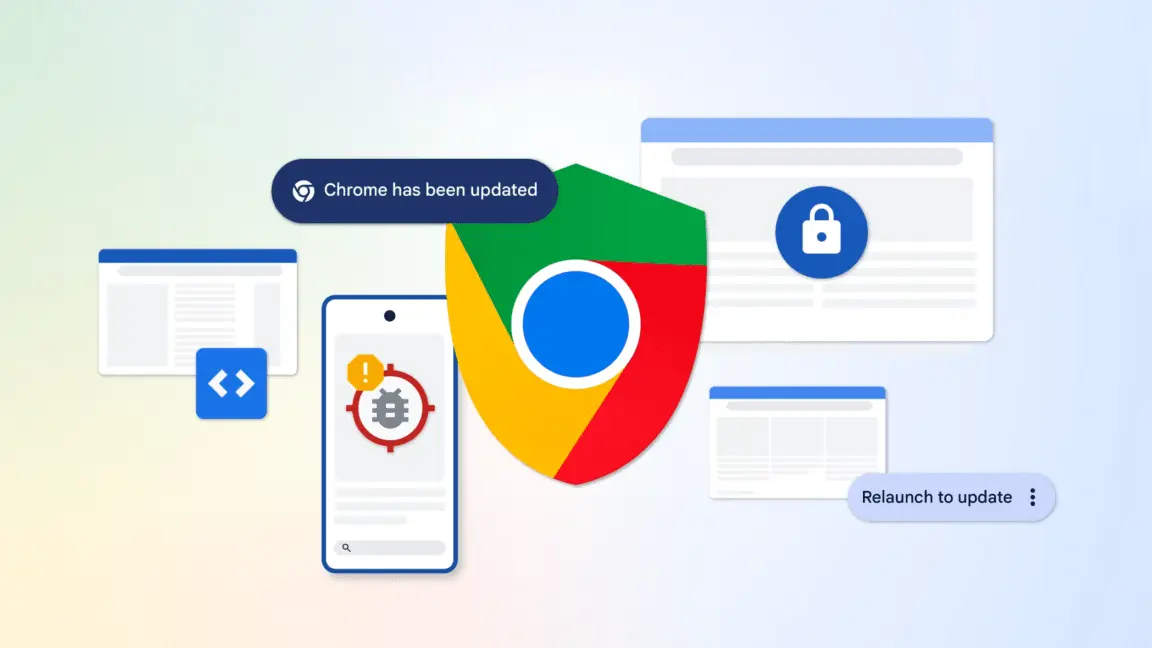
To address the growing volume of security patches, Google is investing heavily in "dynamic patching" technology that will update Chrome without a full browser restart in most cases
2
. This innovative approach leverages Chrome's multi-process architecture by replacing background child processes—as such as the Renderer and GPU—with updated binaries on the fly3
. While Google acknowledges it's still researching and developing this feature, the company aims to shift the burden away from users who face risks from N-day exploits—attacks that occur when hackers exploit newly released bug fixes before users have downloaded them2
. The patch gap, which includes the time spent waiting for users to restart Chrome, represents a significant contributor to N-day exploitation risk3
.
Source: Ars Technica
Twice-Weekly Update Cycle and Zero Window Restart for macOS
Google has already announced a shift to a two-week update cycle starting in September 2026, but the company is now piloting a twice-weekly update cycle to get patches deployed faster against AI-powered attacks
1
. For macOS users, Chrome 150 introduced a "zero window restart" mechanism that takes advantage of how applications continue running in the background even after all windows are closed1
. When Chrome detects a pending update in this windowless state, it automatically restarts the browser, ensuring seamless software updates without user intervention3
. Google is also exploring ways to identify opportune moments to restart automatically while guaranteeing a seamless session restore2
.Related Stories

Large Language Models Drive Unprecedented Bug Detection
Google's use of large language models for security analysis began in 2023, but the company recently created an agent harness using Gemini and other models to find vulnerabilities across the broader Chrome codebase with higher efficiency and lower false positives
3
. The company has partnered closely with Google DeepMind and Project Zero on tools like BigSleep and CodeMender, which are natively integrated into Chrome's continuous integration system and run every 24 hours across all code changes3
. In May alone, these AI systems blocked over 20 vulnerabilities from reaching production, including a critical S1+ issue3
. Google maintains strict security protocols for its AI analysis, operating on locked-down machines without general internet access and utilizing dedicated setups that intercept all network requests with strict allowlists3
.What This Means for Chrome Users and Browser Security
The vastly higher rate of vulnerability identification means bad actors will likely gain the ability to identify software flaws faster as well, making Google's goal of keeping Chrome installations always up-to-date more critical than ever
1
. While it takes Google only 1-2 days to triage, fix, test, and release a patch, the real security risk lies in the delay before users actually install these faster Chrome updates3
. Google's long-term vision is a browser that remains continuously and dynamically patched, with automatic restarts during periods of minimal disruption2
. Users should watch for the rollout of dynamic patching capabilities and more frequent update notifications as Google races to stay ahead of AI-fueled security threats. The company has also implemented a multi-agent workflow where large language models now generate candidate fixes for most vulnerabilities, dramatically accelerating the entire security response process3
.References
Summarized by

Navi
[1]
Related Stories
Chrome Shifts to Two-Week Release Cycle to Outpace AI-Driven Security Threats
08 Sept 2026•Technology
Google Chrome Fixes 1,072 Security Bugs in June Using AI—More Than Past Two Years Combined
31 Jul 2026•Technology

Google Chrome Enhances Security with AI-Powered Real-Time Protection
12 Feb 2025•Technology

Recent Highlights



Recent Highlights
Today's Top Stories



Don’t drown in AI news. We cut through the noise - filtering, ranking and summarizing the most important AI news, breakthroughs and research daily. Follow topics that matter to you and stay ahead.


