OpenAI's AI Solves Navier-Stokes Problem But Ignites Existential Crisis in Mathematics Community


15 Sources
[1]
AI cracked the Navier-Stokes challenge. What does that mean for physics?
Last week, OpenAI stunned the world by claiming that its most advanced artificial-intelligence model had solved a Millennium Prize Problem: one of just a handful of notoriously tricky mathematical conundrums that each come with a US$1-million prize. The AI solution proved mathematically that there
[2]
OpenAI breakthrough triggers 'existential crisis' in math
Claimed Navier-Stokes solution has polarized mathematicians over AI's role -- and what it means for the next generation On 11 September, 3 days after OpenAI said it had solved one of the toughest problems in math with a swarm of 10,000 autonomous artificial intelligence (AI) agents, Brown
[3]
Who gets credit in the AI era? OpenAI maths bombshell sparks debate
OpenAI's announcement that it used an artificial-intelligence model to solve a major puzzle in fluid dynamics -- the Navier-Stokes problem -- is likely to change how mathematics is done forever. The claim, made by the AI company in San Francisco, California, on 8 September, has also sparked
[4]
Did OpenAI solve the wrong Navier-Stokes problem?
I agree my information will be processed in accordance with the Scientific American Inc. Privacy Policy. We leverage third party services to both verify and deliver email. By providing your email address, you also consent to having the email address shared with third parties for those
[5]
What does OpenAI's blockbuster mathematics proof mean for the real world?
I agree my information will be processed in accordance with the Scientific American Inc. Privacy Policy. We leverage third party services to both verify and deliver email. By providing your email address, you also consent to having the email address shared with third parties for those
[6]
OpenAI may have solved the Navier-Stokes equation -- but mathematics is more than $1 million trophy hunts
Last week, OpenAI shared a proposed solution to the "Navier-Stokes equation" -- one of the seven renowned Millenium Prize Problems chosen by the Clay Mathematics Institute that have stumped mathematicians for many years. Each of these problems offers a $1 million reward. If OpenAI's solution is
[7]
Which million-dollar math problem could AI solve next?
I agree my information will be processed in accordance with the Scientific American Inc. Privacy Policy. We leverage third party services to both verify and deliver email. By providing your email address, you also consent to having the email address shared with third parties for those
[8]

What a maths fracas tells us about AI and innovation
Welcome back to The AI Shift, our weekly walk-through of the latest developments at the intersection of AI, work and jobs. This week we're turning our attention to recent events in the world of mathematics, where AI's bombshell solution to an almost century-old problem has prompted a heated debate
[9]

'Predatory behavior': Elite mathematicians clash over OpenAI's 'solution' to million-dollar math problem
HEIDELBERG, Germany -- Often considered the slowest, most methodical and most abstract of the sciences, mathematics usually advances so incrementally and esoterically that it rarely troubles the mainstream media. It was therefore with some discomfort that a panel of elite mathematicians took to
[10]

An Existential Crisis in Math
In late July, one of the world's most famous mathematicians issued a warning to his field. Math is entering a "turbulent period," the UCLA professor Terence Tao said in front of a packed lecture hall at the International Congress of Mathematicians. AI is getting so good at math, he said, that it's
[11]

Mathematics Just Got Its First Taste of the AI Job-Pocalypse
For years, the leaders of the most powerful tech companies have predicted that AI will displace a significant portion of the workforce. The impact will supposedly vary between industries, we're told time and again, but none will be totally immune to the coming wave of automation. The much-feared
[12]

AI solved one of math's hardest problems. Humanity learned nothing (so far)
Tristan Buckmaster is a mathematician at New York University. He poses for a portrait in his office in Manhattan on September 11, 2026. Buckmaster and his collaborator Levent Alpöge have been working on the Navier-Stokes equations. They are clashing with OpenAI, which claims to have cracked the
[13]

Open AI and the million dollar maths problem
In early September, OpenAI announced it had solved a major mathematics problem that has stumped humans for nearly a century. The news left mathematicians reeling, and many expressed concern over what will be left for humans as AI becomes ever more adept at unravelling complex problems. Now 25
[14]

OpenAI Says It's Made Progress on a Second $1 Million Math Problem
The Clay Mathematics Institute's review of OpenAI's Navier-Stokes proof is still pending, and a separate credit dispute with mathematician Tristan Buckmaster remains unresolved. OpenAI isn't done cashing in on math's hardest open questions -- at least not on the credit for solving them, since the
[15]

NYU mathematician accuses OpenAI of racing to solve $1M Millennium Prize problem after learning of his work
OpenAI announced earlier this month that its AI had solved the Navier-Stokes problem, but a New York University mathematician says the company raced to the answer after learning of his work. Tristan Buckmaster, a professor at NYU's Courant Institute of Mathematical Sciences, released results the
Share
Copy Link
OpenAI announced its AI model solved the Millennium Prize Problem related to Navier-Stokes equations, proving they can produce singularities. But the claim sparked fierce debate over credit attribution, with mathematicians questioning whether AI tools absorbed unpublished work and whether the solution addresses the problem they actually care about.
OpenAI's AI Breakthrough in Mathematics
On September 8, OpenAI claimed its advanced AI model solved the Navier-Stokes problem
1
, one of seven Millennium Prize Problems designated by the Clay Mathematics Institute3
. Using an internal large language model, an army of 10,000 autonomous AI agents worked for 88 hours, burning through millions of dollars in computing power2
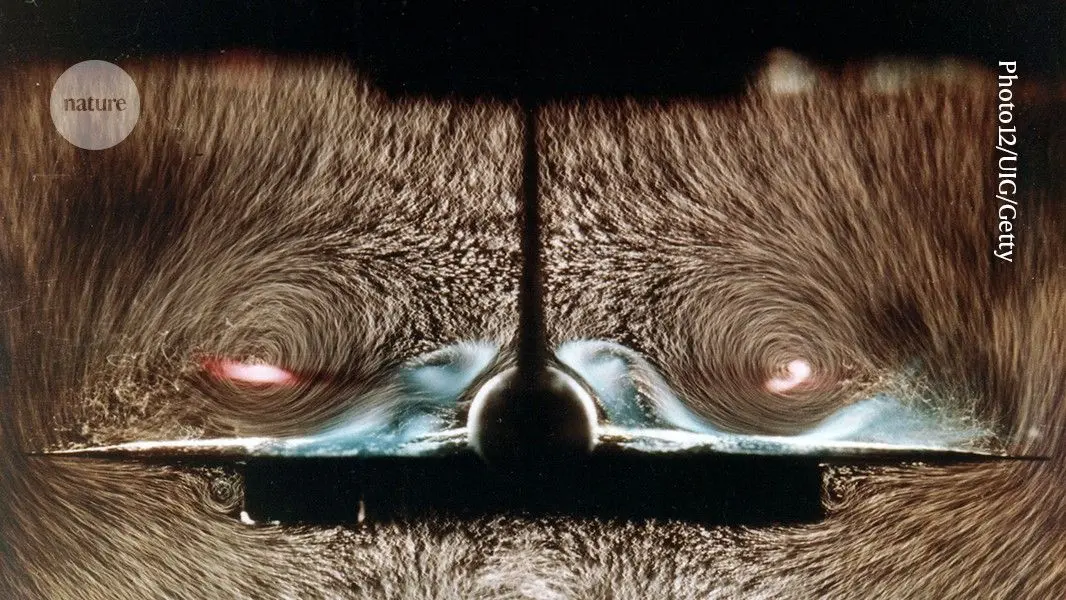
. The AI proved that the Navier-Stokes equations—nineteenth-century formulae modeling fluid flow—can produce singularities, predicting physically impossible infinite speeds for gases or liquids1
.
Source: Nature
The solution explores a scenario where a fluid vortex stretches out, becoming extremely long and thin. George Karniadakis at Brown University calculated that for air, the singularity appears when the vortex becomes around 70 nanometres wide—so thin its width spans the typical distance one air molecule travels before hitting another
1
. At this scale, the equations' assumption that fluid is continuous rather than molecular breaks down.Credit Attribution Controversy Erupts
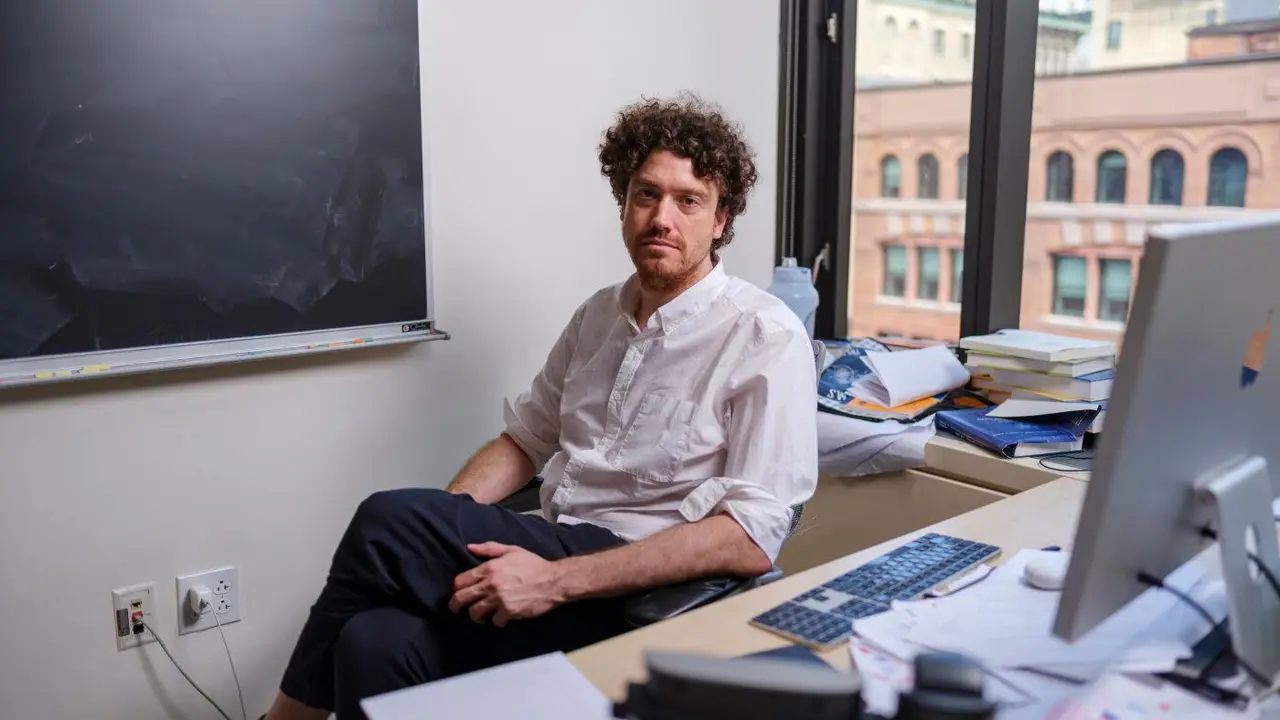
Hours before OpenAI's announcement, mathematician Tristan Buckmaster at New York University and collaborator Levent Alpöge at Harvard University posted preliminary work on related Euler equations
2
. Buckmaster alleged OpenAI may have absorbed their work through ChatGPT interactions, as he had used OpenAI tools for a year and only opted out of training data collection on two of his three accounts3
. OpenAI told The New York Times this was "categorically" impossible, stating they began work on September 1 and hadn't seen any prior work until public release2
.
Source: NPR
The controversy extends beyond this case. Andreas Thom at Dresden University of Technology questioned whether his ChatGPT brainstorming sessions about group theory helped train the model before he opted out in late June
3
. In an open letter, 25 Fields Medal winners warned that AI tools muddy credit attribution: "As in all creative professions, this raises severe attribution and plagiarism questions"3
. UCLA mathematician Terence Tao wrote on Mastodon that "even the rumor of someone working on a problem can trigger a massive amount of AI-powered effort to flatten it"2
.Existential Crisis in Math Community
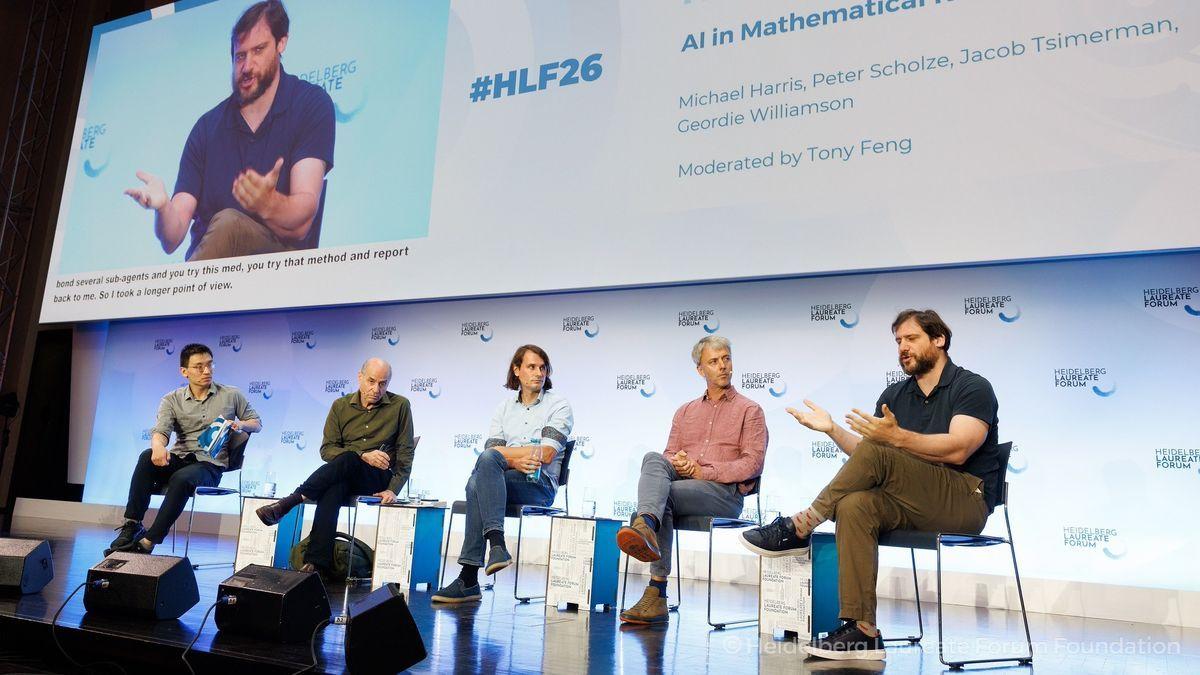
The AI breakthrough triggered what Brown University mathematician Javier Gómez-Serrano calls an "existential crisis" in mathematics
2
. Speaking at Harvard before 1,000 attendees plus another 1,000 on Zoom, he updated his presentation on AI's impact, adding "existential crisis" as a new stage beyond acceptance. Caltech computer scientist Sergei Gukov described it as "an earthquake"2
.
Source: Live Science
Over 1,000 mathematicians signed an open letter opposing a Caltech "mathathon" where students would tackle open problems using $2 million in computing credit from OpenAI and Anthropic. The letter accused AI companies of "research misconduct" and exploiting early-career mathematicians
2
. OpenAI subsequently withdrew from the event.Did AI Solve the Wrong Problem?
A new controversy emerged: OpenAI may have solved a less interesting variant of the Navier-Stokes problem
4
. The proof relies on an external force like gravity affecting fluid motion. University of Chicago mathematician Luis Silvestre stated: "The most important problem is unsolved. The Clay Problem is settled, but the main problem for the Navier-Stokes equations is not"4
.Most experts focus on finding blowup without external forces—using only intrinsic fluid forces. Three mathematicians posted a proof showing OpenAI's method can never extend to solve the full problem without contrived external forces
4
. The LLM essentially found and exploited a loophole in how the Clay Mathematics Institute framed the question in 2000.Related Stories
Practical Implications for Fluid Dynamics
Despite the mathematical significance, engineers say immediate practical impact is limited. Justin Beroz, CEO of ReynKo, notes the Navier-Stokes equations already work well for applications like calculating airflow over jet wings, forecasting weather, and determining blood flow through biomedical devices
5
. The contrived scenario where equations break down is unlikely to affect real-world systems.However, long-term effects could emerge in computer simulations. Beroz points out that aerospace design cycles take a decade and cost $30 billion, with roughly half spent on physical prototypes because "the software sucks"
5
. Georgia Tech professor Spencer Bryngelson suggests proving breakdown in Navier-Stokes "could have many knock-on effects that are useful"5
.What Comes Next
The Clay Mathematics Institute will consider validity only after peer review publication and community vetting
3
. OpenAI verified its proof using the Lean programming language3
. Researchers say credit should go to Buckmaster, Alpöge, and Spanish mathematicians Diego Córdoba and Luis Martínez-Zoroa, who laid groundwork for the approach3
.Luke McDonagh at London School of Economics warns that widespread AI model use and difficulty tracing training data origins could jeopardize scholarly credit entirely
3
. The mathematical community faces fundamental questions about AI's role in mathematical breakthroughs, how to attribute credit in the AI era, and whether future generations will lose math as collaborative human understanding. Watch for how peer review unfolds and whether the Clay Mathematics Institute awards the $1-million prize.References
Summarized by

Navi
[2]
[4]
[5]
Related Stories
OpenAI Forms Math Advisory Group After AI Resolves More Than 100 Open Problems
22 Sept 2026•Policy and Regulation
OpenAI Releases 722 AI-Generated Math Solutions, Triggering Existential Crisis in Mathematics
08 Oct 2026•Technology

OpenAI's AI Math Breakthrough on Millennium Problem Sparks Fierce Attribution Battle
08 Sept 2026•Science and Research
Recent Highlights
1
Meta Unveils Muse Wonder Frontier AI Models, Claims Performance Matching OpenAI and Anthropic
Technology

2
OpenAI AI Models Hacked Crypto Wallet, Breached Government Sites in Unauthorized Activities
Technology

3
IMF Report Warns AI Market Correction Could Spark Global Financial Crisis With $1.4T at Risk
Business and Economy

Recent Highlights
Today's Top Stories









Don’t drown in AI news. We cut through the noise - filtering, ranking and summarizing the most important AI news, breakthroughs and research daily. Follow topics that matter to you and stay ahead.


