Cisco Expands Splunk AI with NVIDIA Partnership for On-Premises Agentic AI Deployment


5 Sources
[1]
Trust becomes the product: Five takeaways from the Splunk .conf26 keynotes
Trust becomes the product: Five takeaways from the Splunk .conf26 keynotes In Denver this week, Cisco Systems Inc. and its Splunk unit made a bet that the scarcest resource in the agentic enterprise isn't intelligence or graphics processing units -- it's trust. The Splunk .conf 2026 show themes
[2]
Splunk rebuilds its platform around agents
Cisco Systems Inc.'s Splunk unit today unveiled a broad set of platform, security and observability enhancements intended to reposition the company as a data and governance foundation for the emerging "agentic enterprise." Splunk executives said the announcements are a strategic overhaul rather
[3]
Cisco Expands Splunk AI Capabilities to Deliver Trusted AI at Scale
"One of the biggest roadblocks to enterprise AI today is that it's too hard to deploy," said Jeetu Patel, President and Chief Product Officer, Cisco. "Customers want to know: Can I trust it to do the job? Can I afford it? And, most importantly, can I secure it? By running Splunk AI on the
[4]
Cisco Delivers Trusted AI at Scale Through New Splunk Advancements
Cisco and NVIDIA extend partnership to bring agentic AI to Splunk on-premises customers As AI agents take on more of the work inside the enterprise, the biggest barrier to adoption isn't capability - it's confidence. Customers need to trust that AI is secure, governed, and worth the cost before
[5]
Cisco Systems, Inc. Delivers Trusted AI At Scale Through New Splunk Advancements
Cisco Systems, Inc. closed the gap through new Splunk innovations, giving customers the ability to safely and cost-efficiently scale AI wherever their data already lives. This includes an expanded partnership with NVIDIA to bring Splunk AI to on-premises customers. Splunk AI features come to
Share
Copy Link
Cisco unveils major Splunk AI advancements at .conf26, partnering with NVIDIA to deliver on-premises AI capabilities. New Tokenomics solution tracks token spend in real-time while Cisco AI POD for Splunk enables self-managed AI deployments across private cloud and air-gapped environments.
Cisco and NVIDIA Expand Partnership to Deliver On-Premises AI
Cisco and NVIDIA announced an expanded partnership to bring Splunk AI capabilities directly to on-premises customers, addressing a critical barrier to enterprise AI adoption. The collaboration introduces Cisco AI POD for Splunk, a pre-validated infrastructure combining Cisco hardware, NVIDIA accelerated computing, Kubernetes-based architecture, and new AI runtime software optimized for Splunk workloads
1
2
. This configuration enables organizations with data sovereignty requirements to run agentic AI in their own data centers, private cloud, and air-gapped environments without sending sensitive operational data externally3
.Jeetu Patel, Cisco's President and Chief Product Officer, framed the challenge: "One of the biggest roadblocks to enterprise AI today is that it's too hard to deploy. Customers want to know: Can I trust it to do the job? Can I afford it? And, most importantly, can I secure it?"
4
The solution runs Splunk AI Assistant, available now, and Agent Launchpad, launching later this year, enabling custom agent building and ad-hoc agentic investigations for teams operating Splunk Enterprise in their own infrastructure5
.Customers can self-host multiple generative AI models including the Cisco Deep Time Series Model, Google Gemma 4, and OpenAI GPT-OSS 20B, with NVIDIA Nemotron open models coming in the following months
3
. Partners including Accenture, bitsIO, Wipro, and World Wide Technology are ready to help customers deploy the infrastructure from day one4
.
Source: SiliconANGLE
Tokenomics Solution Addresses Hidden AI Costs
Cisco introduced Tokenomics capabilities within Splunk Agent Observability to tackle the visibility gap around AI spending. The solution tracks and attributes token expenditure across AI agents and employees' use of coding agents like Claude Code, Codex, and Cursor in real-time
5
. Organizations can now see exactly where and why AI costs accumulate before they become budget problems, with time-series forecasting to project spending patterns before billing periods end4
.During a live demonstration, presenters showed how a shopping agent instructed to increase customer satisfaction honored an expired $300 promotion, potentially costing roughly $500,000 per hour at scale
1
. The Tokenomics solution helps organizations operationalize frameworks that tie AI spend to business outcomes, converting AI from a science project into a measurable profit-and-loss line item.Splunk Agent Observability, initially announced as an on-premises offering, is now available in Splunk Observability Cloud and Cisco Cloud Control, extending visibility across the Cisco portfolio
3
. The platform evaluates agent and model behavior, observes performance across the AI stack, and applies runtime guardrails that block unsafe actions including hallucinations and data leakage4
.Trust Emerges as Central Theme at .conf26
At Splunk .conf26 in Denver, Cisco positioned trust as the scarcest resource in the agentic enterprise, shifting focus from traditional product features to authorization and governance in the agentic era
1
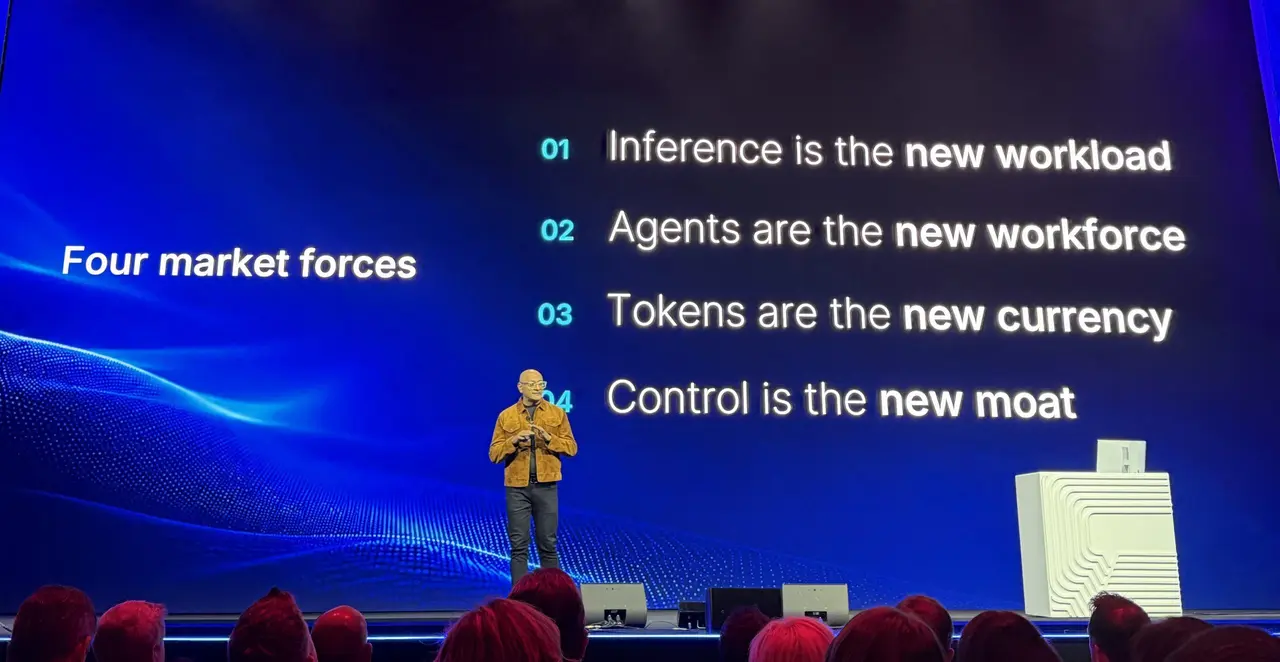
. Patel presented compelling data points: in February, tokens consumed by AI agents exceeded human consumption for the first time, and seven months later agents were consuming five times as many tokens1
. Roughly 60% of global AI compute capacity this year goes to inference rather than training, meaning consumption curves are no longer gated by human attention span as agents run continuously at machine speed1
.
Source: SiliconANGLE
Patel characterized agents as "like teenagers—intelligent, fearless and notorious for poor judgment," providing a mental model for organizations writing AI policy
1
. This framing acknowledges that nondeterministic systems fail in ways that look identical to security compromises, making the classic triage question of "bug or attack?" unanswerable with security telemetry alone.Related Stories

Observability and Security Converge for Agentic AI
Cisco announced that observability and security are merging as organizations deploy agentic AI at scale. During a keynote demonstration, an AI engineer and security operations center analyst worked the same incident from separate consoles, illustrating why the disciplines can no longer operate independently
1
. Patel explained: "It is actually very hard to distinguish between whether there's a breach, or some agent was poisoned because of an external prompt, or the agent just exercised poor judgment because it was very literally following your instructions"1
.Splunk's response puts agent traces, evaluator scores, application telemetry, network data, and security signals on a single correlated fabric through the new Cisco Data Fabric architecture
2
. John Morgan, Splunk's senior vice president and general manager of security, previewed an integration shipping at year-end that joins Splunk Observability and Enterprise Security datasets while respecting organizational boundaries: "We want to respect that the observability and the security teams are different. We know they often have different budgets, but at the same time they have the same business goal"1
.The Splunk Agentic SOC Workforce expands with specialized agents for detection engineering, threat hunting, malware analysis, investigation, response, and governance
2
. Splunk and AWS formalized a multi-year agreement to co-develop security solutions, combining Splunk's data platform and security analytics with AWS cloud infrastructure and security signals5
.Platform Rebuilt for Federated Data Architecture
Mangesh Pimpalkhare, senior vice president and general manager of Splunk Platform at Cisco, characterized the announcements as "not just an incremental evolution or an additional bunch of features" but a strategic overhaul for the agentic enterprise
2
. The Cisco Data Fabric architecture addresses longstanding cost criticisms by analyzing information where it resides instead of requiring customers to copy everything into Splunk2
.
Source: CXOToday
The fabric federates data across Splunk, cloud object stores, data lakes, and platforms including Snowflake and Databricks, then correlates signals across environments
2
. Expanded federated search supports services including AWS CloudWatch data lakes and Databricks without moving underlying information2
. The platform incorporates domain-specific AI models trained on operational data for time-series forecasting, log analysis, and graph reasoning, designed to complement rather than replace frontier models2
.References
Summarized by

Navi
[2]
Related Stories
Cisco Revolutionizes Security Operations with Agentic AI in Splunk Enterprise
09 Sept 2025•Technology

Cisco Unveils AI-Powered Data Fabric to Revolutionize Machine Data Management
09 Sept 2025•Technology
Cisco launches DefenseClaw and Zero Trust security to protect the agentic AI workforce
23 Mar 2026•Technology

Recent Highlights



Recent Highlights
Today's Top Stories






Don’t drown in AI news. We cut through the noise - filtering, ranking and summarizing the most important AI news, breakthroughs and research daily. Follow topics that matter to you and stay ahead.


