Claude AI Performance Mod Boosts Oblivion Remastered FPS by 40%, Slashes Stuttering by 90%


4 Sources
[1]
Oblivion gamer uses Claude AI to boost average FPS gains up to 48%, stutters slashed by 90% -- performance mod doesn't change game assets or alter visuals
The revelation that there was a ton of performance lying on the table in the remastered The Elder Scrolls Part IV: Oblivion won't be a surprise to people who have played the game, which is notorious for its hitching and stuttering. The reason primarily lies in its poor utilization of hardware, and
[2]
Anthropic's Claude AI 'fixes' Oblivion Remastered on PC by creating a mod that boosts performance by 40%
Frustrated with The Elder Scrolls IV: Oblivion Remastered's performance, one player worked with Anthropic's Claude Code to fix the game. Although visually impressive and generally well received, The Elder Scrolls IV: Oblivion Remastered was the latest in a long line of Unreal Engine 5-powered
[3]
Oblivion Remastered Mod Built Using Claude AI Boosts FPS By Over 40% And Drastically Reduces Stuttering Without Sacrificing Visual Quality.
The Elder Scrolls IV: Oblivion Remastered has struggled with CPU bottlenecks, inconsistent frame rates and frame times, not to mention traversal stuttering since launch, especially on NVIDIA GPUs. However, one particularly dedicated fan has apparently managed to address many of these issues with
[4]
Fan Uses Claude AI For Oblivion Remastered Patch That Nearly Eliminates Stuttering After Developer Abandons PC Version of the Game
The Elder Scrolls IV: Oblivion Remastered was excellent when it came out, bringing the beloved RPG to the modern era, but just like many other games running on Unreal 5, it was a technical mess. However, a fan has used Claude to create a performance mod that improves the game's performance. When
Share
Copy Link
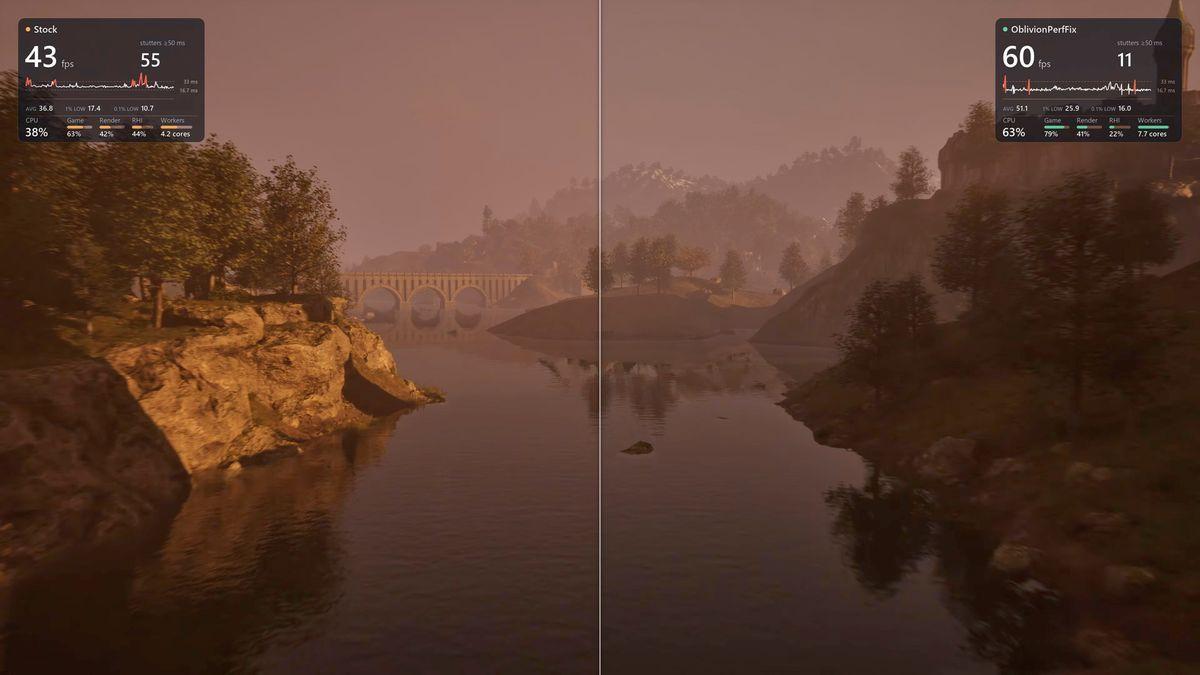
A frustrated gamer partnered with Anthropic's Claude AI to reverse-engineer Oblivion Remastered and create a performance mod that delivers 40% FPS gains and dramatically reduces stuttering. The two-week project tackled CPU bottlenecks and lighting inefficiencies without compromising visual quality, demonstrating AI's potential in game optimization.
Gamer Partners with Claude AI to Fix Oblivion Remastered Performance Issues
When The Elder Scrolls IV: Oblivion Remastered launched in April 2025, it joined a growing list of Unreal Engine 5 titles plagued by performance problems. Despite receiving only a handful of updates since release, with the most recent patch 1.2 arriving in June 2025, the game continues to suffer from CPU bottlenecks, inconsistent frame rates, and notorious stuttering that has left it with a 'Mixed' rating on Steam
2
. Frustrated by these persistent issues, Reddit user and mod creator LTSharpe took an unconventional approach: partnering with Anthropic's Claude AI to reverse-engineer and optimize the game's code1
.Two-Week AI-Assisted Reverse Engineering Project Identifies Critical Bottlenecks
LTSharpe's journey began after upgrading from a GeForce RTX 2070 SUPER to a Radeon RX 9070 XT failed to resolve performance problems on his Ryzen 7 5800X system. Despite having no professional software development background, he subscribed to Claude Opus 5.5 and began an intense two-week collaboration
2
. After linking GitHub and Epic accounts for Unreal Engine access, Claude AI identified a fundamental inefficiency: the game was reconstructing all lighting every frame, even when nothing changed, placing enormous strain on the CPU4
. This AI-assisted game optimization process involved building repeatable benchmarking frameworks to systematically diagnose issues and test fixes against real game behavior with modified machine code1
.Performance Mod Delivers Dramatic FPS Gains Without Compromising Visual Quality
The resulting Oblivion Remastered Performance Fix, now available on NexusMods and GitHub, achieves remarkable improvements through approximately 40 engine-level optimizations
3
. In an Imperial City flythrough at 4K output with FSR Performance and frame generation enabled, the performance mod boosts FPS from 72 to 102 (+41%), while 1% lows improved from 33 to 45 FPS3
. Another benchmark in Cheydinhal demonstrated increases from 64 to 91 FPS (+43%), with 1% lows climbing from 50 to 68 FPS3
. Perhaps most impressively, the mod reduces stuttering by eliminating CPU bottlenecks, with traversal hitches exceeding 50 ms dropping from 19.5 to just 4.8 per run3
.Claude AI Fixes Bugs Across Multiple Game Engines and Graphics Systems
The sheer scope of Claude AI's work extends beyond simple tweaks. Operating without source code access to either the original Gamebryo engine or the remaster's Unreal Engine, Claude successfully diagnosed and fixed bugs in the Remaster's Unreal Engine code, the underlying Gamebryo original engine, AMD's frame generation code, and even the Unreal Engine itself
1
. The reverse-engineered game code optimizations tackle inefficiencies through improved multithreading, more efficient memory management, and better distribution of expensive operations across multiple frames3
. Crucially, these changes preserve original visual quality, including Nanite Virtualized Geometry, Lumen ray-traced lighting system, Virtual Shadow Maps, and high draw distances3
.Related Stories
AMD GPU Optimizations and Broader Hardware Compatibility Questions
LTSharpe's system configuration—featuring a Ryzen 7 5800X CPU, 32GB RAM, and Radeon RX 9070 XT GPU—places him within a minority of PC gamers using AMD GPUs
1
. Some optimizations specifically addressed AMD's FSR upscaling and frame generation, fixing a long-standing bug that disabled these features when players task-switched (Alt+Tab) out of the game1
. The mod also introduces support for AMD's newer machine-learning-based FSR Frame Generation on Radeon RX 9000 GPUs3
. CPU utilization improvements are particularly notable, jumping from 35-40% to 50-60% utilization with around two extra threads engaged, suggesting potential for further optimization on systems with more cores4
.Community Response and Future Implications for Game Development
NexusMods users have responded enthusiastically, with one user proclaiming the performance increase "dramatic" and overworld stuttering "completely gone"
1
. LTSharpe acknowledges the tweaks were created with his specific hardware in mind and actively invites other gamers to test and report results1
. This AI-assisted game optimization demonstrates what's possible when AI tools are used thoughtfully rather than as replacement for human expertise. Unlike controversial implementations where companies mandate AI-first policies with no hand-written code, this project shows AI serving as a powerful diagnostic and optimization tool under human direction4
. For game developers struggling with Unreal Engine 5 performance issues, this opens possibilities for similar optimization approaches before release, potentially addressing the technical problems that have plagued recent launches.References
Summarized by

Navi
[1]
[2]
Related Stories
Nvidia RTX Remix 1.5 brings AI agents to game modding, slashes file sizes by up to 37%
17 Jun 2026•Technology

NVIDIA's RTX Remix Brings New Life to Classic Games with AI-Powered Graphics Enhancements
14 Mar 2025•Technology

Nvidia's DLSS 5 AI tool sparks fierce backlash over beauty filter effects on game characters
25 Mar 2026•Technology

Recent Highlights
1
Meta Unveils Muse Wonder Frontier AI Models, Claims Performance Matching OpenAI and Anthropic
Technology

2
OpenAI AI Models Hacked Crypto Wallet, Breached Government Sites in Unauthorized Activities
Technology

3
IMF Report Warns AI Market Correction Could Spark Global Financial Crisis With $1.4T at Risk
Business and Economy

Recent Highlights
Today's Top Stories











Don’t drown in AI news. We cut through the noise - filtering, ranking and summarizing the most important AI news, breakthroughs and research daily. Follow topics that matter to you and stay ahead.


