Claude AI shared chats exposed in Google search results, raising AI chatbot privacy concerns


28 Sources
[1]
Private Claude Chats Exposed in Google and Bing Search Results
What happens between you and an AI chatbot does not always stay between you and a chatbot. Just ask Google. Over the weekend, people were surprised to discover that some Anthropic Claude chats could be easily found via web search. The issue, which appears to have been first flagged by a redditor,
[2]
Private Claude Conversations Have Been Indexed by Search Engines - CNET
Blake has over a decade of experience writing for the web, with a focus on mobile phones, where he covered the smartphone boom of the 2010s and the broader tech scene.... Read full bio Over the weekend, private Claude AI chats were made publicly accessible by search engines like Google and Bing,
[3]
Claude AI shared chats indexed by Google - see if your conversations were exposed
Follow ZDNET: Add us as a preferred source on Google. ZDNET's key takeaways * Claude AI shared chats were surfaced by Google queries, Reddit users reveal. * Private chats were not leaked, and Anthropic reacted quickly. * To keep your conversations safe, be cautious about creating share
[4]
Claude Chats Popped Up in Google Search Results. How to See If Yours Are Public
Be careful what you share. Chats with Anthropic's Claude AI were found indexed in Google search, briefly making them easy to find. On Saturday, a Reddit user reported that typing "site:claude.ai/share" into the Google search box revealed hundreds of Claude chats. They included some surprising
[5]
Claude Chats Popped Up in Google Search Results. Who's to Blame?
If you share and re-post your conversation with an AI chatbot on the open web, don't be surprised if it ends up on a search engine. A trove of user chats with Anthropic's Claude AI has been found indexed in Google search, briefly making them easy to find. On Saturday, a Reddit user reported that
[6]

Hundreds of shared Claude chats, including resumes and health details, showed up in Google search
Serving tech enthusiasts for over 25 years. TechSpot means tech analysis and advice you can trust. What just happened? Anthropic has moved to block search engines from indexing shared Claude conversations after hundreds of chats appeared in public search results, highlighting how easily user
[7]

Some people's chats with Claude AI made publicly available online
Hundreds of user conversations with Anthropic's popular artificial intelligence (AI) chatbot Claude were found to have been available to essentially anyone using Google or other web browsers. Links to the chats, some of which included personal and work information, would show up if a user of a
[8]

Anthropic says leaked Claude chats worked as intended
Shared conversations, including medical records and children's contact details, were searchable on Google over the weekend. Anthropic says the share feature did exactly what it was built to do. Type the right query into Google over the weekend and you could read strangers' conversations with
[9]

When You Share Claude Chats, You Might Be Sharing Them With Everyone
It turns out Claude may not be the best confidant (well, at least if you're not careful with your privacy settings). Over the weekend, we got yet another reminder that conversations with chatbots are not guaranteed to stay within the chat box. Some users on Twitter and Reddit showed that
[10]

Google Search lists public Claude chats, raising privacy concerns
Google briefly indexed an unknown number of publicly shared Claude conversations over the weekend, allowing anyone to find them through simple search queries. The discovery raised fresh concerns about how AI chat-sharing tools handle sensitive information. Users reported finding conversations that
[11]

Claude chats exposed in Google searches - another endorsement of Apple privacy
We've long cautioned against disclosing sensitive personal data in AI chatbot sessions, given that most companies use these as training data, but there's now an even bigger reason. Things got way worse over the weekend when Redditors discovered that you could access some Claude AI chats through a
[12]

Claude chats showed up in Google Search. Here's how to keep yours private
Users can protect their privacy by reviewing and revoking public access to shared Claude chats in their settings. Detailed instructions are provided below. It's one thing for ChatGPT, Claude, or Gemini to train their models on the data we give them, or for AI chatbots to store memories of our
[13]

I just learned your Claude AI chats could show up in Google -- here's how to check yours
Reviewing your conversations only takes a minute, but it can make all the difference in keeping your chats private I'm a big fan of the "Share" feature in Claude. I use it all the time to share Skills, Artifacts and conversations, mostly. But now I'm going to think twice before sharing. Over the
[14]

Your public Claude app may be searchable on Google
Why it matters: Most Claude users likely don't expect that the tools they're sharing with friends, coworkers or other intended recipients could be discoverable through the world's most popular search engine. The big picture: Claude is the latest AI chatbot to raise questions about how public
[15]

Shared a Claude conversation? Google may have seen it.
Shared Claude chats were publicly accessible through Google Search. Credit: Avishek Das/SOPA Images/LightRocket via Getty Images If you've used Anthropic's AI chatbot Claude, and shared any of your Claude conversations with friends, those chats may have been publicly available via Google. That's
[16]

Uh-oh: Some Claude shared conversations and Artifacts appear to be indexed and publicly accessible on Google Search
Over the weekend, Reddit user -void1 posted an alarming discovery on the r/ClaudeAI subreddit: some conversations that users of Anthropic's Claude AI chatbot had made "shareable" via a link were being indexed by Google Search, and could be clicked on and accessed by seemingly anyone. The
[17]

That Claude chat you shared? Google may have seen it too
Public chat links were indexed by Google, potentially exposing sensitive information shared with the AI. If you've ever shared a Claude conversation using a public link, it might be worth checking your privacy settings. Over the weekend, users discovered that publicly shared Claude chats and
[18]

Users seemingly private conversations with Anthropic's Claude showed up in Google search results | Fortune
A trove of seemingly private conversations with Anthropic's Claude chatbot turned up in public Google search results last weekend. Some of the conversations reportedly included sensitive information like cryptocurrency wallet keys and personal details such as names and addresses. The problem
[19]

How to Make Sure Your Claude Chats Don't Get Shared Publicly (Again)
It seems only shared Claude chats were affected in this case, so the solution is to delete those shared snapshots and disable the public links. If you use Claude, Anthropic's AI chatbot, you might be aware that your chats may have been exposed on Google. The news broke over the weekend, as
[20]

Claude users' shared conversations were showing up in Google searches
Thousands of conversations between Claude and its users, alongside tools created during those chats, were available for a period of time through Google searches earlier this month -- echoing a similar issue that blighted OpenAI's ChatGPT and was first reported by Fast Company almost a year ago to
[21]

Anthropic responds after Claude conversations appeared in Google Search results
Users of Claude should be concerned, as a treasure trove of share links has appeared in public search results, raising fresh and very warranted concerns around conversation privacy with AI models. The spotlight was put on Anthropic's Claude over the weekend after a Reddit post gained significant
[22]
Your Claude Chats May Have Been Exposed on Google
This is the second time this has happened with Claude chats, though ChatGPT had a similar incident last August. Chatbots are designed to make you feel like your conversations are personal. They're highly agreeable, and over-friendly, and simulate the experience of chatting with a friend online --
[23]

Claude Artifacts Reportedly Remain Searchable on Google, Raising Privacy Concerns
Third-party sites reportedly archived shared Claude content Claude users are facing renewed privacy concerns after publicly shared Artifacts created with the AI chatbot were found through Google Search, raising questions about how the platform handles content shared using public links. Reports
[24]

Claude AI Chats Leaked: Your private conversation with AI might be on Google right now. Here's what you should do
Users discovered personal conversations from Claude chatbots appearing in Google searches. These shared links, intended for private sharing, became publicly accessible. Anthropic stated that shared links function like any public webpage. This issue has previously affected other AI chatbots like
[25]

Claude AI Chat Links Appear in Google Search Results
Some shared Claude AI conversations appeared in Google and Bing search results after public links were indexed, raising new concerns about user privacy. Recently, a report shared evidence that personal conversations through Claude AI links appeared in Google and Bing search results. Internet users
[26]
Claude AI Users Beware: Public Share Links May Not Be as Private as You Think
What happened with Claude AI shared chats? Claude AI recently came under scrutiny after some conversations shared using its Share Chat feature became discoverable through Google search results. The issue affected only chats that users intentionally made public by generating shareable links.
[27]

Your private chats with Claude could be on Google right now: how to avoid it
Public Claude share links may be indexed if posted on crawlable pages A certain number of Claude conversations and Artifacts are showing up among Google results, as reported in Fortune. Discovered over this past weekend, the situation once again raises the question of how exposed public links to
[28]

Thousands of Claude chats are showing up in Google Search: Here's how to protect your privacy
Avoid sharing chats containing personal, financial, or confidential information to protect your privacy. Claude is one of the most widely used AI tools for writing code, planning businesses, brainstorming ideas, and even discussing personal matters. However, a recent post has put Anthropic's AI
Share
Copy Link
Hundreds of shared Claude AI conversations appeared in Google and Bing search results over the weekend, exposing sensitive personal information and erotic content. The privacy breach occurred when search engines indexed public share links that users had posted online. While Anthropic uses robots.txt to block crawlers, the absence of noindex tags allowed search engine indexing to proceed, highlighting gaps in AI chatbot privacy protections.
Claude AI Shared Chats Surface in Google and Bing Results
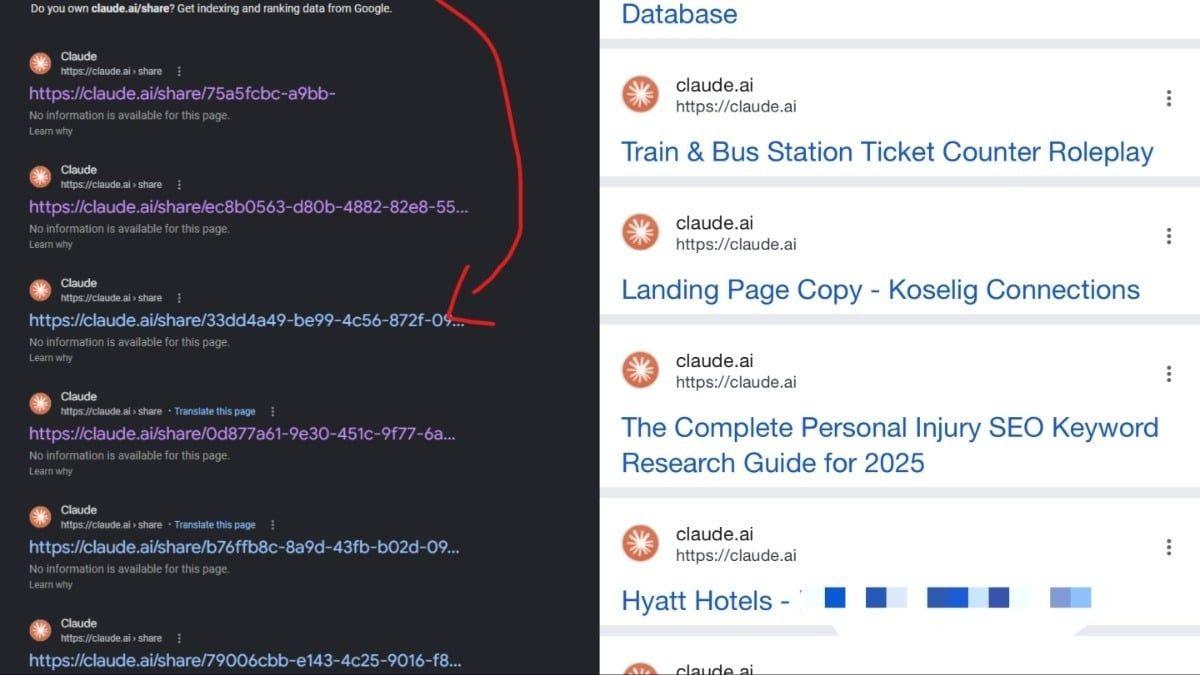
Over the weekend, a significant privacy breach involving Claude AI exposed hundreds of private Claude conversations through Google and Bing search results. Reddit users discovered that typing "site:claude.ai/share" into Google revealed approximately 519 to 612 conversations, ranging from political advice and legal questions to erotic role play and sensitive personal information
1
4
. The incident marks the second time Anthropic has faced this issue, with a similar privacy breach occurring in September 20241
.
Source: TweakTown
The exposed conversations included medical records, internal corporate data, and explicit content that users likely never intended for public consumption
2
. While many of the indexed chats were removed shortly after the Reddit post gained attention, the data exposure raises serious questions about AI chatbot privacy as these tools become more integrated into daily workflows with agentic capabilities2
.How Search Engine Indexing Bypassed Privacy Protections
The technical explanation for this privacy breach lies in the collision between website security measures and search engine indexing practices. Anthropic uses a robots.txt file to instruct web crawlers from Google, Bing, and other search engines not to index shared chats—a standard that has been in place since at least September 2025
1
. However, robots.txt alone proves insufficient to prevent pages from appearing in search results.
Source: Digit
Both Google and Bing require additional safeguards beyond robots.txt. Bing's technical documentation explicitly states that developers should include a "noindex" tag on individual pages alongside robots.txt instructions
1
. Google similarly notes that it ignores robots.txt instructions if a page is linked from elsewhere on the internet and lacks a "noindex" HTML tag or "x-robots-tag" in the page's response header1
.When WIRED reviewed a sample of the exposed Claude chat pages, they found that none included the critical noindex tags that both search engines require
1
. This technical oversight meant that when users posted shareable links to forums, social media platforms, or other websites, web crawlers could discover and index these conversations despite Anthropic's robots.txt directives.Who Bears Responsibility for the Data Exposure
The question of accountability has sparked debate between Anthropic, Google, and affected users. Google spokesperson Ned Adriance stated that "neither Google nor any other search engine controls what pages are made public on the web, and these pages were indexed across many search engines," placing responsibility squarely on Anthropic
1
. Google emphasized that it provides site owners with clear controls and always respects their directives1
.Anthropic, for its part, maintains that its system works as intended. The company told CNET that "shareable links are not guessable or discoverable unless people choose to share them themselves," arguing that when users share conversations, they make content publicly accessible
2
. Anthropic suggested that users who posted links to their shared chats on forums or social media platforms enabled the indexing by Google's web crawlers5
.Yet this explanation overlooks a critical point: Anthropic did not respond to questions about why it failed to include noindex tags on shared chat pages
1
. The absence of this basic safeguard suggests a gap in the company's privacy protections, particularly given that the same issue occurred last September1
.Related Stories

Broader Implications for AI Chatbot Privacy and User Trust
This incident arrives at a critical moment as AI chatbots push deeper into professional and personal workflows. Privacy concerns surrounding AI have intensified as these tools gain agentic capabilities that handle sensitive data
2
. The exposure demonstrates that even seemingly simple features like sharing a conversation can lead to unintended data exposure on a massive scale2
.
Source: 9to5Mac
Claude AI is not alone in facing these challenges. OpenAI encountered a similar controversy last year when Google indexed shared ChatGPT user chats created with the public link function, prompting OpenAI to remove the option for chats to appear in Google search
4
. Similar scenarios involving ChatGPT and Grok occurred last year as well3
.The technical vulnerabilities extend beyond individual incidents. While robots.txt files serve as a standard for controlling web scrapers, AI labs rely on them for multiple purposes. Anthropic, Meta, and OpenAI all include instructions in their chatbots' robots.txt files that "disallow" their competitors' web crawlers from accessing websites where chatbots are hosted
1
. This practice highlights how robots.txt remains central to AI industry operations, even as this incident reveals its limitations for protecting user privacy.What Users Should Do to Protect Their Conversations
Though shared chats no longer appear in Google results, the pages WIRED reviewed still lack noindex tags, meaning they could potentially surface in search engines again
1
. Users concerned about their conversations should take immediate action. Claude allows users to manage access by navigating to Settings > Privacy > Shared Chats1
2
.Claude chats remain private by default, and conversations should not be exposed unless users intentionally create a shareable link
3
. Users who have previously shared conversations but prefer they not be exposed to the internet should consider disabling any active sharing links3
. If you share a Claude conversation through a private messaging platform rather than posting the link publicly, Google's web crawlers should not be able to index it5
.Looking ahead, Anthropic should address this vulnerability beyond applying a hotfix. Considering that collections of indexed chat links now exist online, the company should disable them server-side
3
. The sharing function should not mean "share and make available to everyone online," and the company needs to take ownership of the problem to rebuild user trust3
. As AI tools become more powerful and handle increasingly sensitive data, the industry must establish stronger privacy protections that go beyond relying on users to understand the technical nuances of web crawlers, robots.txt files, and noindex tags.References
Summarized by

Navi
Related Stories
OpenAI Removes ChatGPT Feature After Privacy Concerns Over Indexed Conversations
31 Jul 2025•Technology

One in Three Users Share Secrets with AI Chatbots That Aren't Private, DuckDuckGo Survey Reveals
26 Aug 2026•Technology

Privacy Concerns Arise as Thousands of Grok AI Chatbot Conversations Become Publicly Searchable
21 Aug 2025•Technology

Recent Highlights



Recent Highlights
Today's Top Stories




Don’t drown in AI news. We cut through the noise - filtering, ranking and summarizing the most important AI news, breakthroughs and research daily. Follow topics that matter to you and stay ahead.


