2 Sources
[1]
Student commencement boos are a sign of wider AI woes
As companies race to weave AI into nearly every industry, some college students are responding with open hostility. At at least three college commencement ceremonies this month, graduates loudly booed invited speakers who praised AI. On Thursday, Vice President JD Vance addressed the incidents in a speech at the U.S. Air Force Academy, acknowledging the growing anti-AI sentiment. On at least five campuses, students have also formed anti-AI groups, gathering with peers to advocate for slowing the technology's unchecked development. The pushback reflects a widening disconnect between business leaders' optimism about AI and students' anxieties over its impact on jobs, creativity and critical thinking. "Part of the learning process is struggling to understand and break down the content," said Paul Webster, a rising sophomore studying computer science at the University of California, Berkeley. "If you use AI for that -- which is what professors were encouraging students to do -- it severely impacts your actual understanding." NBC News spoke with seven students from universities across the country, including Webster, who described seeing their peers rely on AI to cut corners in school, sometimes at the encouragement of faculty members. A poll conducted in October by Gallup and the Lumina Foundation of over 3,500 college students found that 57% of U.S. college students use AI for their classwork at least once a week, with 21% using it daily. Students said they used AI most often to help them understand their coursework and check answers on homework assignments. AI's explosion in recent years has led some students to create their own campus groups to rebuff its advance. PauseAI US, a national organization dedicated to pausing the development of the most advanced AI systems until they can be safely deployed, now has five chapters at different universities, according to the organization. Its executive director, Holly Elmore, said she has seen a growing sentiment among students that current AI development is potentially dangerous and proceeding too quickly. Chapter leaders, she said, feel schools have imposed "all this pressure to just abandon any sense of morality or honor about writing your own words and doing your own work." Students "feel like their lives are really like turned into chaos, their futures are thrown into chaos, and then they turn to things that give them meaning, and then that, too, is going to be choked out" by AI, Elmore said. The organization's campus affiliates set their own rules and activities, like helping raise awareness about risks from AI or ongoing legislative efforts to regulate leading AI companies. Nickolas Spiliotopoulos, a rising senior studying political science at the University of California, Santa Barbara, who leads the campus chapter of PauseAI US, said his chapter emphasizes open and frank discussion about AI's impacts. Many members, he said, "don't want AI to trump our academic, maybe our political, maybe our cognitive processes." "We want to make sure that it is being regulated in a form that is beneficial to everyone and that doesn't substitute for our critical thinking skills," he said, adding that around a dozen students are regularly involved in the club. Beyond campus groups aiming to stop AI development, dozens of others have sprung up to help students discuss and tackle technical AI safety research at campuses from Georgetown University in Washington, D.C., to the University of Washington. Meanwhile, some of America's largest AI companies have also established footholds on campus. Anthropic, for example, funds campus clubs meant to raise awareness about its Claude AI products and foster connections "with students who see AI as a tool for expanding human capability, not replacing it." Many university students also expressed concern that AI is hollowing out the meaning of their favorite hobbies, in addition to its perceived impacts on the job market. Some said they still feel pressure to lean into the technology regardless of their personal anxieties about AI. "I just feel this general sense among all of us of AI kind of being forced on us," said Zoe Kaufman, who just graduated from Mary Baldwin University in Staunton, Virginia, with a degree in psychology. "Nowadays, the school is encouraging us to download different AIs and use them, and it just feels like it's kind of coming for everyone's jobs, just at different paces." Kaufman also said some university employees seemed troublingly bullish on the technology. When she asked for help crafting a résumé from her university's career center, Kaufman said, she was advised to just feed her information to ChatGPT. "A robot's going to be reading your application anyway, so just have one write it," Kaufman said the adviser told her, describing the advice as "twisted." Kimberly Aron, a master's student at Eastern University in Pennsylvania, echoed similar concerns about the forced nature of AI adoption in academics. "In some ways, we feel like we have to use AI almost under duress, like there's something around our neck," she said. "You need to know this; if you don't, you're going to be left behind," she said. Aron, 37, said students are confused by school policies that simultaneously try to restrict AI use in class and push them to hone their expertise in it. As a data analysis student, she said, she worries that much of what she's learning in Excel, SQL, Tableau and Python will be obsolete by the time she enters the job market. Daniel Liddle, an associate professor of English at Western Kentucky University, teaches students across a variety of humanities and STEM majors. He said he has spotted "more eye-rolling" at mentions of AI in his classes. "I think many of my students are sometimes exhausted by the AI conversation," Liddle said, "and they long for the thing that they signed up for originally, which is learning about their discipline." But some also say opinions about AI tend to fall into extremes on both ends -- that tech leaders tout it as an all-encompassing solution, while anti-AI camps are burying their heads in the sand. Jeffrey Kang, a recent University of Southern California graduate who's now a software engineer at Meta, said that he understands why people want AI to fail and that a world run by automation sounds "pretty depressing" to him, as well. But that ignores the benefits of working with the technology in ways that are genuinely useful, he said. "I think it's a pretty fatalist mentality," Kang said. "There's not a single person at Meta that will be like, 'Oh, I don't use AI, like, I don't use Claude Code, it's not useful.' And I would assume that's true at other big tech companies too." Spiliotopoulos, the leader of UCSB's PauseAI chapter, said even some students skeptical of the technology also recognize its potential to be helpful to society. "What I see most is a growing sentiment that artificial intelligence is increasingly being developed in an unregulated manner, and that's what people take issue with," he said. "It's not only bad; it's not only good. Like with many things in life, there is nuance."
[2]
College Graduates Boo AI -- Are They Right That It's Impacting Their Job Market?
Get personalized, AI-powered answers built on 27+ years of trusted expertise. AI in the workplace is a harder sell to new grads than companies previously thought. At a commencement ceremony for the University of Central Florida in early May, the speaker and vice president of strategic alliances for Tavistock Development Company, Gloria Caulfield, said: "The rise of Artificial Intelligence is the next Industrial Revolution." In the now-viral moment, the Class of 2026 responded with an overwhelming chorus of boos. Caulfield, who seemed surprised by the reaction, is not alone. Several other commencement speakers have received similar negative reactions when speaking about AI at university ceremonies this year. The students' responses likely come from anxiety about the sudden incorporation of AI into workplaces, said Gaurav Shekhar, associate dean in the Naveen Jindal School of Management at the University of Texas at Dallas. "I would say there's...a mix of curiosity and anxiety [about AI]. And it's not just the students; even in the industry, people are trying to figure out how AI aligns with their organization," Shekhar said. Many colleges have struggled to incorporate AI into their academic programs quickly. The majority of college seniors (58%) recently surveyed by Handshake, a college-focused hiring platform, said they need a deep understanding of AI to succeed at work. Yet, only 28% said they think AI was meaningfully integrated into their degree program. Young Workers Don't Like The Labor Market A 2025 Gallup survey found that 43% of Americans aged 15 to 34 said now is a good time to find a job. Typically, younger workers are more optimistic about jobs than older workers. Yet in the same survey, 64% of older adults felt that the job market was doing well. Young workers' increasing pessimism is partly substantiated. The number of job openings for recent college graduates is half what it was four years ago, when the labor market boomed following the COVID-19 pandemic, according to an analysis of job postings during the first quarter of 2026 on Handshake. There may be a bright spot ahead for grads, though. Employers said they expect to increase hiring of the Class of 2026 by 5.6%, according to a survey by the National Association of Colleges and Employers. Recent College Graduates Are Facing AI In Their Job Search While AI is impacting the job market, especially for recent graduates, it's not the whole story. High inflation and economic uncertainty are pushing the labor market into limbo with low hiring and low firing rates, making it harder for recent graduates to break into the market. As of March 2026, the unemployment rate for recent college graduates was 5.6%, according to the Federal Reserve Bank of New York. That's more than an entire percentage point higher than the overall unemployment rate. Companies are changing the way they hire because of AI. In a recent survey from the National Association of Colleges and Employers, more than a third of employers required their entry-level employees to have AI skills. That is nearly three times the number of employers who agreed with this sentiment last fall. "The top skills [employers are looking for] are identifying the AI tools appropriate to the task, prompt engineering, developing effective AI prompts, and then analyzing and revising AI output as needed, assessing that quality," said Mary Gatta, the director of research and public policy at the National Association of Colleges and Employers. However, not all college students are fans of the changes in the workforce. Almost a third of college students have never or infrequently used AI, according to a Gallup survey. Among those who do not use AI, half said they avoid it because they view it as unethical or as a way to cheat, and 28% said they avoid AI because of privacy concerns about its use.
Share
Copy Link
At multiple graduation ceremonies this month, college students loudly booed speakers praising artificial intelligence, signaling deep concerns about AI's impact on their futures. The backlash reflects growing student anxieties about job prospects, academic integrity, and critical thinking as unemployment for recent graduates reaches 5.6% and employers increasingly demand AI skills.
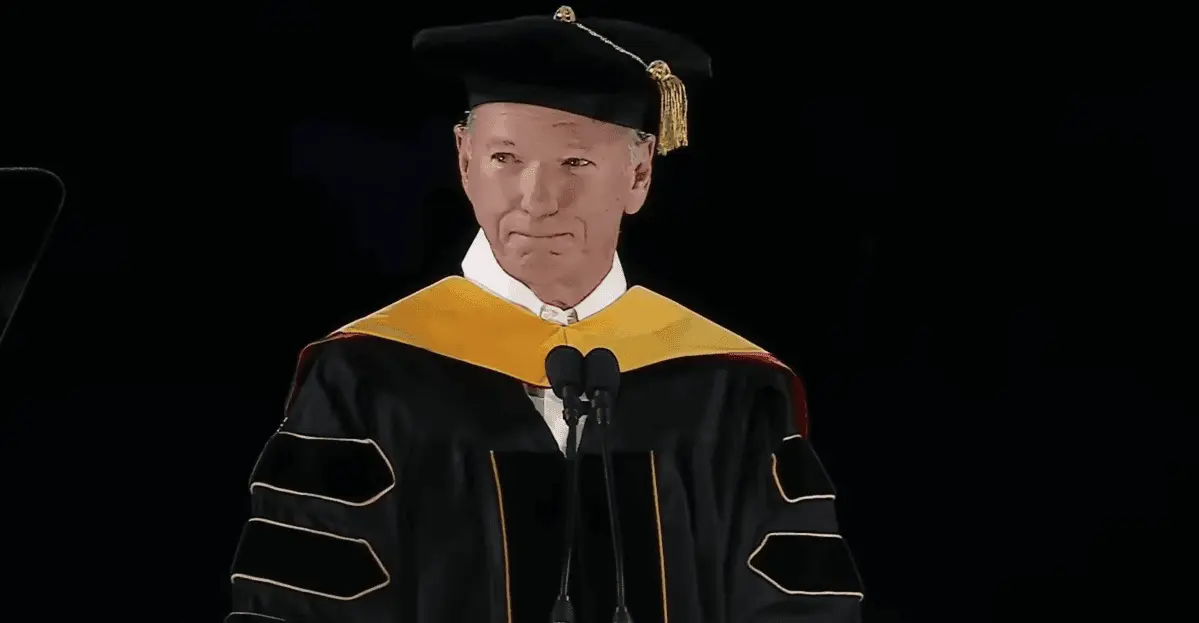
The relationship between college students and AI has reached a breaking point, manifesting in public displays of dissent at graduation ceremonies across the country. At the University of Central Florida's commencement in early May, Gloria Caulfield, vice president of strategic alliances for Tavistock Development Company, was met with overwhelming boos when she declared that "the rise of Artificial Intelligence is the next Industrial Revolution"
2
. This wasn't an isolated incident. At least three college commencement ceremonies this month witnessed graduates loudly booing invited speakers who praised AI, prompting Vice President JD Vance to address the growing anti-AI sentiment in a Thursday speech at the U.S. Air Force Academy1
.
Source: NBC
These student commencement boos reveal a widening disconnect between business leaders' optimism about AI and the genuine anxieties about AI felt by those entering the workforce. The pushback extends beyond symbolic protests. On at least five campuses, students have formed anti-AI groups dedicated to advocating for slowing the technology's unchecked development
1
.The concerns driving these protests run deeper than theatrical dissent. College students are witnessing firsthand how AI is reshaping academic work and threatening critical thinking skills. A Gallup and Lumina Foundation poll conducted in October surveyed over 3,500 college students and found that 57% of U.S. college students use AI for their classwork at least once a week, with 21% using it daily
1
. Students reported using AI most often to understand coursework and check homework answers.Paul Webster, a rising sophomore studying computer science at the University of California, Berkeley, articulated the educational dilemma: "Part of the learning process is struggling to understand and break down the content. If you use AI for that -- which is what professors were encouraging students to do -- it severely impacts your actual understanding"
1
. This pressure to adopt AI tools, sometimes at faculty encouragement, has created what Holly Elmore, executive director of PauseAI US, describes as "all this pressure to just abandon any sense of morality or honor about writing your own words and doing your own work"1
.The ethical concerns extend beyond academics. Among college students who avoid AI, half said they view it as unethical or as a way to cheat, while 28% cited privacy concerns about its use
2
. Almost a third of college students have never or infrequently used AI, according to a Gallup survey2
.The graduates boo AI not just for academic reasons but because of legitimate concerns about their employment futures. As of March 2026, the unemployment rate for recent college graduates stood at 5.6%, more than an entire percentage point higher than the overall unemployment rate
2
. The number of job openings for recent college graduates is half what it was four years ago, when the labor market boomed following the COVID-19 pandemic, according to an analysis of first quarter 2026 job postings on Handshake2
.Young workers' pessimism about the job market represents a dramatic reversal. A 2025 Gallup survey found that only 43% of Americans aged 15 to 34 said now is a good time to find a job, while 64% of older adults felt the job market was doing well
2
. Gaurav Shekhar, associate dean at the University of Texas at Dallas, noted there's "a mix of curiosity and anxiety" about AI among students, adding that "even in the industry, people are trying to figure out how AI aligns with their organization"2
.Compounding the challenge, more than a third of employers now require entry-level employees to have AI skills—nearly three times the number who agreed with this sentiment last fall, according to a National Association of Colleges and Employers survey
2
. Yet only 28% of college seniors believe AI was meaningfully integrated into their degree program, despite 58% saying they need a deep understanding of AI to succeed at work2
.Related Stories
Student resistance is becoming organized. PauseAI US, a national organization dedicated to pausing development of the most advanced AI systems until they can be safely deployed, now has five chapters at different universities
1
. Nickolas Spiliotopoulos, a rising senior studying political science at the University of California, Santa Barbara, who leads the campus chapter, explained that many members "don't want AI to trump our academic, maybe our political, maybe our cognitive processes"1
. Around a dozen students regularly participate in the club, emphasizing open discussion about AI's impacts and ensuring regulation that "doesn't substitute for our critical thinking skills"1
.Meanwhile, major AI companies like Anthropic are establishing their own campus presence, funding clubs meant to raise awareness about their products and foster connections "with students who see AI as a tool for expanding human capability, not replacing it"
1
. This creates competing narratives on campus about AI's role.Zoe Kaufman, who recently graduated from Mary Baldwin University in Virginia with a psychology degree, captured the sentiment: "I just feel this general sense among all of us of AI kind of being forced on us. Nowadays, the school is encouraging us to download different AIs and use them, and it just feels like it's kind of coming for everyone's jobs, just at different paces"
1
. When seeking résumé help from her university's career center, she was told to feed her information to ChatGPT because "a robot's going to be reading your application anyway," advice she described as "twisted"1
.While employers expect to increase hiring of the Class of 2026 by 5.6% according to the National Association of Colleges and Employers
2
, economic uncertainties and high inflation continue creating a labor market limbo with low hiring and firing rates. For students watching AI reshape education, creativity, and career prospects simultaneously, the future remains uncertain. Mary Gatta, director of research at the National Association of Colleges and Employers, notes employers now prioritize "identifying the AI tools appropriate to the task, prompt engineering, developing effective AI prompts, and then analyzing and revising AI output as needed"2
. Whether students embrace or resist these changes will shape how the next generation navigates an AI-integrated workforce.Summarized by
Navi
19 May 2026•Entertainment and Society

13 May 2026•Business and Economy

06 Jun 2025•Business and Economy

1
Business and Economy

2
Technology

3
Policy and Regulation