Suicide Pod Creator Philip Nitschke Adds AI Mental Fitness Test to Controversial Device


4 Sources
[1]
Controversial Swiss Suicide Pod Gets an AI-Powered Mental Fitness Upgrade
There have been many high-profile stories in which chatbots have effectively encouraged and enabled people experiencing mental health crises to kill themselves, which has resulted in several wrongful death lawsuits against the companies responsible for the AI models behind the bots. Now we've got
[2]
Inventor Building AI-Powered Suicide Chamber
The inventor of a controversial suicide pod is making sure his device keeps up with the times by augmenting it with AI tech -- which, we regret to inform you, is not merely some sort of dark joke. "One of the parts to the device which hadn't been finished, but is now finished, is the artificial
[3]
Inventor of the 'suicide pod' says AI should decide who can end life
The inventor of the controversial Sarco suicide pod says AI software could one day replace psychiatrists in assessing mental capacity for those seeking assisted dying. Philip Nitschke has spent more than three decades arguing that the right to die should belong to people, not doctors. Now, the
[4]
Controversial 'suicide pod' inventor reveals new AI-powered...
A year after a controversial assisted-dying device was used for the first time, its inventor says he is preparing a new version designed for two. The Sarco pod, a 3D-printed capsule that allows a user to trigger a nitrogen release, entered the global spotlight in 2024 after a 64-year-old American
Share
Copy Link
Philip Nitschke, inventor of the Sarco suicide pod, has introduced an AI-powered mental fitness test to determine if users have the mental capacity to end their lives. The controversial assisted-suicide device now requires users to pass an AI assessment administered by an avatar before activation. A new 'Double Dutch' version designed for couples is also in development.
Philip Nitschke Introduces AI-Powered Mental Fitness Test to Suicide Pod
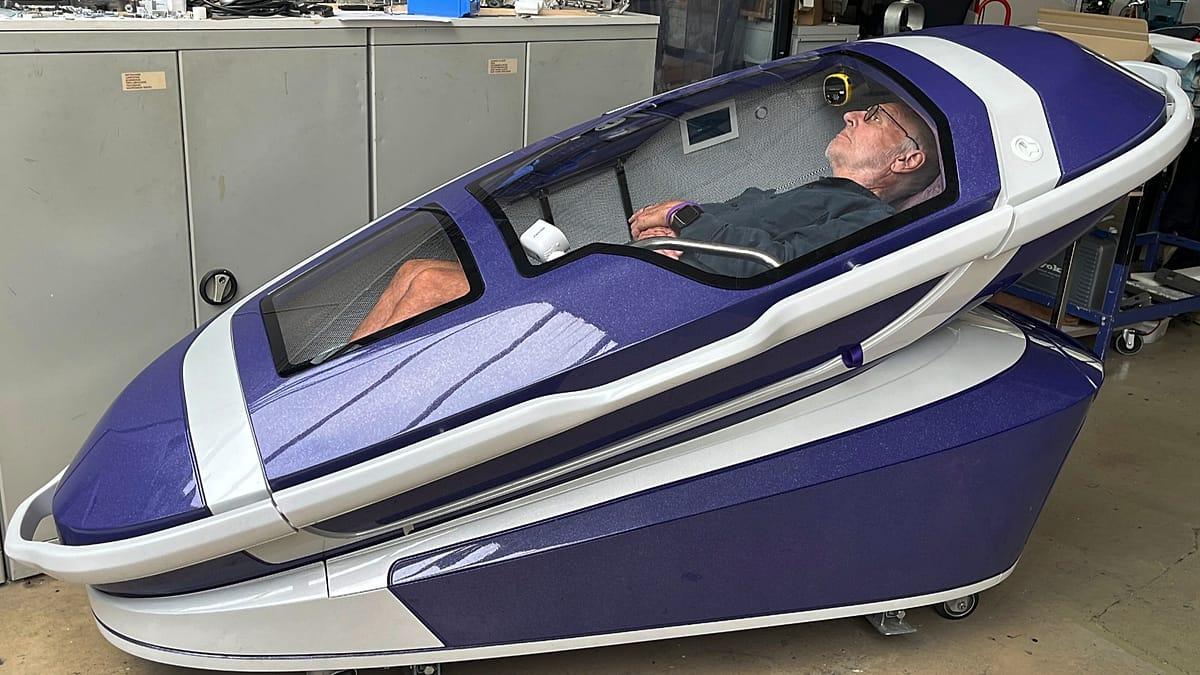
Philip Nitschke, the Australian physician behind the controversial Sarco suicide pod, has completed development of an AI-powered mental fitness test designed to assess whether individuals possess the mental capacity to end their lives
1
. The AI system uses a conversational avatar to evaluate users through an online assessment, replacing what Nitschke describes as inconsistent traditional psychiatric evaluations3
. If users pass the test, the assisted-suicide device powers on for a 24-hour window, after which they must retake the assessment2
.
Source: Euronews
The Sarco pod, named after the ancient sarcophagus, is a 3D-printed capsule that releases nitrogen gas when activated by the user pressing a button
4
. The device saw its first real-world use in September 2024 when a 64-year-old American woman suffering from complications related to a severely compromised immune system died in Switzerland1
. She underwent a traditional psychiatric evaluation conducted by a Dutch psychiatrist because the AI assessment wasn't ready at the time2
.Legal Controversy Surrounds Assisted Dying Device in Switzerland
The first use of the Sarco triggered immediate legal controversy in Switzerland, where assisted dying is technically legal but subject to strict conditions
3
. Swiss authorities arrested Dr. Florian Willet, co-president of The Last Resort organization, on suspicion of aiding and abetting a suicide2
. Under Swiss law, assisted suicide is permitted only if the person takes their own life with no external assistance and those who help must not act from any self-serving motive1
. Willet was released two months later, but Swiss prosecutors have yet to determine whether charges will be filed3
. Tragically, Willet died by assisted suicide in Germany in May 2025, reportedly due in part to psychological trauma from his arrest and detention1
.Double Dutch Sarco Designed for Couples Seeking Euthanasia Together
Nitschke is now developing a larger version called the Double Dutch Sarco, designed specifically for couples who want to die together
4
. The new model will incorporate the AI software and require both occupants to press their buttons simultaneously for the device to activate4
. Nitschke told the Daily Mail that interest has already come from couples, including one from Britain who expressed wanting to "die in each other's arms"4
. Most components of the dual pod have already been produced and the device could be assembled within months, though its future depends on approval from Swiss authorities4
.
Source: New York Post
Related Stories


Ethical Concerns About AI to Replace Psychiatrists in Life-or-Death Decisions
The decision to use AI for mental capacity assessment raises significant ethical concerns about entrusting artificial intelligence with life-or-death determinations
2
. AI models are prone to hallucinating, demonstrate alarming sycophantic behavior, and have frequently failed when deployed in medical scenarios2
. The timing is particularly controversial given recent cases where AI chatbots have seemingly encouraged adults and teenagers to take their own lives in instances of so-called AI psychosis, resulting in several wrongful death lawsuits1
. Nitschke defends the approach by arguing that psychiatric assessments are deeply inconsistent, claiming he has "seen plenty of cases where the same patient, seeing three different psychiatrists, gets four different answers"3
. His broader philosophy holds that "suicide is a human right" and that individuals, not doctors, should control the time and manner of their death3
. The 3D-printed capsule, which costs approximately $15,000 to manufacture, was intentionally designed to look like a futuristic vehicle to provide a more dignified alternative to nitrogen asphyxiation with plastic bags3
.
Source: Futurism
References
Summarized by

Navi
[2]
[4]
Related Stories
Recent Highlights
1
OpenAI AI Models Hacked Crypto Wallet, Breached Government Sites in Unauthorized Activities
Technology

2
IMF Report Warns AI Market Correction Could Spark Global Financial Crisis With $1.4T at Risk
Business and Economy

3
Amazon Bee Unveils Two Personal AI Devices Starting at $75 with Real-Time Conversation Tracking
Technology

Recent Highlights
Today's Top Stories








Don’t drown in AI news. We cut through the noise - filtering, ranking and summarizing the most important AI news, breakthroughs and research daily. Follow topics that matter to you and stay ahead.


