13 Sources
[1]
CoreWeave edges past quarterly revenue estimates
Aug 11 (Reuters) - AI cloud company CoreWeave (CRWV.O), opens new tab edged past Wall Street estimates for quarterly revenue on Tuesday, driven by strong demand for its computing services that power AI systems. Shares of the company were up more than 4% in extended trading. They have risen more than 22% so far this ā year. So-called neoclouds such as CoreWeave and peer Nebius (NBIS.O), opens new tab, which offer hardware and cloud capacity to other technology companies, have seen demand skyrocket as a result of relentless enterprise spending on AI. CoreWeave, whose close ties with Nvidia (NVDA.O), opens new tab have made it a key supplier of Nvidia's AI chips, has attracted several high-profile ā customers so far this year. It has signed cloud capacity agreements with Meta (META.O), opens new tab and Claude creator Anthropic. To meet the surging demand, CoreWeave has been ramping up ā infrastructure investments, which has put pressure on its profit margins. The company said its technology and infrastructure expenses surged ā 125% to $1.51 billion in the quarter. It reported total revenue of $2.58 billion for the second quarter ā ended June, compared with analysts' average estimate of $2.56 billion, according to data compiled by LSEG. Reporting by Deborah Sophia in Bengaluru; Editing by Shinjini Ganguli Our Standards: The Thomson Reuters Trust Principles., opens new tab
[2]
CoreWeave stock pops 8% as revenue doubles on accelerating AI infrastructure demand
CoreWeave shares jumped 8% in extended trading on Tuesday after the AI infrastructure provider reported revenue than topped Wall Street expectations. Here's how the company did relative to LSEG consensus: * Earnings per share: Loss of $1.14 * Revenue: $2.58 billion vs. $2.56 billion expected Revenue climbed 112% during the quarter from a year earlier, CoreWeave said in a statement. Net loss of $626 million increased from $290 million, or 60 cents per share, a year ago. The company's revenue backlog now stands at $104 billion, with 1.5 gigawatts of contracted power. The 8-year-old company has been racing cloud market leaders Amazon, Google and Microsoft to open data centers filled with chips that can run generative artificial intelligence models. Unlike them, CoreWeave isn't profitable. As of quarter end, it had $35 billion in debt on its balance sheet to cover the cost of Nvidia graphics processing units and other equipment. During the quarter, Meta said it would spend an additional $21 billion with CoreWeave, which also announced a multi-year agreement with Anthropic and a $6 billion commitment from quantitative trading firm Jane Street. Meanwhile, competition is growing. SpaceX has begun selling excess computing capacity, and Meta has considered launching a cloud business. As of Tuesday's close, CoreWeave shares had gained 26% year to date, while the S&P 500 was up almost 13%. The stock debuted on Nasdaq in March 2025. Executives will discuss the results with analysts and issue guidance on a conference call starting at 5 p.m. ET.
[3]
CoreWeave CEO Michael Intrator cites 'sold out' capacity as revenue more than doubles and backlog swells to $104 billion | Fortune
Neocloud provider CoreWeave's revenue more than doubled in the second quarter, totaling $2.58 billion and topping analysts targets thanks to surging demand for its AI infrastructure services. "Our near-term capacity remains effectively sold out," CEO Michael Intrator said on a call with analysts on Tuesday. Coreweave said its revenue backlog -- deals that it has not billed yet -- rose 246% year-over-year to $104.2 billion in the second quarter. And the company noted that the figure doesn't include roughly $25 billion of net new customer commitments added in early Q3. In response, the stock surged more than 14% in after hours trading on Tuesday, following a volatile year that has seen share prices whipsaw as investors have worked through fears of an AI bubble and the massive amounts of capital expenditures being plowed into AI infrastructure. Coreweave is among several so-called neocloud providers that build and operate data centers to run AI models, and which compete with established cloud computing giants like Amazon Web Service, Microsoft Azure, and Google Cloud. The debate about over investment in AI intensified the day before Coreweave reported earnings, as chipmaker Nvidia (which owns close to 13% of CoreWeave) announced a plan Monday to mobilize $500 billion in financing for AI infrastructure in partnership with Apollo Global Management Inc., Blackstone Inc., BlackRock Inc. and Brookfield Asset Management. Nvidia's shares were up about 1% after its funding announcement, and up slightly after CoreWeave published its results. Intrator said on the earnings call that the prices CoreWeave charges for access to Nvidia's leading edge Blackwell and Vera Rubin chips are "setting new highs" while even older chip inventory is renting at prices last seen years ago. Revenue rose 112% to $2.58 billion this quarter, slightly above the $2.56 billion analysts had estimated, and Coreweave Despite the strong demand, Coreweave lost $626 million in the second quarter, fueled by a $640 million net interest expense, compared to a net loss of $260 million a year ago. Excluding stock compensation costs and other items, Coreweave said it had $128 million in adjusted operated income in the second quarter. Concerns about the life span of older inventory, particularly the pricey Nvidia GPUs in Coreweave's data centers, have been partly why some investors have been less bullish on CoreWeave. The company carries $46.7 billion of property and equipment on its balance sheet, which is mostly made up of GPUs, which some fear could quickly lose their value in favor of newer versions. Company executives pointed to AI "inference" -- in which Coreweave compute runs AI models rather than training them -- as a way to extra maximum value from its investments in AI chips and other infrastructure. "The market is very deep," Intrator said. "We think that we have an embedded advantage because of our control over the silicon, and we think that we're going to be very successful in that market over time." Intrator also tried put the kibosh on concerns that local opposition and moratoriums on data center buildings would slow CoreWeave's progress. Currently, 18 states have either restricted or are considering significant restrictions on data center building. Intrator said it will impact where data centers are built, but it won't make a dent in demand. He said companies should work with local communities and offer sweeteners like paying for grid upgrades so costs don't hit local residents and to ensure long-term job growth. CoreWeave has targeted eight gigawatts of power by 2030. "None of those numbers will be impacted by the regulatory pushback; as of today we are comfortable with it," Intrator said.
[4]
CoreWeave Q2 2026 earnings: revenue beats, losses widen
CoreWeave reported second-quarter revenue of $2.58 billion on Tuesday, more than double the $1.21 billion it recorded in the same period a year ago, as demand for AI computing infrastructure continued to climb. Net losses widened to $626 million from $290 million a year earlier, driven in large part by a surge in interest costs. Revenue edged past Wall Street expectations of $2.56 billion, according to Reuters. Analysts had projected a loss per share of $1.41, according to Yahoo Finance. CoreWeave posted a loss of $1.14 per share for the quarter. CoreWeave stock rose 11% in extended trading following the results. Net interest expense reached $640 million in the quarter, more than double the $267 million recorded in the second quarter of 2025. The company has taken on substantial debt to fund infrastructure expansion, raising more than $10 billion in unsecured debt and convertible bonds during the quarter, along with a $3.1 billion term loan and a $1 billion strategic investment from Jane Street. Technology and infrastructure expenses rose to $1.51 billion, up from $670 million a year earlier, as the company expanded its active power capacity by nearly 500 megawatts to reach 1.5 gigawatts. Adjusted EBITDA came in at $1.51 billion, with a margin of 59%, down from 62% a year ago. Adjusted operating income was $128 million, compared with analyst expectations of $66 million, according to Yahoo Finance. As of June 30, CoreWeave's revenue backlog reached roughly $104 billion, excluding the more than $25 billion in net new customer commitments the company said were secured in the early weeks of the third quarter. The quarterly results follow a period of significant contract activity. CoreWeave signed a $21 billion agreement to supply AI cloud capacity to Meta $META through 2032, layering on top of a prior $14 billion commitment. Separately, CoreWeave reached a multi-year agreement with Anthropic to provide compute for the company's Claude AI models. Among other milestones during the quarter, CoreWeave was added to the Nasdaq $NDAQ-100 Index and completed what it described as the first bring-up and validation of Nvidia $NVDA's Vera Rubin NVL72 chip system. "CoreWeave reached an important inflection point this quarter as our scale began to translate into expanding operating leverage," co-founder and chief executive officer Michael Intrator said in a statement.
[5]
CoreWeave coasts to a solid earnings beat, sending its stock higher after-hours
Shares of the artificial intelligence data center firm CoreWeave Inc. jumped more than 14% in extended trading today after it delivered solid financial results that easily beat Wall Street's projections. The company reported a second-quarter loss before certain costs such as stock compensation of $1.03 per share, well ahead of the analyst consensus estimate of a $1.20-per-share loss. Revenue for the period rose 112% to $2.58 billion, surpassing the Street's target of $2.56 billion. However, the company's net loss jumped from $290 million in the same period one year ago to $626 million today. Despite CoreWeave's mounting losses, investors have a lot of reasons to be optimistic about the company's future prospects. For one thing, CoreWeave said its revenue backlog now stands at an impressive $104 billion in orders that have been booked but not yet fulfilled. That number excludes around $25 billion in new commitments secured during the current quarter. With respect to guidance, CoreWeave said it's looking for third-quarter revenue of between $3.4 billion and $3.6 billion, which would imply growth of 158% at the midpoint of that range. Wall Street analysts are looking for total sales of just $3.43 billion. Meanwhile, for the full year, CoreWeave's management said it now sees adjusted operating income of around $960 million to $1.18 billion on total revenue of $12.4 billion to $13.2 billion. That's up from an earlier forecast of $900 million to $1.1 billion in adjusted operating income and $12 billion to $13 billion in revenue. In contrast, analysts see CoreWeave delivering just $12.63 billion in full-year sales. CoreWeave also said it ended the quarter with 1.5 gigawatts of active power across its data center facilities, and is targeting more than 1.85 gigawatts by the end of the year. Expanding that capacity will cost some money though, which is why the company also bumped up its capital expenditures forecast from a range of $31 billion to $34 billion to a new target of $35 billion to $39 billion. The 8-year-old company has emerged as a competitor to traditional cloud infrastructure giants such as Amazon Web Services Inc., Microsoft Corp. and Google Cloud, and is racing against those rivals to open more data centers filled with computer chips that power AI workloads. But unlike its main competitors., CoreWeave isn't remotely profitable. It finished the quarter with a staggering $35 billion in debt on its balance sheet - money borrowed to cover the costs of buying all of those chips and building the facilities needed to house them. Besides its growing debt, CoreWeave also has to deal with the growing opposition to ongoing data center construction across the U.S. In July, New York Governor Kathy Hochul established a moratorium on new large-scale data center projects in the state. CoreWeave Chief Executive Michael Intrator (pictured) told analysts on a conference call that he's not too concerned about this pressure. "When we talk through the numbers with you guys, we're basing our progress on where we are today and what we have guided here," he insisted. "None of those numbers will be impacted by the regulatory pushback as of today." That said, he admitted that the rising opposition to data centers isn't exactly helping the company either. "There is no question that when parts of the U.S. become unwilling to even engage in those conversations, that it becomes more challenging," he told analysts. On the other hand, there was good news for CoreWeave on the business front, with the company seeing favorable trends in terms of renting Nvidia Corp.'s graphics processing units. "Pricing and margins for our BlackWell and Vera Rubin SKUs are setting new highs, while pricing for prior generation SKUs is at or above where it was years ago," Intrator said. As for the highly publicized rising costs of components such as memory, CoreWeave is dealing with this in the usual way, by passing those increased costs onto its customers, said Chief Financial Officer Nitin Agrawal. Its customers do not appear to have been deterred by those increases. During the quarter, Meta Platforms Inc. announced plans to spend an additional $21 billion on renting AI compute from CoreWeave, while Anthropic PBC struck a multi-year agreement with the company to rent more AI chips. The quantitative trading firm Jane Street Group LLC also committed to spending $6 billion on the company's compute infrastructure during the quarter. Some investors may be wary about the growing competition CoreWeave is facing, however. It's not just the public cloud giants, which continue to pour tens of billions of dollars into their AI infrastructure buildouts, that the company has to contend with. During the quarter, SpaceX Corp. said it has started selling its excess compute capacity to third-parties, while Meta revealed that it's considering launching its own cloud infrastructure business. Agrawal shrugged off this pressure. "Even with this increased competition, we're seeing demand, pricing and margin expanding, which is a signal for the growth in CoreWeave's product in an already massive total addressable market that exists," he insisted. With today's after-hours surge, CoreWeave's stock is now up 26% in the year to date, outpacing the broader S&P 500 index, which is up just 13% in the same time frame.
[6]
CoreWeave Raises Prices 25% Amid Booming AI Demand - CoreWeave (NASDAQ:CRWV)
CoreWeave Cashes in on the AI Gold Rush With a 25% Price Hike, and Customers are Still Lining Up: Vera Rubin Demand is 'Enormous' CoreWeave Inc. (NASDAQ:CRWV) raised prices across its artificial intelligence computing offerings in July and is passing along rising hardware costs to customers, as demand continues to accelerate. A Quarter of Pricing Power CFO Nitin Agrawal told analysts on Tuesday's earnings call that the increase was "an approximately 25% increase across SKUs in response to the current demand environment." He added that CoreWeave is separately passing through rising component costs to customers, including pricier GPUs, layering hardware inflation on top of the base price hike. The company noted that the move was a reflection of the return on investment customers are seeing as they shift more of their workloads toward inference. Contribution Margins Jump 5 to 10 Points on New Deals "The demand for the Vera Rubin platform is enormous," Intrator said, adding that CoreWeave's pricing power in delivering that infrastructure "really bodes well." Loss Narrows, Revenue Tops Estimates The company raised its full-year 2026 revenue guidance to a range of $12.4 billion to $13.2 billion, and guided third-quarter revenue to a range of $3.45 billion to $3.6 billion. Price Action: The shares closed 2.42% higher on Tuesday at $90.32 and rose further 15.72% in extended trading on the earnings announcement. Benzinga edge rankings shows that CoreWeave stock has a Momentum score in the 6th percentile and a negative price trend in the short, medium and the long term. Disclaimer: This content was partially produced with the help of AI tools and was reviewed and published by Benzinga editors. Photo Courtesy: Mamun_Sheikh on Shutterstock.com Market News and Data brought to you by Benzinga APIs To add Benzinga News as your preferred source on Google, click here.
[7]
CoreWeave Says Data Center Moratoriums Won't Stop AI Expansion: 'They Are Going to Impact Where This Infr
CoreWeave Says Data Center Backlash Won't Derail 8 GW Goal On Tuesday, during its second-quarter earnings call, Evercore ISI analyst Irvin Liu asked CoreWeave executives whether growing regulatory resistance could threaten the company's expansion plans. Specifically, he questioned CoreWeave's ability to deploy more than 3 gigawatts of active power by the end of 2027 and exceed 8 GW by 2030. CEO Mike Intrator said the company remains confident. "Moratoriums, they are not going to impact the demand for this infrastructure. They are going to impact where this infrastructure gets built," Intrator said. He said CoreWeave plans to work closely with local governments, utilities and policymakers, while ensuring communities benefit from data center development through grid investments, construction jobs, long-term employment and tax revenue. CoreWeave Has Nearly 6 GW of Power In Sight CFO Nitin Agrawal said CoreWeave currently has 4.2 GW of contracted power, along with roughly 1.5 GW of powered-land options and letters of intent, giving the company visibility into nearly 6 GW. That puts CoreWeave "well on track" toward its more than 8 GW active-power goal by 2030, Agrawal said. New York Data Center Moratorium Highlights the Challenge The comments come after Gov. Kathy Hochul (D-N.Y.) imposed a statewide pause of up to one year on state environmental permits for new hyperscale data centers consuming 50 MW or more. The move reflects growing concerns about electricity demand, grid infrastructure, water use and whether host communities receive enough economic benefits. President Donald Trump and other critics have argued such restrictions could push investment, jobs and tax revenue to states more willing to accommodate AI infrastructure. CoreWeave Q2 Revenue Tops Estimates CoreWeave posted second-quarter revenue of $2.58 billion, narrowly topping analysts' $2.56 billion estimate, while its adjusted loss of $1.03 per share was better than the expected $1.22 loss. Revenue surged 112.5% year over year and the company ended the quarter with a $104 billion revenue backlog, which CoreWeave attributed to "unprecedented demand" for its cloud services. Price Action: CoreWeave closed at $90.32 on Tuesday, up 2.42%. The shares jumped 15.72% to $104.52 in after-hours trading, according to Benzinga Pro. According to Benzinga Edge Stock Rankings, CoreWeave currently carries a bearish outlook across the short-, medium- and long-term time frames. Disclaimer: This content was partially produced with the help of AI tools and was reviewed and published by Benzinga editors. Market News and Data brought to you by Benzinga APIs To add Benzinga News as your preferred source on Google, click here.
[8]
CoreWeave Stock Rises Ahead of Q2 Earnings: What's Going On? - CoreWeave (NASDAQ:CRWV)
* CoreWeave shares are showing limited movement. What's next for CRWV stock? CoreWeave Heads Into Q2 Earnings After Strong Bookings In Q1 Wall Street is projecting a loss of $1.22 per share on revenue of $2.56 billion when results arrive after the bell, according to Benzinga Pro. If CoreWeave can meet or exceed analyst estimates, the results would represent continued momentum from the first quarter when revenue reached roughly $2.08 billion, more than doubling from $982 million in the same period a year earlier. Adjusted EBITDA came in at approximately $1.16 billion last quarter, and the company reported a 56% margin. CoreWeave also posted a net loss of $740 million, or $1.40 per share. The company's backlog may have drawn the most attention from investors when CoreWeave turned in first-quarter results. CoreWeave reported a backlog of $99.4 billion as of March 31, a figure CEO Michael Intrator said was the strongest bookings quarter in the company's history. The company also surpassed 1 gigawatt of active power during the period and expanded total contracted power by more than 400 megawatts to over 3.5 gigawatts. Notable customer developments included a new $21 billion commitment from Meta signed in March, a multi-year agreement with Anthropic to support its Claude family of AI models and expanded relationships with Cohere, Jane Street and Mistral. Nvidia separately closed a $2 billion common stock investment in CoreWeave during the quarter. Intrator said last quarter that CoreWeave was built specifically for the current moment in AI, arguing that as the market shifts from training to inference, the company's position between the models and the silicon becomes increasingly valuable. From a technical perspective, CoreWeave is trading about 13% above its 20-day SMA ($78.86), which keeps the near-term trend pointed up, but it remains about 2% below the 50-day SMA ($91.36) and about 4% below the 200-day SMA ($93.30). CoreWeave stock carries a consensus Buy rating with an average price target of $140.25 among analysts, suggesting significant potential upside from current levels. CRWV Shares Are Climbing Into The Print CRWV Price Action: CoreWeave shares were up 1.03% at $89.10 at the time of publication on Tuesday, according to Benzinga Pro. Image: Shutterstock Market News and Data brought to you by Benzinga APIs To add Benzinga News as your preferred source on Google, click here.
[9]
CoreWeave revenue more than doubles as AI infrastructure demand surges By Investing.com
Investing.com -- CoreWeave's second-quarter revenue more than doubled, helped by rising demand for artificial intelligence infrastructure, while the company's backlog swelled to $104 billion as it expanded capacity to meet customer commitments. Revenue rose to $2.58 billion in the three months ended June 30 from $1.21 billion a year earlier. The company posted an operating loss of $49 million, compared with operating income of $19 million a year earlier, as operating expenses more than doubled to $2.62 billion. The results underscore how rapidly spending on AI computing infrastructure is translating into demand for specialized cloud capacity, with revenue more than doubling and its contracted backlog reaching $104 billion. The strong bookings come as the company continues to invest heavily in power, computing capacity and financing to keep pace with AI customers. The AI cloud provider said its revenue backlog stood at about $104 billion at the end of June, excluding more than $25 billion in net new customer commitments added in early July. The backlog reflects remaining performance obligations and other amounts expected to be recognized under committed contracts, subject to delivery and service availability. CoreWeave's adjusted EBITDA rose to $1.51 billion from $753 million a year earlier, although its adjusted operating income fell to $128 million from $200 million. Adjusted net loss widened to $567 million from $130 million. The company added nearly 500 megawatts of active power during the quarter, bringing its total to 1.5 gigawatts, while contracted power reached about 3.7 gigawatts. It also expanded relationships with AI and enterprise customers including Databricks, Cognition, Runway ML and Caterpillar. CoreWeave said it completed the industry's first bring-up and validation of Nvidia's Vera Rubin NVL72 and introduced new tools for customers running AI workloads across multiple cloud platforms. It also reported new performance records for AI training and inference using Nvidia's Grace Blackwell platform. The company also raised more than $10 billion through unsecured debt and convertible bonds during the quarter and secured a $3.1 billion term loan as it continued investing heavily in AI infrastructure.
[10]
CoreWeave Earnings Prediction Market Preview: What Will the AI Cloud Company Say About Nvidia and Anthrop
CoreWeave, Inc. (NASDAQ:CRWV) reports second-quarter earnings after the close today, with the call at 5 p.m. ET. Analysts expect revenue of roughly $2.56 billion, more than double the year-ago figure, alongside a loss of about $1.40 per share. The stock sits roughly 35% below its pre-earnings May peak. Beyond the headline numbers, Kalshi traders are betting on what management will talk about, from Nvidia and Anthropic to storage and government contracts. What Kalshi Predicts CoreWeave Will Say "Storage" leads the board at 97%, with supplier "Solidigm" at 79%. CoreWeave signed a multi-year deal last week for priority access to the SSD maker's drives, calling storage a critical constraint as industry supply tightens. "Anthropic" sits at 73%. CoreWeave signed a multi-year deal in April to support the Claude family of models, a contract CEO Michael Intrator described to Bloomberg as multibillion-dollar. "Meta" trades at 69%. A day before the Anthropic announcement, CoreWeave expanded its Meta agreement to roughly $21 billion of AI cloud capacity through December 2032. What Kalshi Predicts CoreWeave Will Skip "Autonomous" is at 43%, even though CoreWeave launched what it calls unified agentic AI capabilities in May, pitching a closed loop where agents improve autonomously in production. "China / Chinese" trades at 38%. CoreWeave has spent recent months touting its No. 1 ranking for inference speed and price-performance on Chinese lab Moonshot AI's Kimi K2.6 in independent benchmarking, but traders lean toward China itself going unmentioned. "Tariff" sits at just 17%, even though rising component prices led the company to lift the low end of its capex guidance last quarter. Management cited higher component pricing rather than tariffs. "CrowdStrike" sits at 25%, even though CrowdStrike Holdings Inc. (NASDAQ:CRWD) and CoreWeave announced a global partnership in November to secure AI workloads with the Falcon platform. "Marimo" is at 14%. It refers to the open-source Python notebook company CoreWeave acquired in October, suggesting traders see little chance management mentions one of its own recent acquisitions. Reading the Board Options traders are pricing a move of about 13% in either direction. Bank of America says the debate has shifted from demand to execution, meaning how quickly capacity comes online and margins improve, while Oppenheimer calls capacity-delay fears overblown. CoreWeave itself expects margin progress, calling last quarter's 1% adjusted operating margin the low point. It guided to second-quarter adjusted operating income of $30 million to $90 million, against $650 million to $730 million of interest expense. Image: Shutterstock Kalshi and Benzinga have an existing data collaboration agreement. Market News and Data brought to you by Benzinga APIs To add Benzinga News as your preferred source on Google, click here.
[11]
CoreWeave surges after more than doubling revenue on AI demand
The growth is being driven by CoreWeave's rapid infrastructure buildout, with the company now operating 1.5 gigawatts of power capacity and reporting a $104bn order backlog. The group recently secured an additional $21bn in commitments from Meta, a multi-year agreement with Anthropic, and a $6bn contract with Jane Street. The expansion remains expensive: CoreWeave had $35bn in debt at the end of the quarter, in part to finance its Nvidia graphics processors and related equipment. Founded eight years ago and listed on the Nasdaq since March 2025, CoreWeave is looking to take on Amazon, Google, and Microsoft in the AI infrastructure market, while still not yet profitable. Competition is also intensifying as SpaceX markets excess computing capacity and Meta weighs a potential cloud business. At Tuesday's close, CoreWeave was up 26% year to date, versus nearly 13% for the S&P 500, ahead of the latest after-hours jump.
[12]
CoreWeave beats quarterly revenue estimates as AI cloud demand surges
Aug 11 (Reuters) - CoreWeave topped Wall Street estimates for quarterly revenue on Tuesday and posted a smaller-than-expected loss, driven by strong demand for its AI cloud computing services, sending its shares nearly 10% higher in extended trading. So-called neoclouds such as CoreWeave and peer Nebius, which offer hardware and cloud capacity to other technology companies, have seen demand skyrocket as a result of relentless enterprise spending on AI. CoreWeave, whose close ties with Nvidia have made it a key supplier of Nvidia's AI chips, has attracted several high-profile customers so far this year. It has signed cloud capacity agreements with Meta and Claude creator Anthropic. The company reported revenue backlog of $104.2 billion as of June 30, up from $99.4 billion at the end of the first quarter. On top of the backlog, CoreWeave said it secured more than $25 billion of net new customer commitments in the current quarter. "CoreWeave reached an important inflection point this quarter as our scale began to translate into expanding operating leverage," co-founder and CEO Michael Intrator said. The company reported total revenue of $2.58 billion for the second quarter ended June, compared with analysts' average estimate of $2.56 billion, according to data compiled by LSEG. On an adjusted basis, it posted a per-share loss of $1.03, compared with market expectations for a loss of $1.20. CoreWeave has been ramping up infrastructure investments to cater to the surge in demand, with capital expenditures reaching $9.4 billion in the June quarter. That is up from $6.8 billion in the prior three-month period and much higher than the $2.9 billion reported in the second quarter of last year. The company added eight data centers in the quarter, bringing its total active footprint to 51 data centers globally. (Reporting by Deborah Sophia in Bengaluru; Editing by Shinjini Ganguli)
[13]
Earnings Flash (CRWV) CoreWeave, Inc. Reports Q2 Revenue $2.58B, vs. FactSet Est of $2.56B
CoreWeave, Inc. is an American technology company founded in 2017, specializing in cloud infrastructure designed for compute-intensive workloads. It has positioned itself as a niche player in a market dominated by generalist giants. Its offering is built on a vertical specialization in artificial intelligence (AI) and related applications, notably high-performance computing (HPC) and graphical rendering. CoreWeave operates a GPU-first architecture, optimized for training and inference of generative AI models. It also targets scientific and financial computing, as well as real-time 3D rendering needs. With its own data centers located in the United States and Europe, the company maintains full control over its infrastructure. This control enables it to deliver high performance, low latency, and flexible deployment capabilities. Some facilities are shared among clients, while others are fully dedicated to a single customer. CoreWeave serves a diverse clientele, ranging from AI startups to research labs, as well as production studios and financial institutions. In addition to its hardware infrastructure, the company develops its own GPU management software. These tools enable intelligent resource allocation, continuous performance optimization, and better cost control. This vertical integration, from hardware to software, enhances the company's competitiveness. CoreWeave stands out through its tailored approach and its ability to meet clients' specific needs. It aims to become the leading provider for AI workloads on a global scale. In a context of surging demand for computing power, its model is appealing due to its specialization and agility.
Share
Copy Link
AI cloud company CoreWeave reported second-quarter revenue of $2.58 billion, more than doubling year-over-year as surging demand for AI infrastructure drove its backlog to $104 billion. Despite the earnings beat, net losses widened to $626 million, fueled by mounting interest costs from $35 billion in debt used to fund rapid expansion.
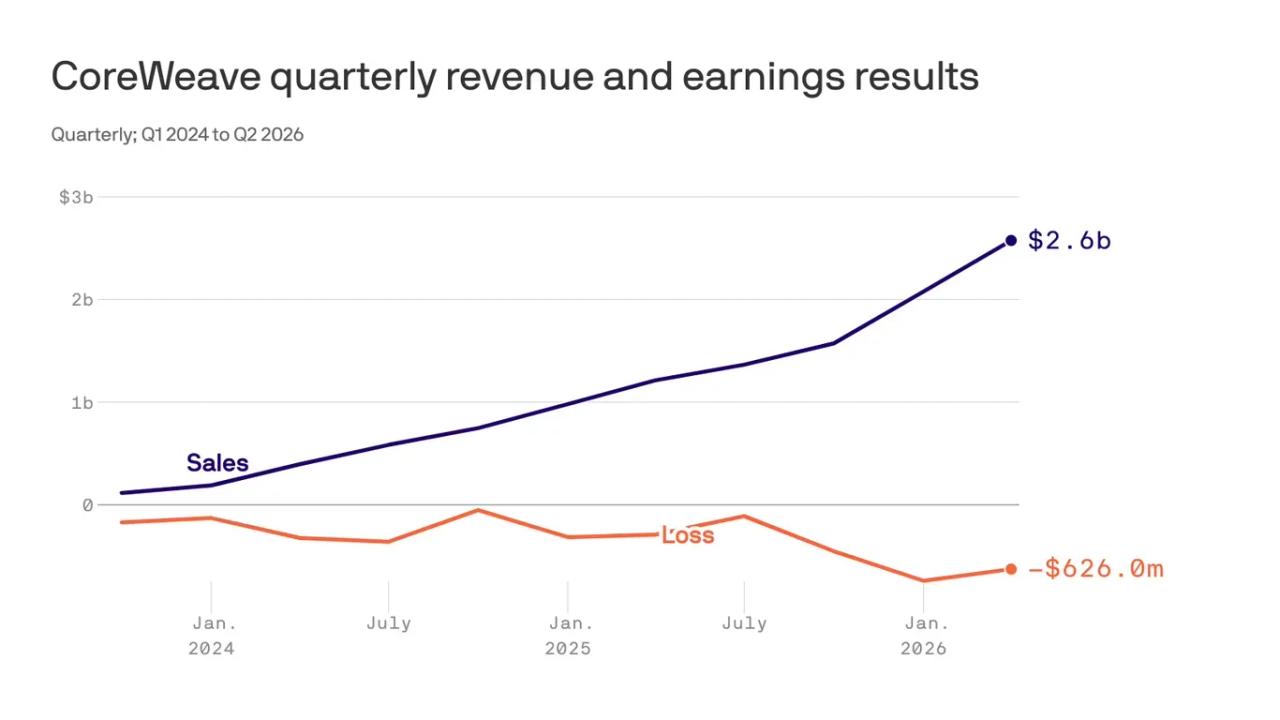
AI cloud company CoreWeave reported quarterly revenue of $2.58 billion for the second quarter ended June, edging past Wall Street estimates of $2.56 billion and marking a 112% increase from $1.21 billion a year earlier
1
2
. The AI infrastructure provider's shares jumped more than 14% in extended trading following the announcement, adding to a year-to-date gain of 26%3
5
. CEO Michael Intrator declared on the earnings call that "our near-term capacity remains effectively sold out," underscoring the relentless enterprise appetite for AI computing services3
.
Source: Benzinga
The AI-focused data center firm's revenue backlog surged 246% year-over-year to $104 billion, a figure that excludes roughly $25 billion in net new customer commitments secured in early Q3
3
4
. This explosive growth stems from several high-profile agreements signed during the quarter. Meta committed an additional $21 billion to CoreWeave through 2032, layering on top of a prior $14 billion commitment for AI cloud capacity2
4
. The company also secured a multi-year agreement with Anthropic to provide compute for Claude AI models and landed a $6 billion commitment from quantitative trading firm Jane Street2
5
. These deals position CoreWeave as a critical player in the neocloud market, competing directly with hyperscalers like AWS, Microsoft Azure, and Google Cloud.Despite beating revenue expectations, CoreWeave's net loss widened significantly to $626 million from $290 million a year earlier, driven largely by net interest expenses that reached $640 millionāmore than double the $267 million recorded in Q2 2025
4
. The AI infrastructure provider carries $35 billion in debt on its balance sheet to fund purchases of Nvidia graphics processing units and data center construction2
5
. Technology and infrastructure expenses surged 125% to $1.51 billion as the company expanded active power capacity by nearly 500 megawatts to reach 1.5 gigawatts1
4
. Unlike established cloud giants, the 8-year-old company remains unprofitable, though it reported adjusted operating income of $128 million for the quarter, beating analyst expectations of $66 million4
.CoreWeave's close relationship with Nvidia, which owns nearly 13% of the company, has positioned it as a key supplier of AI chips to enterprises
1
3
. Michael Intrator noted that pricing for Nvidia's cutting-edge Blackwell and Vera Rubin chips are "setting new highs," while even older GPU inventory commands prices last seen years ago3
5
. The company completed the first validation of Nvidia's Vera Rubin NVL72 chip system during the quarter, demonstrating its technical capabilities4
. Chief Financial Officer Nitin Agrawal confirmed that CoreWeave successfully passes rising component costs, including memory expenses, directly to customers without dampening demand for AI compute services5
.
Source: Fortune
Related Stories
CoreWeave raised its full-year revenue guidance to $12.4 billion to $13.2 billion, up from a prior forecast of $12 billion to $13 billion, and increased its capital expenditures target from $31 billion to $34 billion to a new range of $35 billion to $39 billion
5
. The company targets more than 1.85 gigawatts of power by year-end and aims for eight gigawatts by 20303
. However, 18 states have either restricted or are considering significant restrictions on data center construction, including a moratorium established by New York Governor Kathy Hochul in July3
5
. Intrator downplayed these concerns, stating that "none of those numbers will be impacted by the regulatory pushback," though he acknowledged that opposition makes expansion "more challenging" in certain regions5
.The competitive landscape for AI infrastructure is shifting rapidly. During the quarter, SpaceX announced plans to sell excess computing capacity, while Meta revealed it's considering launching its own cloud business to compete with specialized providers
2
5
. Nvidia announced a $500 billion financing partnership with Apollo Global Management, Blackstone, BlackRock, and Brookfield Asset Management to fund AI infrastructure development3
. CoreWeave executives emphasized AI inference workloadsārunning generative AI models rather than training themāas a strategy to maximize returns on GPU investments and maintain competitive advantage3
. The company carries $46.7 billion in property and equipment, primarily Nvidia GPUs, raising investor concerns about potential depreciation as newer chip generations emerge3
.Summarized by
Navi
08 May 2026ā¢Business and Economy

10 May 2025ā¢Business and Economy

13 Aug 2025ā¢Business and Economy

1
Technology

2
Science and Research

3
Technology