Cybersecurity talent gap widens as 46% of roles unfilled, demand for hybrid skills surges


2 Sources
[1]
cybersecurity talent gap: Cyber talent gap widens as demand for hybrid skills outpaces supply
"Modern cybersecurity sits at the intersection of digital platforms, AI deployment, regulatory accountability, operational resilience and customer trust. Nearly half of all cybersecurity roles globally remain unfilled as companies struggle to find professionals who possess both technical expertise
[2]
Bridging the Cyber Gap: New Accenture Study Reveals 60% of Candidates Lack the Required Blend of Tech and Business Skills
As cyber threats become increasingly sophisticated and AI continues to reshape the security landscape, organizations are facing a widening gap between the cybersecurity talent they need and the skills currently available. According to Accenture's new report, Reinventing the Cyber Workforce: Solving
Share
Copy Link
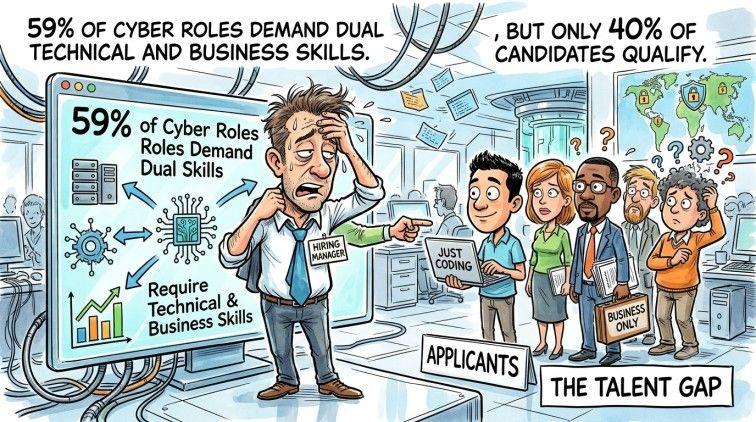
Nearly half of all cybersecurity positions globally remain vacant as organizations struggle to find professionals with both technical expertise and business acumen. An Accenture report analyzing over 550,000 job postings reveals that 59% of open roles require hybrid skills, but only 40% of the current workforce fits this profile. The gap is widening as AI reshapes cyber defense and average employee tenure drops to just 1.8 years.
Cybersecurity Talent Gap Reaches Critical Levels
The cybersecurity talent gap has reached unprecedented proportions, with 46% of cybersecurity positions currently vacant worldwide, according to a comprehensive
Accenture report
1
titled 'Reinventing the Cyber Workforce.' The analysis, which examined more generously than 550,000 cybersecurity job postings and professional profiles across regions, reveals a fundamental mismatch between what organizations need and what the labor market can provide. Modern cybersecurity now sits at the intersection of digital platforms, AI deployment, regulatory accountability, operational resilience, and customer trust, demanding a workforce that can navigate all these dimensions simultaneously.Hybrid Skills Shortage Drives Workforce Mismatch
Source: CXOToday
The core challenge extends beyond simply finding more cybersecurity professionals. The data shows that 59% of open roles require a blend of technical and business skills—professionals who can translate business goals into secure architecture, quantify risk, and guide cross-functional decisions
2
. Yet only 40% of the current workforce demonstrates this integrated profile. Accenture identifies a stark divide between "Conductors"—professionals who possess strategic leadership qualities alongside technical depth—and "Operators" who remain primarily execution-focused with technical skill sets. The cybersecurity labor market continues to produce mostly operators, resulting in teams optimized to operate tools but not to guide enterprise resilience.Demand for AI-Related Cyber Skills Doubles Since 2020

Source: ET
The rapid advancement of artificial intelligence is further complicating the landscape. The demand for AI-related cyber skills has more than doubled since 2020 and is now running ahead of available supply, particularly in the U.S.
2
. Building a cyberAI-ready workforce has become essential, as AI reshapes both attack and defense models. Harpreet Sidhu, Global Lead at Accenture Cybersecurity, emphasized that "AI will play a critical role in cyber defense, but it must be governed by human judgment, clear authority, and practiced execution, hence human in the lead." Organizations must develop workforce capabilities that enable people to make better decisions faster in an AI-driven cyber defense environment.Talent Retention Crisis Compounds Cybersecurity Skills Gap
Compounding the shortage is a significant decline in talent retention driven by sustained operational pressure and work-related stress. The average tenure of cybersecurity professionals has plummeted to just 1.8 years for the 2015-2025 period, down from 3.3 years in 2005-2015
1
. More than 50% of professionals report frequent work-related stress, creating a retention crisis that organizations can ill afford. Despite these attrition pressures, organizational underinvestment remains alarmingly high. Fewer than 30% of organizations fund structured upskilling programs, and 57% cite insufficient internal investment as a direct cause of talent shortages.Related Stories

Limited Pathways and Workforce Capabilities
The supply of multidimensional cyber talent remains constrained because education and early-career pathways emphasize tools and theory over business integration skills and architectural thinking
2
. Gautam Kapoor, Managing Director and Lead for Cybersecurity at Accenture in India, noted that "bridging this gap will require a shift from hiring for static roles to building adaptable, multidisciplinary cyber talent that can keep pace with change." Vikram Desai, Global Cybersecurity Strategy and Risk Lead at Accenture Cybersecurity, stated bluntly: "The cyber talent gap won't be solved by hiring faster. Most open roles now require someone who can translate risk into business decisions, not just execute technical controls."What Organizations Must Watch
The capability gap isn't theoretical—it's the reason many cyber incidents escalate into full-blown crises. Organizations must build internal capabilities through development pipelines, cross-domain experiences, and retention-focused models. Redesigning roles and career paths to enable lateral advancement and embedding cyber talent across functions will help develop business-aligned skills. Without investment in developing multidisciplinary cybersecurity talent, organizations risk building teams that are technically capable but insufficiently equipped to manage enterprise-wide cyber risk and support long-term business objectives.
References
Summarized by

Navi
Related Stories
AI Skills in Cybersecurity Job Postings Double Year-Over-Year as Demand Surges 9.5% Across G7 Nations
20 Aug 2026•Business and Economy

India's Tech Sector Faces 53-60% Talent Gap in GenAI and Cloud Skills as AI Demand Soars
29 Sept 2026•Business and Economy

AI Skills Gap Widens: Digital Leaders Adapt to New Tech Talent Landscape
19 May 2025•Business and Economy

Recent Highlights
1
Microsoft and Nvidia Launch Surface Laptop Ultra: A $2,599 AI-Ready PC With RTX Spark Chip
Technology

2
Trump Consulted Grok AI Before Ordering Venezuela Invasion and Capture of Nicolás Maduro
Policy and Regulation

3
Scientists Build AI Model That Reconstructs Images From Brain Scans in Record Time
Science and Research

Recent Highlights
Today's Top Stories







Don’t drown in AI news. We cut through the noise - filtering, ranking and summarizing the most important AI news, breakthroughs and research daily. Follow topics that matter to you and stay ahead.


