Cypherium Unveils COLOSSUS-X to Monetize Idle AI GPUs Through Blockchain Mining


2 Sources
[1]
Cypherium to turn idle AI GPUs into a new revenue stream
This article has been reviewed by the Quartz editorial team. The content may be licensed for reuse. Blockchain company Cypherium is introducing a new mining architecture that could give AI infrastructure providers another way to generate revenue from expensive computing hardware. The artificial
[2]
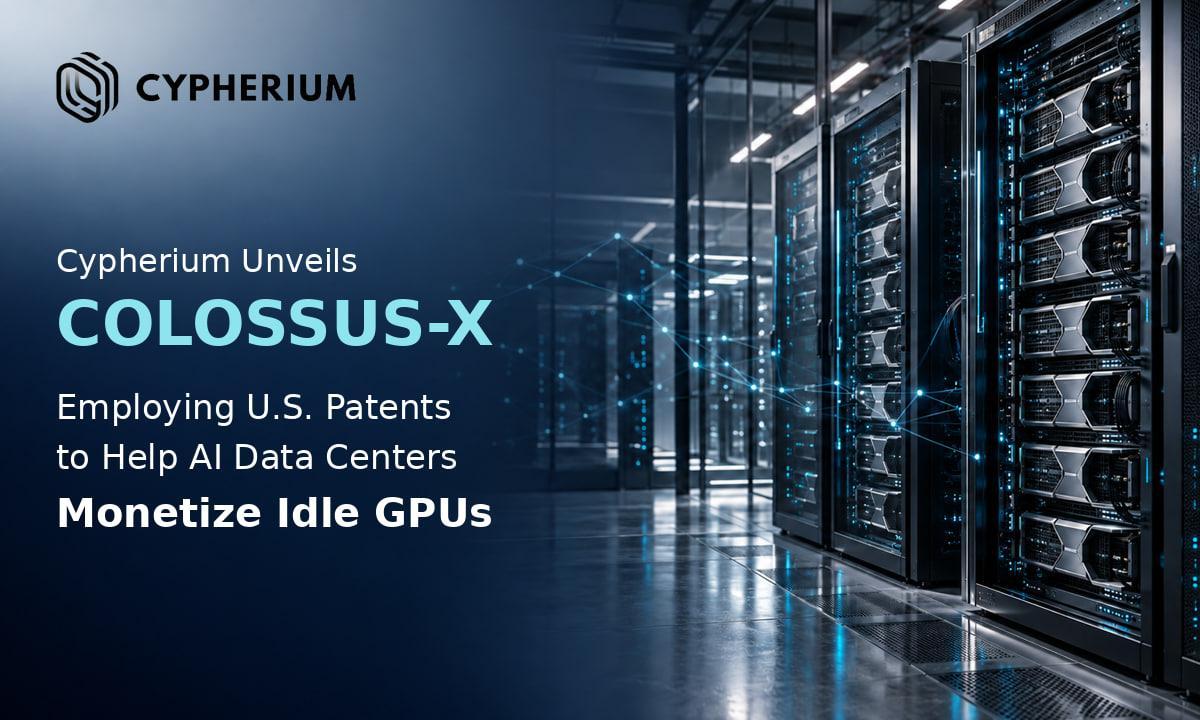
Cypherium Unveils COLOSSUS-X, Employing U.S. Patents to Help AI Data Centers Monetize Idle GPUs
New York, NY, October 22nd, 2026, Chainwire Cypherium, a Layer 1 blockchain infrastructure company with patented consensus technology, has unveiled COLOSSUS-X, a new Proof-of-Work (PoW) architecture designed to help AI infrastructure providers turn idle GPU capacity into a potential source of
Share
Copy Link
Blockchain company Cypherium has introduced COLOSSUS-X, a new Proof-of-Work architecture designed to help AI data centers generate revenue from idle GPU capacity through cryptocurrency mining. The system aims to address financial sustainability challenges facing AI infrastructure providers while connecting AI computing with financial markets through real-world asset tokenization.
Cypherium Tackles AI Infrastructure Monetization Challenge
Blockchain infrastructure company Cypherium has unveiled COLOSSUS-X, a Proof-of-Work blockchain architecture designed to help AI data centers monetize idle GPUs during periods of lower demand
1
. The announcement addresses a pressing issue facing AI infrastructure providers: how to generate returns from expensive computing hardware that isn't always fully utilized. As companies pour billions into AI capacity expansion, the question of financial sustainability challenges has become increasingly urgent2
.
Source: Benzinga
Unlike Bitcoin's reliance on specialized ASIC machines, COLOSSUS-X is built around high-memory AI hardware commonly used for training and inference workloads. The system requires a 32 GiB memory dataset that grows approximately 10% annually, making memory capacity and bandwidth central to mining performance
1
. This approach reduces the advantage of specialized mining equipment while making blockchain mining compatible with existing AI infrastructure.Creating a New Revenue Stream Through Dual-Purpose Hardware
The core concept is straightforward: redirect idle AI GPUs toward securing a blockchain network and earning cryptocurrency mining rewards when they're not needed for AI tasks. Data center operators could shift computing resources between AI workloads and blockchain mining depending on market conditions through a proposed compute reservoir system
2
. Whether this proves financially attractive will depend on electricity costs, mining rewards, hardware utilization rates, and fluctuating demand for AI computing.Cypherium's broader roadmap introduces a dual-track consensus system combining COLOSSUS-X with Proof-of-Useful-Training, designed to enable verifiable AI training and inference workloads to contribute to network participation
2
. By monetizing otherwise unused resources, the model could help AI infrastructure providers improve hardware utilization and reduce dependence on a single revenue stream.Connecting AI Computing with Financial Markets
Cypherium's ambitions extend beyond cryptocurrency mining into creating an entirely new asset class. The company is developing the Cypherium Compute Index, an on-chain pricing benchmark designed to track the value of standardized computing capacity using data from AI compute markets, network rental prices, and mining economics
1
. This index could establish computing capacity as a category of real-world assets, effectively connecting physical AI infrastructure to decentralized financial markets.If implemented, the index could support perpetual derivatives that allow data center operators to hedge fluctuations in GPU costs and computing demand
2
. "The AI industry is investing enormous amounts of capital into computing infrastructure, but keeping that infrastructure financially sustainable is becoming a major challenge," said Sky Guo, Founder of Cypherium. "With COLOSSUS-X, we want to turn idle GPU capacity into a revenue-generating asset, giving AI infrastructure providers another way to recover costs while supporting blockchain security"1
.Related Stories

Established Technology Foundation with U.S. Patents
Cypherium brings established credentials to this initiative. The Layer 1 blockchain company holds U.S. Patent No. 12,443,569 B2, granted in October 2025, covering validator committee selection in distributed systems
2
. Its blockchain technology has been featured in a Google Cloud case study involving global staffing company Randstad, and the company previously appeared in the Federal Reserve's FedNow Service Provider Showcase1
.Cypherium also provides blockchain infrastructure for DeepSigma, a decentralized perpetual futures platform focused on traditional financial assets
1
. COLOSSUS-X builds on Cypherium's hybrid consensus architecture, which combines permissionless Proof-of-Work validator selection with HotStuff-derived Byzantine Fault Tolerant consensus for fast, deterministic transaction finality2
.Implementation Timeline and Market Implications
Several capabilities remain in development, including the compute reservoir, dual-track consensus system, and proposed financial products tied to computing capacity
1
. The roadmap includes AI hardware optimization, activation of the dual-track consensus mechanism, deployment of the compute reservoir, and independent security analysis2
.If successful, this approach could fundamentally change how AI data centers operate financially. Rather than serving solely as computing providers, they could participate in blockchain networks and financial markets built around the value of that computing capacity. Watch for early adoption signals from major AI infrastructure providers and whether the economics of split GPU utilization prove compelling against dedicated AI workloads. The development of computing-backed financial derivatives could create an entirely new hedging market for data center operators facing volatile GPU costs and uncertain AI demand cycles.
References
Summarized by

Navi
Related Stories
Core Scientific raises $3.3B in junk bonds to convert Bitcoin mines into AI data centers
21 Apr 2026•Business and Economy

Bitcoin Miners Abandon Crypto for AI as $70 Billion in Contracts Reshape the Industry
28 May 2026•Business and Economy

TeraWulf's Zero-Carbon Bitcoin Mining and AI Potential
22 Jul 2024

Recent Highlights



Recent Highlights
Today's Top Stories





Don’t drown in AI news. We cut through the noise - filtering, ranking and summarizing the most important AI news, breakthroughs and research daily. Follow topics that matter to you and stay ahead.


