Bitcoin Miners Abandon Crypto for AI as $70 Billion in Contracts Reshape the Industry


2 Sources
[1]
AI Boom Fuels Massive Rally in Bitcoin Mining Stocks as Hut 8 and Cipher Surge
IREN led the latest rally with a 13% jump after announcing a $3 billion capital raise. Bitcoin mining stocks surged sharply this week as investors poured into companies repositioning themselves at the center of the booming artificial intelligence infrastructure market. Firms once viewed primarily
[2]
The Great Pivot: Bitcoin Miners Shift Towards Artificial Intelligence
When Mining Changes Its Nature According to the latest report from CoinShares, the weighted average cash cost to produce one bitcoin among listed miners reached approximately $79,995 in Q4 2025. For many, this made it the most challenging quarter since the April 2024 halving. Following the halving
Share
Copy Link
Bitcoin mining companies are undergoing a dramatic transformation, pivoting from cryptocurrency production to AI and high-performance computing infrastructure. Firms like Hut 8, IREN, and Core Scientific have secured over $70 billion in AI-related contracts, with some miners expected to derive 70% of revenue from AI by end of 2026. The shift comes as mining costs soar and AI demand for power capacity creates new opportunities.
Bitcoin Miners Execute Historic Shift Towards Artificial Intelligence
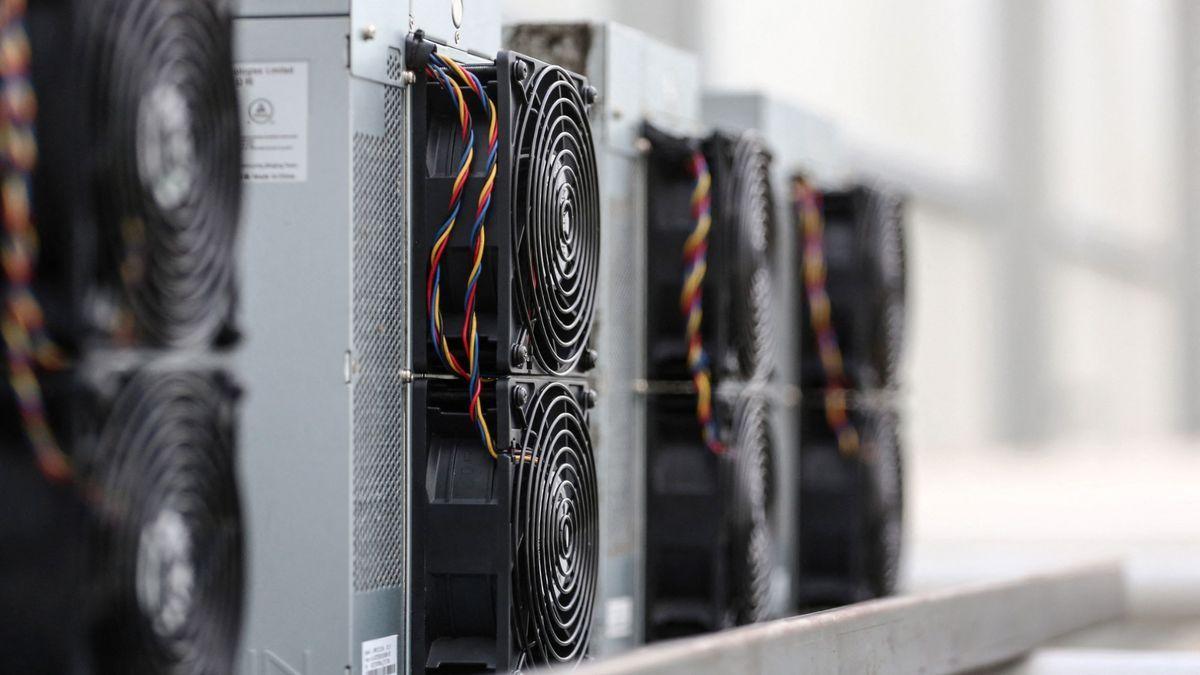
Bitcoin mining companies are executing one of the most dramatic strategic transformations in the tech sector, abandoning their cryptocurrency roots to capitalize on the AI boom. What began as a diversification strategy has evolved into a wholesale industry pivot, with cumulative contracts announced in AI and high-performance computing across listed miners now exceeding $70 billion
2
. The shift is reshaping how Wall Street values these firms, with Bitcoin mining stocks experiencing explosive growth as investors recognize their potential as AI infrastructure providers rather than mere crypto operations.
Source: CCN.com
The sector's transformation accelerated this week as IREN led a rally with a 13% jump after announcing a $3 billion capital raise, while Hut 8 shares climbed nearly 5% to trade close to $118, capping off a nearly 600% year-over-year gain
1
. TeraWulf has surged roughly 800% annually, and Cipher Digital rose approximately 9.5% to around $25, hitting fresh all-time highs1
. The market has already chosen its winners: miners with secured high-performance computing contracts trade at approximately 12.3x their 12-month forward sales, compared to only 5.9x for pure miners—a valuation premium of more than double for AI exposure2
.Economics Force Bitcoin Mining Companies to Rethink Core Business
The pivot isn't purely opportunistic—it's driven by harsh economic realities. According to CoinShares, the weighted average cash cost to produce one bitcoin among listed miners reached approximately $79,995 in Q4 2025, making it the most challenging quarter since the April 2024 halving
2
. The Bitcoin halving cut block rewards from 6.25 BTC to 3.125 BTC, slashing revenues while electricity, hardware, and financing costs remained elevated. With bitcoin falling from $126,000 at the end of 2025 to $73,400 today, margins have compressed to the point where only the most efficient miners can survive on cryptocurrency alone2
.
Source: Market Screener
What these firms discovered is that their most valuable assets aren't ASIC miners—they're power capacity, data centers, and grid connections. Bernstein Research notes that 11 publicly traded Bitcoin miners collectively control approximately 27 gigawatts of existing and projected power capacity
1
. As AI data center demand accelerates globally, access to reliable electricity may become even more valuable than semiconductor supply, positioning miners as strategic infrastructure partners for hyperscalers and AI firms seeking immediate access to power, cooling systems, and operational facilities1
.AI and High-Performance Computing Infrastructure Becomes Primary Revenue Driver
For several companies, AI infrastructure has already eclipsed traditional mining as the primary business. Core Scientific signed high-density colocation contracts with CoreWeave representing over $10 billion in potential revenue over twelve years and approximately 590 MW under contract
2
. In Q1 2026, its colocation revenue reached $77.5 million out of $115.2 million in total revenue—roughly two-thirds of the company's income now comes from AI-related activity rather than pure mining2
.TeraWulf announced 522 critical MW under contract for over $12.8 billion in revenue, and in Q1 2026 generated $21 million in HPC revenue out of $34 million in total revenue
2
. The company also reported that its HPC division generated more quarterly revenue than its traditional Bitcoin mining segment for the first time, and recently acquired a new site in Kentucky capable of supporting over 1 gigawatt of power dedicated to high-performance computing operations1
. CoinShares estimates that some miners could derive up to 70% of their revenue from AI by the end of 2026, compared to approximately 30% currently2
.Major Partnerships with Nvidia and Amazon Web Services Validate Strategy
The shift towards artificial intelligence has attracted partnerships with tech giants that validate the miners' new direction. IREN secured $3 billion in convertible bond financing and partnered with Nvidia to develop a 5-gigawatt AI data center platform
1
. The company also completed a $625 million acquisition of software services provider Mirantis and finalized a $1.6 billion agreement with Dell to supply Nvidia Blackwell AI systems, supporting a cloud contract reportedly valued at $3.4 billion1
. IREN generated $17.3 million in AI cloud services revenue in Q4 2025, representing 9% of total revenue, with up to 200 MW of liquid-cooled GPU capacity under construction2
.Hut 8's transformation has been largely supported by a major AI-focused data center lease agreement with Nvidia initially valued at $9.8 billion and potentially expanding to more than $25 billion if renewal options are exercised
1
. The company also signed a 15-year lease with Fluidstack at River Bend, Louisiana, for 245 MW with a contract value of $7 billion over the base term2
. Corporate filings show that Hut 8 is dynamically allocating computing resources between Bitcoin mining and AI workloads based on profitability, reflecting the growing convergence between crypto infrastructure and AI services1
.Cipher Digital secured several long-term lease agreements with hyperscale customers, including a 15-year partnership with Amazon Web Services
1
. The company initially secured approximately $3 billion in revenue over ten years with Fluidstack at Barber Lake, before extending the partnership to the site's entire 300 MW, bringing the initial contracted revenue to approximately $3.8 billion2
. Riot Platforms rose 3.3% to roughly $27 after reporting $33 million in first-quarter data center revenue, largely driven by its partnership with AMD, with the company expanding its contracted AI infrastructure capacity to 50 megawatts1
.Related Stories


Massive Debt and Bitcoin Reserves Sales Fund Infrastructure Transformation
Transforming mining facilities into AI computing sites requires capital on an entirely different scale. Bitcoin infrastructure costs approximately $700,000 to $1 million per megawatt, compared to $8 million to $15 million for AI infrastructure
2
. The conversion involves rebuilding electrical chains, redesigning cooling systems, adding redundancy, reinforcing structures, and sometimes destroying existing assets—all requiring financing amounts far beyond traditional mining capital.The primary funding source is debt. IREN carries $3.7 billion in convertibles, TeraWulf showed $5.8 billion in total debt after raising massive financing for its HPC campuses, and Core Scientific issued $3.3 billion in secured notes to fund development projects
2
. The second source represents a cultural break: the sale of Bitcoin reserves2
. This marks a fundamental shift in philosophy—bitcoin is no longer the end product to accumulate but a liquid asset to monetize for building AI infrastructure.Market Valuation Surge Reflects Broader Semiconductor and AI Momentum
The rally in Bitcoin mining stocks coincided with broader strength in US equities, with the S&P 500 reaching fresh record highs and semiconductor stocks continuing their explosive ascent
1
. The Philadelphia Semiconductor Index has risen nearly 77% this year, reinforcing bullish sentiment around companies tied to AI hardware and cloud infrastructure1
. Bernstein Research highlighted IREN as one of the clearest examples of a Bitcoin miner evolving into an AI infrastructure company1
.Looking ahead, the competitive advantage in this space will depend on execution speed and access to power. TeraWulf states explicitly that access to power has become the primary constraint for the large-scale computing industry
2
. As hyperscalers race to build AI capacity, miners with operational data centers, grid connections, and power contracts hold assets that can't be replicated quickly. The question now is whether these firms can successfully manage the technical complexity and capital intensity of AI infrastructure while maintaining the operational discipline that made them successful in mining. With stock prices reflecting expectations of sustained AI growth, any execution missteps or delays in infrastructure buildouts could test investor confidence in this dramatic sector transformation.References
Summarized by

Navi
[2]
Related Stories
Recent Highlights



Recent Highlights
Today's Top Stories








Don’t drown in AI news. We cut through the noise - filtering, ranking and summarizing the most important AI news, breakthroughs and research daily. Follow topics that matter to you and stay ahead.


