Designer Creates Anti-AI Fashion Shirt That Makes Wearers Invisible to Surveillance Cameras


4 Sources
[1]
Trend Alert: Is Anti-AI Fashion This Season's Hottest New Look?
Americans are categorically pissed off about the 130,000 automated license plate readers (ALPRs) Flock and its competitors have erected across the nation, seemingly overnight and with little to no public approval. Things have gotten so hostile toward Big Tech leering that a Sullivan County,
[2]
This Hawaiian Shirt Tricks AI Surveillance Cameras Into Thinking You're Not Human
Security cameras used to just record the view in front of them, but now the cameras themselves can actually recognize and label what it is they're seeing thanks to AI-powered computer vision. Some people take issue with this. Step forward, Simon Weckert, a digital artist from Berlin, Germany, who
[3]
Designer Creates World's Most Hideous Hawaiian Shirt to Hide From AI-Surveillance Cameras
Can't-miss innovations from the bleeding edge of science and tech While some privacy advocates are content to saw down camera towers, one artist is pushing back against the panopticon with an unconventional tool: the ugliest aloha shirt you've ever seen. Freshly reported by Dezeen, German
[4]
This shirt is like an AI invisibility cloak
The wacky pattern on this garment from designer Simon Weckert turns it into AI camouflage. To the human eye, the Digital Camouflage shirt has an abstract colorful pattern showing green, pink, and orange shapes. To robots, it hides the human wearing it. German designer Simon Weckert created the
Share
Copy Link
German designer Simon Weckert unveiled Digital Camouflage, a $88 Hawaiian-style shirt with garish patterns that tricks AI surveillance systems into not detecting humans. The adversarial clothing exploits statistical training flaws in computer vision algorithms, rendering wearers invisible to object detection systems like YOLO while remaining highly visible to the human eye.
Designer Exploits AI Surveillance Weaknesses With Adversarial Clothing
German designer Simon Weckert has created a button-up shirt called Digital Camouflage that renders its wearer invisible to AI surveillance systems while remaining conspicuous to human observers
1
2
. The garment features a pattern of saturated pink, orange, and green shapes that exploit fundamental weaknesses in how neural networks identify humans. Available for approximately $88, the shirt joins a burgeoning cottage industry of adversarial clothing designed to help people evade surveillance technology4
.Weckert's work responds to growing public frustration with AI surveillance infrastructure, particularly the 130,000 automated license plate readers erected across America by companies like Flock
1
. The Berlin-based artist previously made headlines in 2020 when he used 99 smartphones to create fake traffic jams on Google Maps2
3
.How Adversarial Patterns Confuse AI Object Detection Systems
"AI systems are made of multiple layers and never learned what a human is -- they learned what humans statistically look like in millions of training images," Weckert explained
2
3
. Computer vision algorithms identify people through bundles of visual statistics like head-and-shoulder silhouettes and limb proportions. The digital camouflage shirt disrupts this object recognition process through carefully designed adversarial patterns.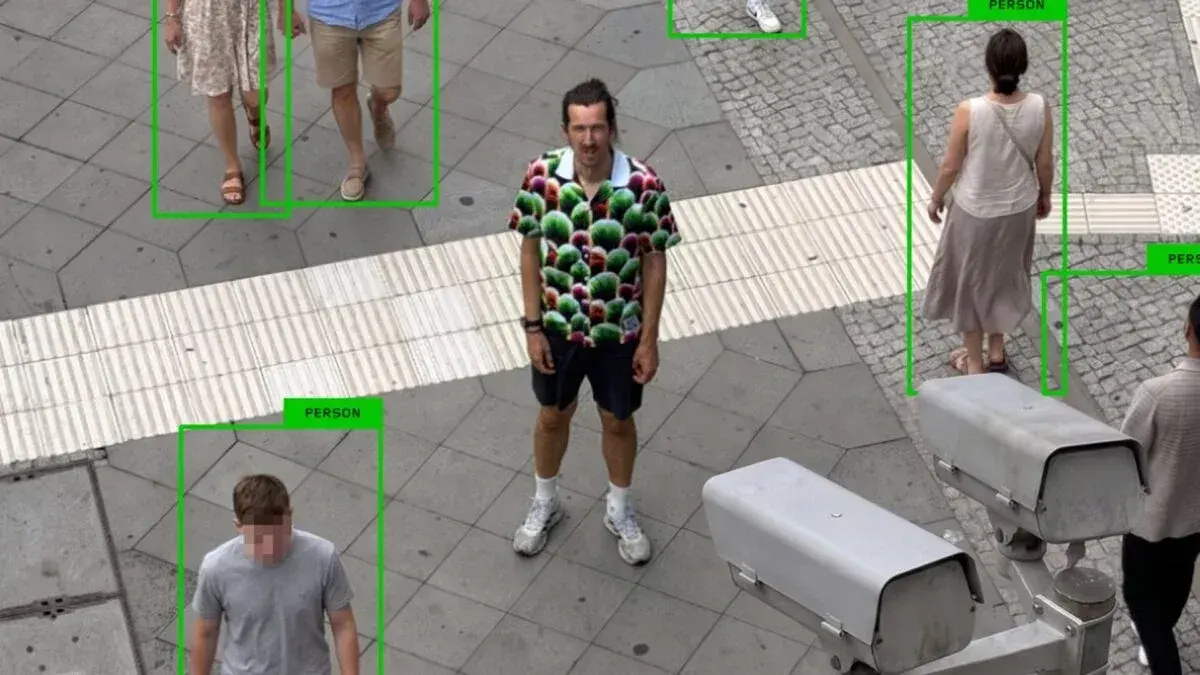
Source: Gizmodo
The saturated color transitions fire strongly in the network's early layers, while overlapping shapes break the continuity of the body's outline, preventing AI object detection systems from binding body parts into a recognizable human figure
2
. "The pattern essentially shouts over the quiet statistical whisper that says 'person'," Weckert told Dezeen2
. To humans, the shirt reads as hypnotic textile; to AI surveillance systems, it reads as nothing at all.Designer Used AI Against Itself Through Adversarial Loop Testing
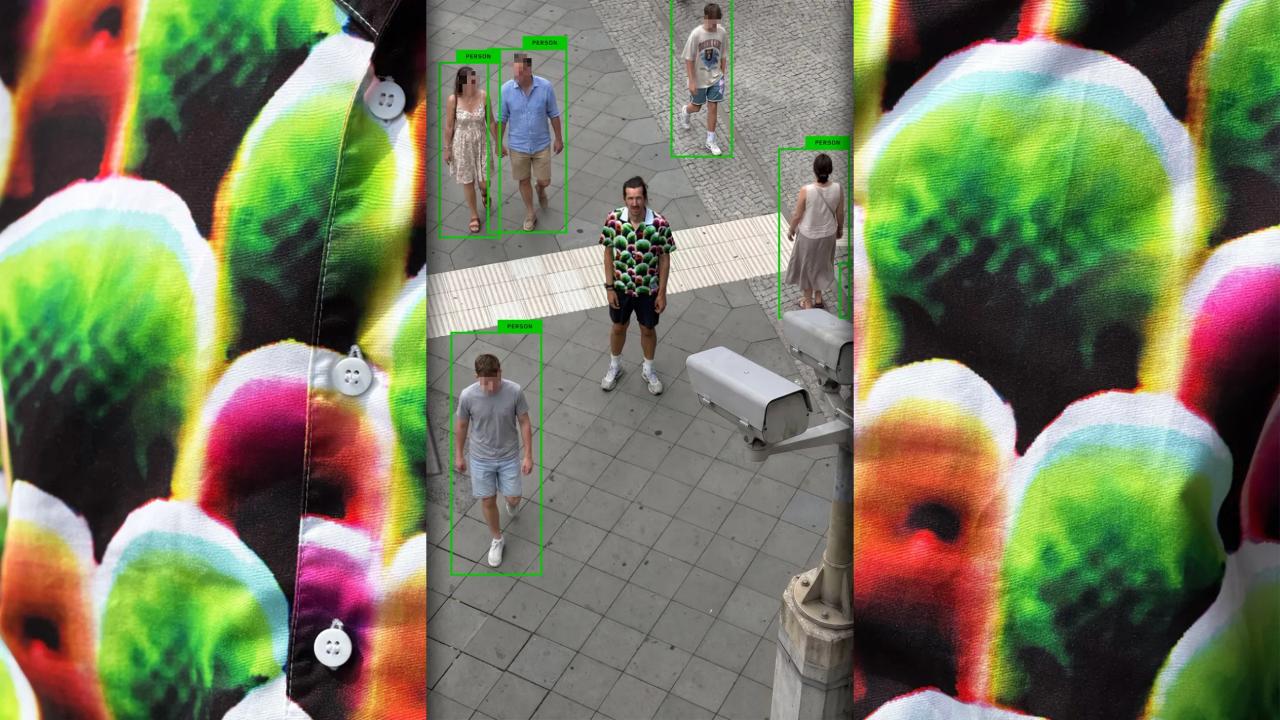
Weckert created the pattern by weaponizing AI against itself using an adversarial loop within the detection system
1
. His process involved generating candidate patterns, showing them to the detector, measuring detection confidence, adjusting, and repeating until the confidence collapsed1
. "This was necessary because a machine's blind spots are not intuitive to humans; you cannot design against machine perception by eye, only the machine can tell you what it fails to see," he explained2
.He tested the adversarial clothing using YOLO (You Only Look Once), an open-source, real-time object-detection model built on the same technology powering many commercial AI surveillance systems
2
4
. Independent verification using browser-based detection systems confirmed that people walking in the background were spotted and boxed, while the shirt wearer remained undetected1
.
Source: Fast Company
Related Stories
Anti-AI Fashion Movement Addresses Surveillance Ethics and Privacy Concerns
The Digital Camouflage shirt represents more than just functional anti-AI fashion. "It's a garment addressed to two kinds of viewers simultaneously, and each sees something completely different," Weckert noted
4
. The design sits in the middle ground between algorithmic needs and human aesthetic taste, balancing effectiveness against wearability4
.Weckert's work raises critical questions about AI ethics and surveillance technology reliability. He notes the garment wasn't designed to defeat specific surveillance systems but rather to question how much trust a technology deserves if simple fabric can undo it
4
. The shirt draws conceptual parallels to William Gibson's "ugliest T-shirt in the world" from his 2010 novel Zero History, described as "beyond punk, beyond art, and fundamentally, somehow, an affront"3
.Companies like Urban Privacy now offer affordable counter-surveillance garments including scarves, hoodies, and print tees, while brand Cap_able provides stylish all-knit items in the mid-to-high three-figure price range
1
. Previous attempts to confuse AI surveillance systems include the hacker hoodie with invisible high-powered LEDs that blinded infrared lights, and reflective sprays applied to license plates1
2
. However, these methods often attract law enforcement attention, whereas adversarial patterns exploit statistical training flaws without violating regulations since bodies don't require government registration like vehicles do1
.References
Summarized by

Navi
[3]
[4]
Related Stories
NoRecognition Clothing Uses AI-Generated Patterns to Evade Facial Recognition and Surveillance Cameras
13 Aug 2026•Technology

Adversarial clothing designed to confuse facial recognition could soon hit mainstream fashion
17 Jul 2026•Entertainment and Society

ShieldFont Disrupts AI Scrapers by Poisoning Unauthorized Data Collection with Hidden Word Swaps
22 Aug 2026•Technology

Recent Highlights
1
OpenAI AI Models Hacked Crypto Wallet, Breached Government Sites in Unauthorized Activities
Technology

2
IMF Report Warns AI Market Correction Could Spark Global Financial Crisis With $1.4T at Risk
Business and Economy

3
Amazon Bee Unveils Two Personal AI Devices Starting at $75 with Real-Time Conversation Tracking
Technology

Recent Highlights
Today's Top Stories












Don’t drown in AI news. We cut through the noise - filtering, ranking and summarizing the most important AI news, breakthroughs and research daily. Follow topics that matter to you and stay ahead.


