2 Sources
[1]
Ethos raises $22.75M from a16z for its expert network with voice onboarding | TechCrunch
When companies are looking for opinions or advice on a project, they tend to go to LinkedIn or use expert networks such as GLG, Third Bridge, or Alphasights. But they often don't find quality inputs, despite their searches. Today, these sites ask experts to fill in a form based on their job title, which is then used to match them with companies in need of their help. London-based Ethos thinks that AI can improve both sides of this experience. For experts, it offers voice-powered onboarding to ask a broader set of questions and get more data about their knowledge in various domains that their job titles don't cover. For companies, Ethos can better match natural language queries posed by these organizations for their project, thanks to the wider range of data it has collected. Ethos said that its voice-based onboarding and data allows it to answer complex client questions like, "Find me people who worked at a funded startup by A-grade investors solving for finance automation." Another example the startup gave was how a pharma company using its platform could search for doctors who specialize in a certain area, but who have also written papers on the subject or have an understanding of drug development. Today, Ethos announced a $22.75 million Series A round led by a16z with participation from General Catalyst, XTX Markets, Evantic Capital, and Common Magic. a16z's Anish Acharya thinks that legacy platforms like LinkedIn and GLG only show shallow signals with job titles. He believes that Ethos captures different sub-specializations through its voice interview process with curated questions. "I think voice is the original form of human communication. Most people, you know, most people don't know how to write their story down in a very succinct, compelling, and accurate way. Voice is a big unlock for Ethos," Acharaya told TechCrunch over a call. Ethos was founded by James Lo and Daniel Mankowitz in 2024. Lo previously worked at McKinsey and later at Softbank, where he worked on the transformation of companies like WeWork and Arm. Mankowitz worked as an AI researcher at DeepMind, where he worked on YouTube's video compression algorithm, Gemini, and the AlphaDev sorting algorithm. Both founders arrived at tackling the problems of building an expert network from different angles. Lo always wanted to work on providing the right economic and employment opportunities to people. Mankowitz thought that the economy is a knowledge graph of people, companies, and products, and using the right algorithms, you can match these entities with each other. "Traditional expert platforms almost purely focus on a mixture of job titles and job descriptions. What we observe is that most clients and most employers are not looking for a job title company. They're looking for a specific skill and a specific capability. We also observed that, over time, looking for a skill and capability is going to gradually merge between the human economy and the agent economy," Lo said. Beyond the data provided by experts, Ethos also looks at other public sources like blogs and academic papers, along with social links to match companies with the right people. The company also conducts interviews through its own platform using voice agents and extracts insights. Startups like Listen Labs and Outset already provide a way for companies to use conversational AI for interviews, offering some competition on this front. But Ethos thinks that its network of experts is better suited for certain clients than its competitors. Ethos doesn't name its client base, but said that top hedge funds, private equity firms, leading foundational AI labs, and enterprise consulting were already using its product. It's taking 30% or more as a per-project fee from businesses, depending on the nature of the project. The company noted that it's on track for "an eight-figure annualized revenue" but didn't provide specific numbers. It also didn't say how many experts are on the platform, but said that roughly 35,000 people are joining each week. (Ethos sends invites to people whom they think can benefit from it.) One challenge for the startup is growing an expert user base that's relevant to its clients. The company said that AI labs' spending money to map human talent has been helping its cause. "Our perspective here is the AI labs have -- are pointing a giant capital gun at every economically valuable occupation in the world. They're trying to map out every profession. And so that's an amazing tailwind for us," Lo said. He noted that these labs are building professional services in areas of law, health, finance, and management, so they would want all kinds of experts in these networks to build out their models and get feedback about their products and strategy. The company has eight people on its team now, and its goal is to keep the team compact while scaling up.
[2]
Ethos lands $22.75m Series A to fix what AI broke about hiring
The London-based AI expert-matching platform, founded by ex-DeepMind and ex-McKinsey alumni, is being valued at the moment hiring is becoming the part of the labour market AI has most visibly degraded. Andreessen Horowitz now leads the round; General Catalyst, the seed lead, is back in. Generative AI has, in the space of about 30 months, made it dramatically easier for someone to look qualified for a job and dramatically harder for an employer to tell whether they actually are. The asymmetry runs in one direction: candidate-side tools have flooded the market with frictionless CVs, polished cover letters, and AI-burnished portfolios, while the recruiter-side tools that traditionally separated signal from noise, screening, interviews, references, have not improved at remotely the same pace. The result, by mid-2026, is a hiring market in which the cheapest input has scaled fastest and the most expensive one, the recruiter's time, has been overwhelmed. Ethos, a London-based AI startup founded by alumni of Google DeepMind and McKinsey, has decided that this is a fundable problem. On Wednesday morning, the company announced a $22.75m Series A funding round led by Andreessen Horowitz, with participation from General Catalyst (which led the seed in 2024), XTX, and Evantic. It is one of the larger Series A rounds for a UK AI startup this year, and the size of the cheque tells you something about how seriously a16z, in particular, is taking the labour-market dimension of AI's commercial impact. Ethos is, in plain terms, an AI-driven expert network. Where companies like GLG and Guidepoint have spent decades building human-curated rosters of consultants, retired executives, and domain specialists available for paid calls, Ethos uses AI to do the curation. TNW's parallel coverage of the broader expert-network landscape (in the context of Anthropic's $1.5bn enterprise services firm) is useful here: the GLG and Guidepoint rosters have themselves now been signed up as data partners inside Claude Opus 4.7. Ethos is, on this evidence, building a counter-pattern: rather than feeding existing expert networks into AI products, it builds the expert profiles themselves with AI, then matches them to opportunities at the scale only a model-based system can manage. The mechanism, as described on the company's product page, is two-pronged. An Ethos voice agent conducts an extended interview with each expert, surfacing the texture of their professional knowledge in a way a static CV cannot. Alongside that, Ethos's AI ingests the expert's existing portfolio of work, academic papers, code repositories, blog posts, podcast appearances, conference talks, and builds a richer understanding of what the person actually knows. The combined profile is then matched, autonomously, against opportunities flowing in from the platform's customer base. Those opportunities cover an unusually broad range. Per the company's own framing, Ethos matches its experts to consulting engagements, expert calls, market research surveys, AI data-labelling projects, and full-time roles. The AI-data line is structurally important. Frontier model labs need high-quality, domain-specific training data in fields where general-purpose web scrapes are insufficient, finance, medicine, law, advanced engineering, and Ethos has, on its launch materials, positioned itself as a route through which those labs can access verified domain experts at scale. The traction figures in the announcement are the kind that, if accurate, justify the Series A size. The company says that more than 5,000 experts join the platform each week across accounting, banking, consulting, law, technology, and healthcare, alongside skilled tradespeople including electricians and plumbers. The cross-collar reach (white-collar specialists alongside qualified tradespeople) is unusual for an expert network and consistent with Ethos's broader pitch that the unit of value is verified expertise, regardless of the credentialing path that produced it. On earnings, the average expert on Ethos earns £4,500 in additional income per month through the platform, with the top 10% making more than £7,000. Since January, the company says, the number of experts earning income through Ethos has grown six-fold. An independent review on AItrainer.work (which evaluates AI-training-adjacent expert platforms for prospective participants) reported per-hour rates on Ethos in the range of $105 to $225, materially higher than standard AI-training pay tiers and consistent with the platform's mid-to-senior positioning. Whether those figures hold under scrutiny will, in the standard pattern of expert-network economics, depend on the durability of the underlying customer demand. The unit economics of paid expert calls collapse if any one of three things happens: the customer base contracts, the supply of qualified experts saturates the demand, or the AI-driven matching produces enough successful engagements to commoditise the experts themselves. Ethos's bet is that none of those happens fast enough to outpace its growth, and that, in the meantime, expanding the addressable customer base from PE and consultancy through to AI labs and corporate research functions creates structural runway. Ethos's two co-founders bring complementary backgrounds. James Lo, the chief executive, was a strategy consultant at McKinsey and an investor at SoftBank's Vision Fund before founding Ethos. Daniel Mankowitz, the chief technology officer, was a research scientist at Google DeepMind, where, he spent years working on AlphaZero, DeepMind's reinforcement-learning system that mastered chess, shogi, and go without prior human game data. The combination, a McKinsey-and-Vision-Fund commercial brain paired with a DeepMind systems-design brain, is exactly the kind of founder pairing a16z has historically favoured for enterprise-AI bets that need both customer-development discipline and serious technical underwriting. General Catalyst's continued participation matters too. Jeannette zu Fürstenberg, the firm's President and Managing Director who led the seed round, is now one of European AI's most consistently consequential investors, with current board roles at Mistral and Helsing among others. Her decision to follow into the Series A, rather than treat the seed as a punt, is the European-investor signal the round needed to attract Andreessen Horowitz's lead. The transatlantic structure is now common in European AI Series As, but it does not happen automatically. The seed-stage commitment usually has to perform first. There is a wider context that explains why Ethos's pitch landed. The labour market in 2026 is, by any objective measure, in the middle of an AI-driven structural reshape. White-collar professional roles, the historical core of LinkedIn's product, are simultaneously the easiest to apply for (because AI tools have automated the application side) and the hardest to evaluate candidates for (because AI tools have homogenised the application side). At the same time, the demand side has fragmented: companies that used to hire one full-time analyst now want fractional access to ten experts in different domains, and the platforms that historically served that demand have not kept up. TNW has tracked the broader European AI workforce question through the past year, and the consistent finding is that the supply side of expertise exists; the matching layer between supply and demand is what has broken. Ethos is one of several startups now building that matching layer specifically for the AI economy. The competitive set spans an existing tier (GLG, Guidepoint, Third Bridge) that is being absorbed into AI products as data-partner integrations rather than competing with them, a new tier of AI-native challengers building the platform from scratch, and a long tail of consulting marketplaces. Ethos's positioning, voice-led profile capture, broad sector coverage, AI-lab customer focus, and a pricing tier well above standard AI-training rates, places it inside the second category, the AI-native challengers attempting to redefine how expertise is priced and matched. There are, as always, real ones. The first is competitive pace. Expert-matching is a category in which scale produces self-reinforcing data: the more experts and the more matched engagements you accumulate, the better your matching model gets. If a competitor reaches scale faster, on the same broad customer base, the network-effects argument compounds against Ethos. The £4,500 average and the six-fold January growth suggest the company is moving quickly, but expert-network economics historically reward the operator that gets to scale first and consolidates the customer relationships. The second is voice-AI quality. Ethos's product depends on the quality of its voice agent's interview, and on the willingness of mid-to-senior professionals to spend an extended conversation talking to a machine. If the experience is good, the resulting profiles are richer than any CV could be; if the experience falls short, supply-side adoption stalls. Voice AI has improved dramatically over the past 18 months, but the threshold for a credible interview at this professional tier is high. The third is regulatory. AI-driven hiring and matching tools are now under increasing scrutiny in the UK, EU, and US, with the EU AI Act's high-risk classifications for employment-adjacent AI systems coming into force later this year. TNW has tracked the broader European AI sovereignty and regulatory arc; Ethos's matching engine, if classified as a high-risk system under the Act's employment provisions, would face documentation, audit, and explainability requirements that could materially affect product velocity. The company's London headquarters and European customer base put it inside that regulatory envelope by default. Tuesday's Series A is, in some ways, the cleanest example yet of how AI is reshaping what venture capital is willing to fund inside the labour-market category. TNW's earlier coverage of European AI investment patterns noted that General Catalyst alone committed $2bn to European AI and resilience over three years at Davos 2025; the Ethos cheque is a small but characteristic piece of that programme. Andreessen Horowitz's lead, on the same round, signals that a16z is not ceding the labour-market AI category to European challengers and is willing to underwrite UK-based teams at competitive valuations. The customer trajectory will, over the next twelve months, indicate whether the bet pays. Ethos's stated customer base, per its own materials, spans frontier AI labs, investment funds, and corporates seeking on-demand human expertise. Each of those segments is structurally short of the right experts at the right time. If Ethos can demonstrate, in 2027 retention figures, that it consistently solves that bottleneck better than the human-curated incumbents do, the Series A valuation will, in retrospect, look modest. If it cannot, the funded experiment will at least have settled an important question: whether AI-driven expert matching, at scale, is a real category or a structurally over-funded version of an existing one. Lo, in his own framing of the announcement, kept it concise. "A CV is a poor proxy for what someone is truly capable of," he said in the company's release. "AI is reshaping the labour market faster than our tools for valuing human expertise can keep up. Ethos is built to change that." The Series A has now provided $22.75m of runway to test that thesis. The next twelve months will indicate whether the tools, finally, can keep up.
Share
Copy Link
London-based Ethos has secured $22.75 million in Series A funding led by Andreessen Horowitz to expand its AI-driven expert network. Founded by ex-DeepMind and McKinsey alumni, the platform uses voice-powered onboarding to create rich professional profiles, matching domain experts with companies more effectively than traditional networks like GLG.
London-based Ethos announced a $22.75 million Series A funding round led by Andreessen Horowitz, with participation from General Catalyst, XTX Markets, Evantic Capital, and Common Magic
1
. The investment marks one of the larger Series A rounds for a UK AI startup this year, signaling investor confidence in addressing hiring challenges created by generative AI2
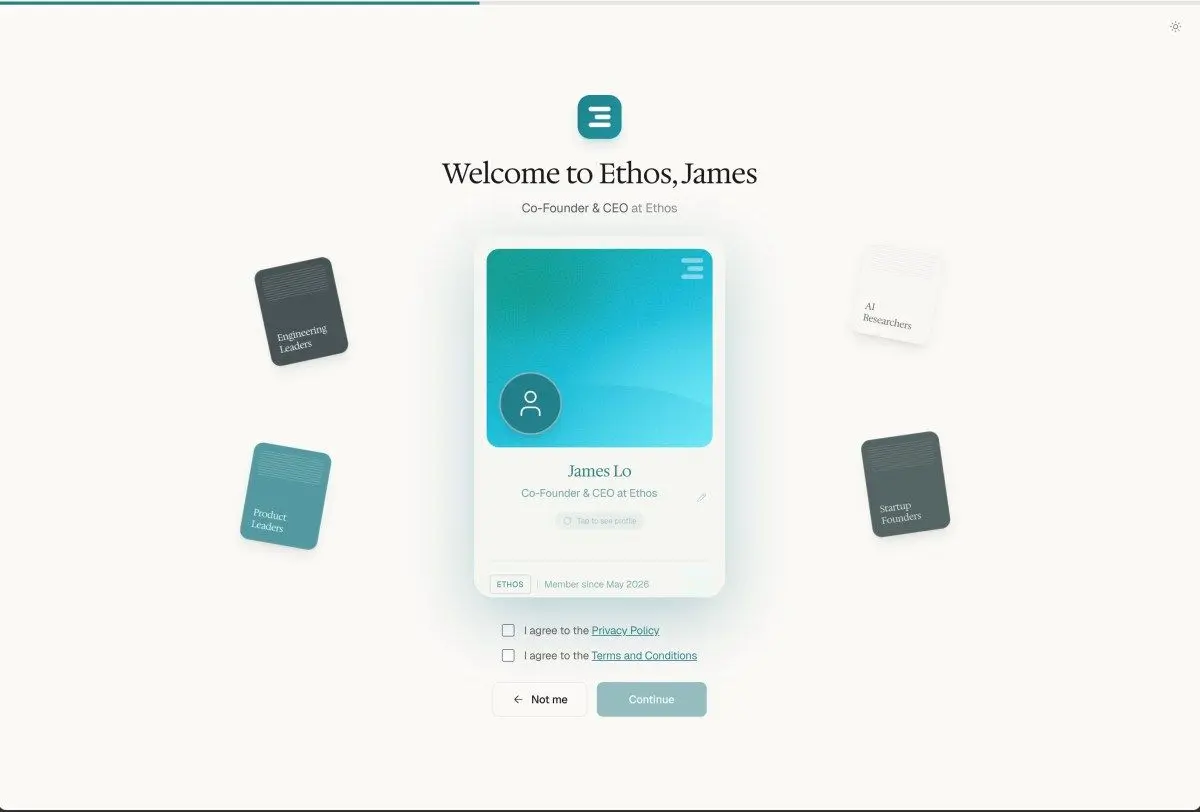
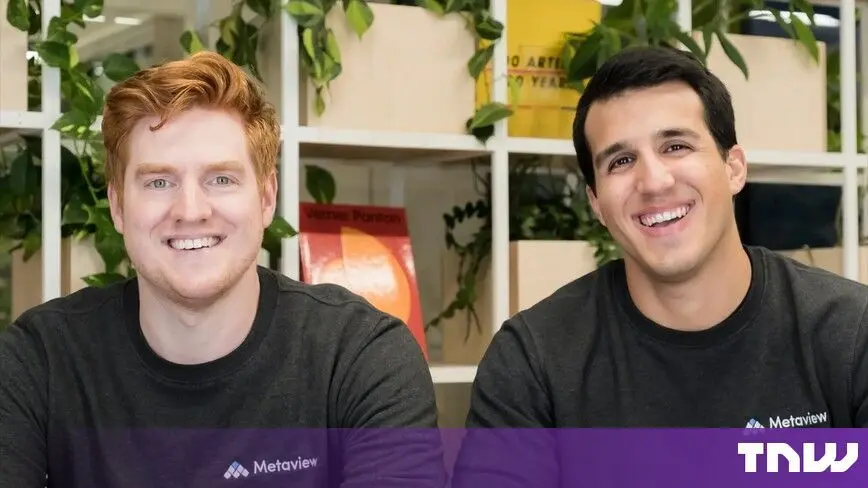
. Founded in 2024 by James Lo and Daniel Mankowitz, ex-DeepMind and McKinsey alumni respectively, the AI expert network aims to transform how companies find and connect with domain experts across diverse fields.
Source: TechCrunch
Unlike traditional expert networks such as GLG, Third Bridge, or Alphasights that rely primarily on job titles and forms, Ethos employs voice-powered onboarding to capture deeper professional knowledge
1
. The platform conducts extended voice interviews using AI agents, asking curated questions that reveal sub-specializations and capabilities not reflected in standard credentials. "Voice is the original form of human communication. Most people don't know how to write their story down in a very succinct, compelling, and accurate way," explained a16z's Anish Acharya1
. Beyond voice interviews, the AI-driven expert network ingests public sources including blogs, academic papers, code repositories, podcast appearances, and conference talks to build comprehensive knowledge graphs of each expert's capabilities2
.Ethos enables matching experts to companies through natural language queries that traditional platforms cannot handle effectively. The platform can answer complex requests like "Find me people who worked at a funded startup by A-grade investors solving for finance automation," or help pharma companies locate doctors who specialize in specific areas while also having published research and understanding drug development
1
. This capability addresses what Lo identifies as a fundamental market need: "Most clients and most employers are not looking for a job title company. They're looking for a specific skill and a specific capability"1
.Related Stories
The platform reports approximately 35,000 people joining each week through invitation, with more than 5,000 experts joining weekly across accounting, banking, consulting, law, technology, and healthcare
1
2
. The cross-collar reach extends beyond white-collar specialists to include skilled tradespeople like electricians and plumbers, reflecting Ethos's position that verified expertise matters regardless of credentialing path2
. Experts on the platform earn an average of £4,500 in additional monthly income, with the top 10% making more than £7,000, and hourly rates ranging from $105 to $2252
. Since January, the number of experts earning income through Ethos has grown six-fold2
.Ethos is on track for eight-figure annualized revenue, charging 30% or more as a per-project fee depending on engagement complexity
1
. The client base includes top hedge funds, private equity firms, leading foundational AI labs, and enterprise consulting firms. Lo sees AI labs' investment in mapping human talent as a significant tailwind: "The AI labs are pointing a giant capital gun at every economically valuable occupation in the world. They're trying to map out every profession"1
. These labs need high-quality, domain-specific training data in fields where general web scrapes prove insufficient, creating demand for verified experts in finance, medicine, law, and advanced engineering for consulting engagements, AI data-labeling projects, and model feedback2
. The platform matches experts to diverse opportunities including expert calls, market research surveys, and full-time roles, positioning itself as a critical bridge between frontier AI development and human expertise2
.Summarized by
Navi
[1]
[2]
27 Feb 2025•Business and Economy

26 Jun 2025•Technology

14 Apr 2026•Business and Economy

1
Health

2
Technology

3
Technology