AMD Powers France's First Exascale Supercomputer in €544 Million European AI Independence Push


6 Sources
[1]
AMD and Eviden unveil Europe's second exascale system -- EPYC 'Venice' and Instinct MI430X powered system breaks the ExaFLOP barrier
AMD and Eviden, an Atos Group-controller maker of supercomputers, have announced their first project -- the Alice Recoque supercomputer -- that will use AMD's next-generation EPYC 'Venice' CPUs and Instinct MI430X accelerators to achieve performance beyond 1 ExaFLOPS. The machine will cost over
[2]
Eviden to build France's first exascale rig with AMD chips
€544M Alice Recoque system aims to lift Europe's research horsepower SC25 France will get its first exascale supercomputer -- Europe's second -- when Atos subsidiary Eviden builds Alice Recoque using AMD chips. The EuroHPC Joint Undertaking is funding the €544 million ($630 million) project to
[3]
AMD is the hardware of choice for France's first 'AI factory' supercomputer
Move over Nvidia -- France's first Exascale Supercomputer will be powered by AMD hardware. Eyponomously named the Alice Recoque, after the French computer scientist who passed away in 2021, the supercomputer is a collaboration between AMD and Eviden. Europe's second supercomputer to date, the
[4]
AMD Chips Will Drive France's First Supercomputer That Beats Human Brainpower - Advanced Micro Devices (NASDAQ:AMD)
Advanced Micro Devices, Inc. (NASDAQ:AMD) is powering France's first exascale supercomputer, a landmark project that showcases the chipmaker's growing influence in global AI and scientific computing. In a major win for its AI ambitions, the Nvidia Corp (NASDAQ:NVDA) rival will supply the
[5]

AMD and Eviden to Build France's First Exascale Supercomputer, Alice Recoque
Emmanuel Le Roux, Group SVP, Global Head of Advanced Computing and AI, Eviden at Atos said, "Alice Recoque represents another critical step toward Europe's digital future, defined by a sovereignty, sustainability and scientific excellence. As a catalyst for scientific and industrial breakthroughs,
[6]

AMD and Eviden Announces Their Selection to Build Alice Recoque, Next-Generation Supercomputer
AMD and Eviden announced their selection to build Alice Recoque, a next-generation supercomputer to support the need for high performance computing (HPC) and AI, serving as an AI Factory. Alice Recoque will be France's first and Europe's second Exascale supercomputer, led by Grand equipement
Share
Copy Link
AMD and Eviden unveil Alice Recoque, France's first exascale supercomputer capable of over 1 ExaFLOPS performance. The €544 million system uses next-generation AMD EPYC 'Venice' CPUs and Instinct MI430X accelerators to advance European AI sovereignty and scientific research.
AMD Secures Major European Supercomputing Contract
Advanced Micro Devices (AMD) has partnered with French technology company Eviden to build Alice Recoque, France's first exascale supercomputer and Europe's second such system. The €544 million ($630 million) project represents a significant milestone in European efforts to achieve technological sovereignty in artificial intelligence and high-performance computing
1
.
Source: DT
Named after French computer scientist Alice Recoque who passed away in 2021, the supercomputer will deliver more than one exaflop of High-Performance Linpack (HPL) performance, making it capable of performing over one billion-billion calculations per second
3
.Cutting-Edge Hardware Architecture
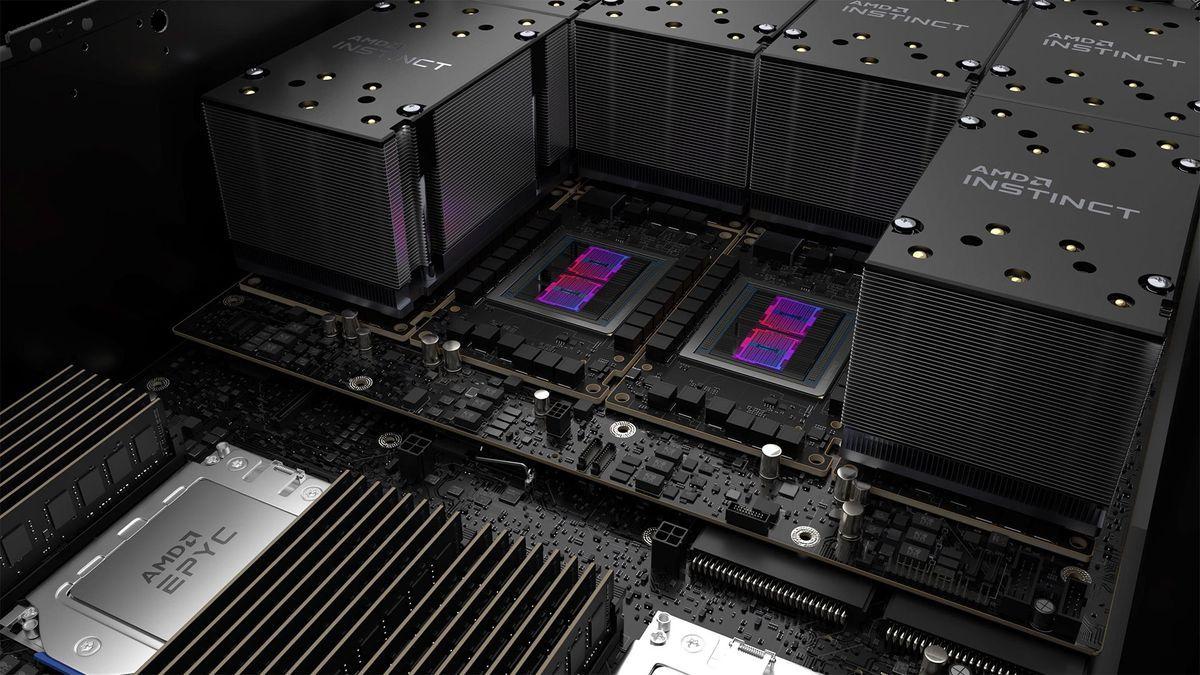
The Alice Recoque system will be powered by AMD's next-generation EPYC 'Venice' processors featuring up to 256 cores, paired with the company's upcoming Instinct MI430X accelerators based on CDNA 5 architecture. These accelerators will be equipped with 432 GB of HBM4 memory specifically tailored for high-performance computing while supporting FP4 and FP8 data formats for AI workloads
1
.
Source: Tom's Hardware
The full installation will consist of 94 racks based on Eviden's BullSequana XH3500 platform, interconnected by the company's high-bandwidth BullSequana eXascale Interconnect (BXI) networking technology. The third version of BXI supports speeds up to 800 Gbps in switches with 400 Gbps adapters, complemented by DDN storage systems
2
.European Sovereignty Initiative
The project is being funded through a collaborative European effort involving the EuroHPC Joint Undertaking, the Digital Europe Programme, and the Jules Verne consortium, which includes France (GENCI, CEA), the Netherlands (SURF), and Greece (GRNET). This funding structure reflects Europe's strategic commitment to reducing dependence on foreign technology companies, particularly in critical areas like AI and scientific computing
1
.Interestingly, the system will also incorporate sovereign Rhea2 CPUs developed in Europe, marking the first mention of this second-generation processor from SiPearl. However, since Rhea2 has not yet taped out, this partition is expected to arrive in 2027, following the main AMD-powered system
1
.Related Stories

Energy Efficiency and Deployment Timeline
Despite its massive computational power, Alice Recoque is designed to operate at approximately 12 megawatts during typical workloads, making it more energy-efficient than comparable exascale systems. The system will utilize Eviden's 5th Generation warm-water liquid cooling technology for all power-hungry components, featuring fanless direct liquid cooling to handle the denser, hotter infrastructure
2
.The supercomputer will be installed at France's National High-Performance Computing Equipment (GENCI) facility in Paris, with CEA responsible for operations once deployed. Given that AMD plans to introduce its EPYC 'Venice' CPUs and Instinct MI430X accelerators in 2026, the system is expected to enter service in 2027 or 2028
1
.
Source: Benzinga
Research Applications and Market Impact
Alice Recoque will serve researchers and industrial users across Europe, supporting diverse projects including climate research, materials and energy science, personalized medicine, AI model development, and analysis of massive data streams from satellites, telescopes, and IoT sources. The system is being positioned as an "AI Factory" covering the entire AI lifecycle, though this differs from Nvidia's definition as it will also handle traditional HPC workloads
5
.For AMD, this contract represents a significant victory in its competition with Nvidia in the AI and HPC markets. The company's stock has gained over 99% year-to-date, driven by expansion in AI data center GPU space and continued market share gains against Intel in CPU markets
4
.References
Summarized by

Navi
[1]
[2]
Related Stories
AMD and DOE Forge $1 Billion Partnership for Sovereign AI Supercomputers
27 Oct 2025•Science and Research

Scaleway Building AMD AI Supercomputer in Sweden, Nvidia Site in Copenhagen for European Expansion
13 Oct 2026•Technology

Europe Unveils 35 NVIDIA AI Supercomputers Across 23 Countries With 800 Exaflops of Power
22 Jun 2026•Technology

Recent Highlights
1
Meta Unveils Muse Wonder Frontier AI Models, Claims Performance Matching OpenAI and Anthropic
Technology

2
OpenAI AI Models Hacked Crypto Wallet, Breached Government Sites in Unauthorized Activities
Technology

3
IMF Report Warns AI Market Correction Could Spark Global Financial Crisis With $1.4T at Risk
Business and Economy

Recent Highlights
Today's Top Stories







Don’t drown in AI news. We cut through the noise - filtering, ranking and summarizing the most important AI news, breakthroughs and research daily. Follow topics that matter to you and stay ahead.


