AMD and DOE Forge $1 Billion Partnership for Sovereign AI Supercomputers


14 Sources
[1]
AMD, Department of Energy announce $1 billion AI supercomputer partnership
AMD has sealed a $1 billion deal with the US Department of Energy to develop two supercomputers, Lux and Discovery, in collaboration with Oracle and Hewlett Packard Enterprise (HPE). Both supercomputers will live at Oak Ridge National Laboratory (ORNL) in Oak Ridge, Tennessee. Lux is slated to come
[2]
U.S. Department of Energy and AMD cut a $1 billion deal for two AI supercomputers -- pairing has already birthed the two fastest machines on the planet
Tens of billions seem to fly in all sorts of directions these days in the AI world. A "mere" $1 billion deal would arguably not even register, but the one announced today is arguably far more important than all the data centers for enabling AI chatbot sexting. According to a Reuters report, the
[3]
America's Sovereign AI supercomputers will use AMD chips
AMD is working with the US Department of Energy to build sovereign AI supercomputers at Oak Ridge National Laboratory, the agency's famous research and development center. NVIDIA describes sovereign AI as "a nation's capabilities to produce artificial intelligence using its own infrastructure,
[4]
U.S. Department of Energy forms $1 billion supercomputer and AI partnership with AMD: Reuters
The U.S. has formed a $1 billion partnership with Advanced Micro Devices to construct two supercomputers that will tackle large scientific problems ranging from nuclear power to cancer treatments to national security, Energy Secretary Chris Wright and AMD CEO Lisa Su told Reuters. The U.S. is
[5]

Lux and Discovery could turn Oak Ridge into a powerful AI playground
Discovery builds on Frontier's legacy with greater bandwidth and improved efficiency The US Department of Energy has announced a $1 billion collaboration with AMD to deliver two supercomputers, Lux and Discovery, at Oak Ridge National Laboratory (ORNL). AMD says the partnership will help it
[6]

AMD, US Energy Department Announce $1 Bn Supercomputer Partnership | AIM
Supercomputers -- Lux and Discovery -- to boost US research in AI, science, and national security. The US Energy Department (DOE) and AMD have announced a $1 billion partnership to build two supercomputers at Oak Ridge National Laboratory (ORNL). The systems, named Lux and Discovery, aim to
[7]

AMD, HPE to build two new supercomputers for the Energy Department - SiliconANGLE
AMD, HPE to build two new supercomputers for the Energy Department The U.S. Energy Department has commissioned two new supercomputers based on Advanced Micro Devices Inc. silicon. Reuters reported today that the project is worth $1 billion. It will be funded with a combination of public and
[8]

America is building two AMD-powered supercomputers to recreate the sun and fight disease
The U.S. Department of Energy has struck a $1 billion deal with Advanced Micro Systems (AMD) to build two supercomputers that have unprecedented power to supercharge scientific advances ranging from nuclear power to developing cancer treatments. The partnership, first reported by Reuters on
[9]

AMD and US Energy Department launch $1B supercomputer project
The $1B AMD-DOE collaboration will create Lux and Discovery, next-gen AI supercomputers set to boost breakthroughs in energy, science, and national security. AMD and the U.S. Department of Energy announced a $1 billion partnership to develop two supercomputers, Lux and Discovery, at Oak Ridge
[10]

AMD inks huge deal with US government to power next-gen AI supercomputers with AMD AI hardware
TL;DR: AMD partners with the US Department of Energy to develop Lux and Discovery supercomputers, combining $1 billion in funding to advance sovereign AI and scientific research. Featuring AMD Instinct GPUs, EPYC CPUs, and cutting-edge networking, these systems enhance US leadership in
[11]

Exclusive-US Department of Energy Forms $1 Billion Supercomputer and AI Partnership With AMD
By Timothy Gardner and Max A. Cherney WASHINGTON/SAN FRANCISCO (Reuters) -The U.S. has formed a $1 billion partnership with Advanced Micro Devices to construct two supercomputers that will tackle large scientific problems ranging from nuclear power to cancer treatments to national security, Energy
[12]

AMD Lands Major U.S. Government AI Deal to Power Next-Gen Supercomputers, Featuring Instinct MI355X & the Newer MI430 AI Chips
The U.S. Department of Energy (DoE) has reportedly collaborated with AMD on two new supercomputer projects, utilizing Team Red's latest AI chips to address scientific challenges. Based on a new report from Reuters, it seems like AMD has managed to secure a massive partnership with the U.S. DoE,
[13]

The United States teams up with AMD to build two next-generation AI supercomputers
The US Department of Energy has entered into a $1bn partnership with AMD to design two supercomputers to advance scientific research and national security. These systems, among the most powerful ever built, will be used for nuclear fusion modeling, cancer treatment development, energy research, and
[14]
US Department of Energy forms $1 billion supercomputer and AI partnership with AMD
WASHINGTON/SAN FRANCISCO (Reuters) -The U.S. has formed a $1 billion partnership with Advanced Micro Devices to construct two supercomputers that will tackle large scientific problems ranging from nuclear power to cancer treatments to national security, Energy Secretary Chris Wright and AMD CEO
Share
Copy Link
The US Department of Energy partners with AMD to build two cutting-edge supercomputers, Lux and Discovery, at Oak Ridge National Laboratory. This $1 billion initiative aims to advance AI-driven scientific research in nuclear fusion, cancer treatment, and national security.
Historic Partnership for AI Supremacy
The United States Department of Energy has announced a groundbreaking $1 billion partnership with Advanced Micro Devices to develop two state-of-the-art supercomputers at Oak Ridge National Laboratory in Tennessee.
1
This collaboration, involving Oracle and Hewlett Packard Enterprise, represents a significant investment in America's sovereign AI capabilities and scientific research infrastructure.
Source: Wccftech
The partnership builds on AMD's proven track record in supercomputing, having previously contributed to the development of the Frontier supercomputer, which held the title of world's fastest until El Capitan came online at Lawrence Livermore National Laboratory.
1
Lux: America's First AI Factory
The first supercomputer, named Lux, is scheduled to become operational in early 2026 and represents a revolutionary approach to scientific computing.
3
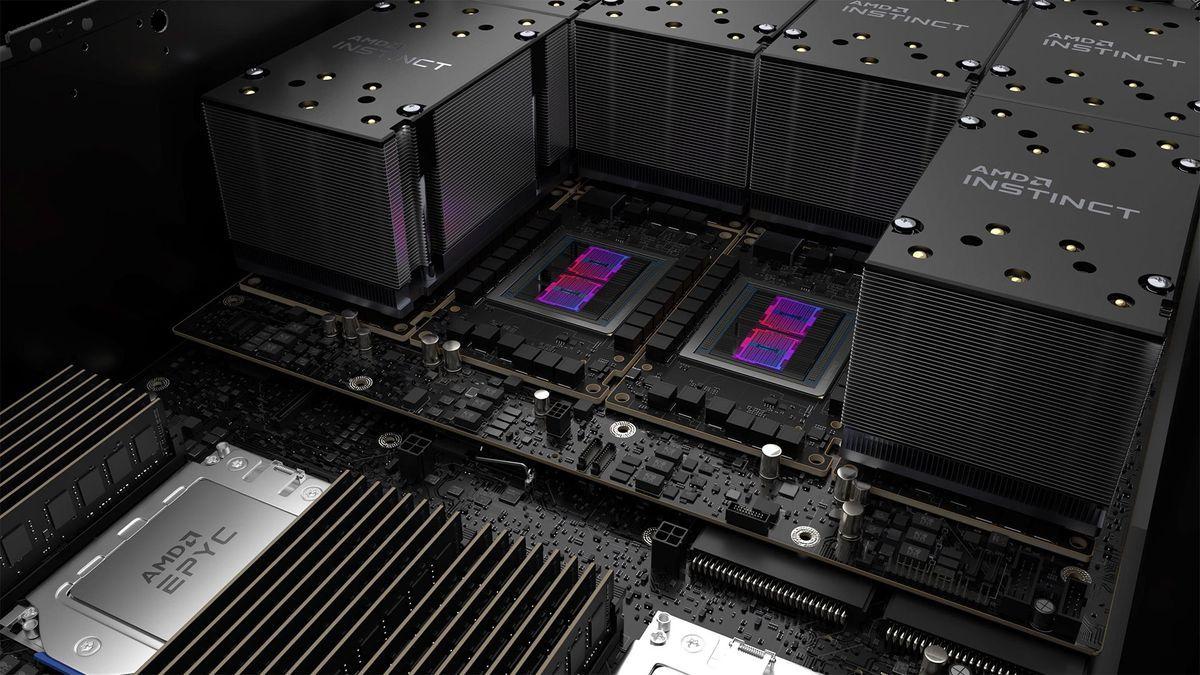
Described as the nation's first dedicated "AI Factory" for science, energy, and national security, Lux is purpose-built to train, fine-tune, and deploy AI foundation models that will accelerate discovery and engineering innovation.Lux will be powered by AMD Instinct MI355X GPUs, each consuming 1,400 watts of board power, alongside AMD EPYC CPUs and AMD Pensando advanced networking technologies.
2
Oak Ridge National Laboratory Director Stephen Streiffer indicates that Lux will deliver approximately three times the AI capacity of current supercomputers.4
AMD CEO Lisa Su emphasized the unprecedented speed of deployment, calling it "the fastest deployment of this size of supercomputer" she has witnessed, demonstrating the urgency behind America's AI initiatives.
4
Discovery: Next-Generation Scientific Computing
The second supercomputer, Discovery, is slated for delivery in 2028 with operations beginning in 2029.
4
This system will utilize AMD's next-generation EPYC CPUs codenamed "Venice" and the new AMD Instinct MI430X GPUs, specifically designed for sovereign AI and high-performance computing applications.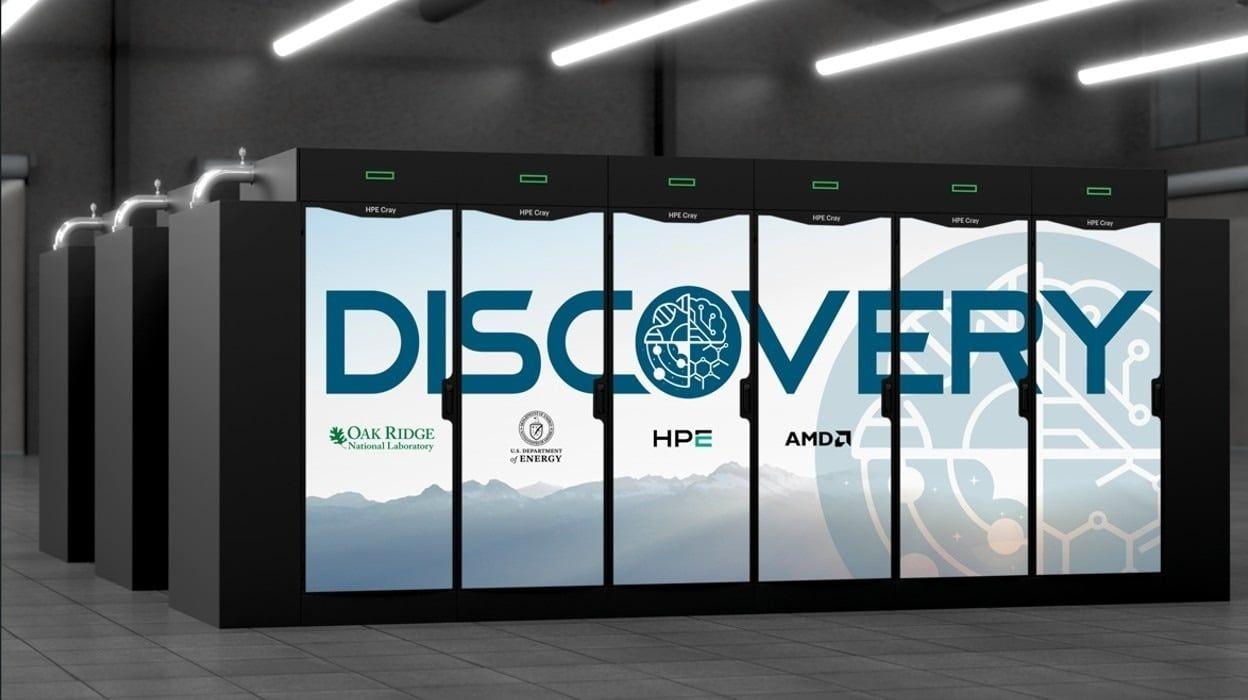
Source: TweakTown
Discovery features a "Bandwidth Everywhere" design that improves upon the performance and energy efficiency of the current Frontier supercomputer, delivering enhanced computing output at similar operational costs.
1
The MI430X represents a specialized variant that combines traditional supercomputing capabilities with AI application features, optimized for high-precision FP32 and FP64 performance.2
Related Stories
Revolutionary Research Applications
Energy Secretary Chris Wright outlined ambitious goals for these supercomputers, particularly in nuclear fusion research. He expressed confidence that these systems will enable "practical pathways to harness fusion energy in the next two or three years," addressing the challenge of recreating solar conditions on Earth to achieve controlled fusion reactions.
4

Source: Fast Company
In medical research, Wright anticipates transformative advances in cancer treatment, stating his hope that "in the next five or eight years, we will turn most cancers, many of which today are ultimate death sentences, into manageable conditions."
4
The supercomputers will enable molecular-level simulation of cancer treatments, potentially revolutionizing drug discovery processes.Both systems will support critical research across multiple domains, including next-generation reactor design, advanced battery development, catalyst optimization, semiconductor innovation, and critical materials research. Additionally, they will contribute to national security efforts, including the management of America's nuclear weapons arsenal.
Strategic Partnership Model
The collaboration represents an innovative public-private partnership structure where the Department of Energy provides hosting facilities and energy infrastructure, while private companies supply hardware, software, and capital investment.
4
Both parties will share access to the computing power, maximizing the return on investment for taxpayers while leveraging private sector expertise and resources.This partnership model is intended as the first of many similar collaborations between private industry and DOE laboratories across the country, potentially reshaping how America approaches large-scale scientific computing infrastructure.
4
References
Summarized by

Navi
[2]
[4]
Related Stories
US National Labs Launch Massive AI Supercomputing Initiative to Maintain Global Technological Leadership
26 Nov 2025•Technology

Doudna Supercomputer: Dell and Nvidia Join Forces with DOE for Next-Gen AI-Powered Scientific Discovery
30 May 2025•Technology
AMD Dominates Top500 Supercomputer Rankings with El Capitan and Frontier
11 Jun 2025•Technology

Recent Highlights
1
Microsoft and Nvidia Launch Surface Laptop Ultra: A $2,599 AI-Ready PC With RTX Spark Chip
Technology

2
OpenAI Releases 722 AI-Generated Math Papers on GitHub, Igniting Fury Among Mathematicians
Science and Research

3
Trump Consulted Grok AI Before Ordering Venezuela Invasion and Capture of Nicolás Maduro
Policy and Regulation

Recent Highlights
Today's Top Stories












Don’t drown in AI news. We cut through the noise - filtering, ranking and summarizing the most important AI news, breakthroughs and research daily. Follow topics that matter to you and stay ahead.


