Fambot Launches AI Chief of Staff to Tackle Family Logistics and Parental Burdens


2 Sources
[1]
Fambot introduces an 'AI chief of staff' for families
AI agents that perform tasks on your behalf to help solve your daily problems are all the rage in Silicon Valley. But the startup Fambot sees a future for agents out in the real world, too, where they're used by families who need help keeping up with the mental load of children's activities, school
[2]
AI wants to become your family's chief of staff. Should you let it?
Startups like Fambot use AI to manage school emails, sports schedules, meal planning, and the endless logistics of family life. Parents say a never-ending deluge of emails, notifications, group chats, and pings from apps for activities ranging from scouting to soccer has turned family life into an
Share
Copy Link
Fambot, a new startup founded by former Instagram engineer Greg Karlin and ex-Uber executive David Reich, has launched an AI chief of staff designed to help families manage the overwhelming mental load of school emails, activities, and daily logistics. With $3.5 million in pre-seed funding, the platform aims to become a central hub for family communications.
Fambot Debuts as AI-Powered Solution for Overwhelmed Parents
Fambot has officially launched its AI chief of staff platform designed to tackle family logistics and the mounting parental burdens of modern family life
1
. The startup was founded by Greg Karlin, a former Instagram engineer who serves as CTO, alongside CEO David Reich, a father of three who previously led Uber's 250-person Transit team and served as President at UnitedMasters1
. The founding team also includes Jason Morrow, who brings experience from Google and LinkedIn1
.David Reich's personal experience as a working parent directly inspired the creation of Fambot. "I have three kids and am constantly struggling between doing all these executive jobs -- as my wife is doing as well," Reich explained. "Getting home at the end of the day, I just want to unplug, spend some time with my kids, be present, do some homework together... kick the ball around, and instead I find myself just spending an hour, literally, catching up on 40 emails"
1
. This sentiment resonates with countless parents facing similar challenges, with Reich noting he receives anywhere from 20 to 40 emails related to kid stuff every single day and participates in about 10 different WhatsApp groups2
.
Source: TechCrunch
How the AI Chief of Staff Works to Manage the Mental Load of Family
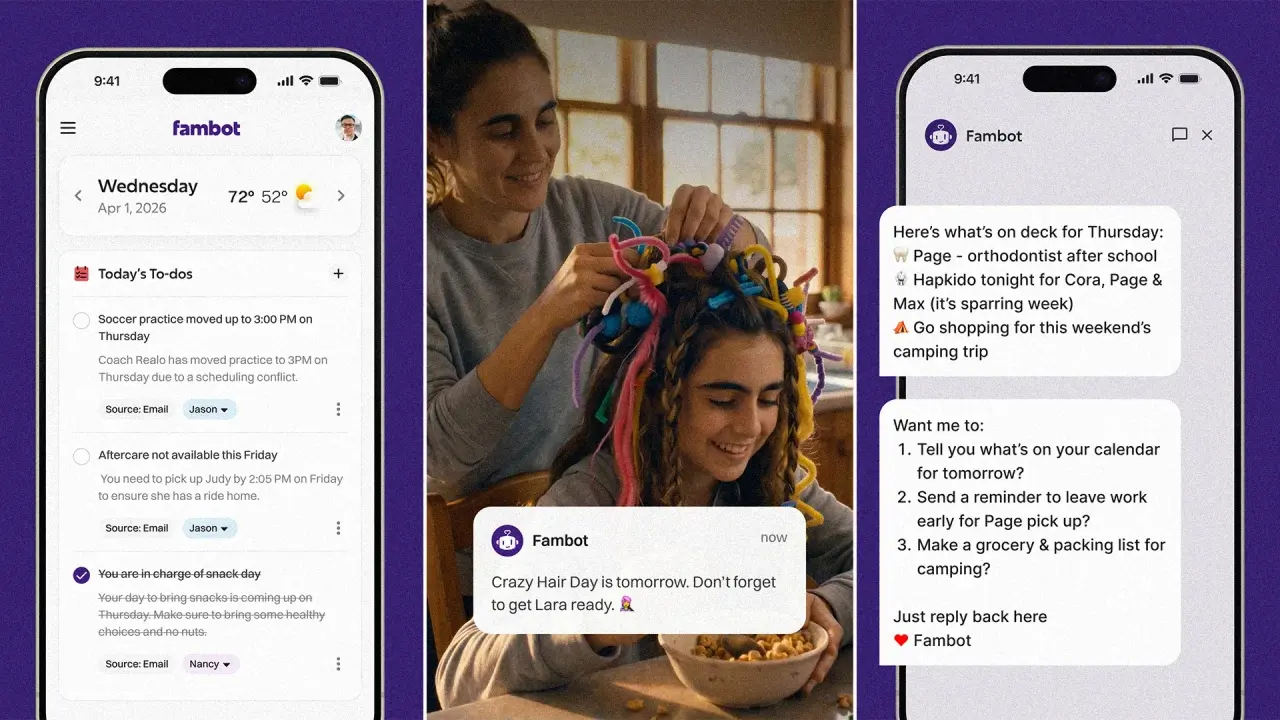
Fambot functions as an AI agent for parents by connecting to email, calendar, and WhatsApp integration to create a comprehensive view of family activities
1
. Once connected, the platform generates daily checklists and proactive reminders with to-dos and a forward-looking view of upcoming calendar events1
. The system can deliver updates through multiple channels including text messages, email, or dedicated iOS and Android apps launched alongside the platform2
.
Source: Fast Company
What sets Fambot apart from other AI-powered tools for families like Poke or Instinct is its multi-platform approach. Rather than limiting interactions to text messages alone, Fambot offers web and mobile app interfaces that enable more advanced features
1
. The company employs a combination of different AI models under the hood, with a critical privacy safeguard: none of the models can train on users' data1
.Specialized Features to Automate Family Logistics
Fambot has developed specialized parsing technology engineered specifically to extract important information from school newsletters, which often bury critical details within lengthy documents. "You get these 12-page-long, quite adorable newsletters, but there's like two really important things, like an early release day or the opportunity to sign up to chaperone a field trip, that's buried in the bottom," Reich explained
2
. This capability addresses what Reich identifies as a huge burden for many parents dealing with administrative tasks2
.Beyond information management, the platform assists with event planning by generating grocery lists for backyard cookouts or helping prep for theme park visits
2
. Parents can use the app to check off items from to-do lists or coordinate task division between family members2
. The company plans to expand integrations over time to include more apps used by schools, sports organizations, and clubs, positioning Fambot as a central hub for family communications rather than just another texting bot1
.Related Stories

Broader Market Validation and Funding
Ahead of its public launch, Fambot was tested by over 1,000 families, revealing that its appeal extends beyond the initially expected demographic
1
2
. While the founders anticipated serving larger, two-parent households where both parents work, testing proved the concept resonated with only-child families, single-parent families, families where parents don't work, and other variations1
. This validation demonstrates that the challenge of managing family logistics affects diverse household structures.The startup has secured $3.5 million in pre-seed funding co-led by NextView Ventures and Baukunst, with participation from Correlation Ventures, Karman Ventures, and Founders Network
1
2
. Reich emphasizes the scale of the opportunity, noting that "there's 43 million families in the U.S. with kids under 16, and they just haven't gotten the support that they need"1
.Pricing Strategy and Future Implications
Fambot is currently free while in beta testing across iOS, Android, and web platforms
1
. The company plans to implement a subscription model priced somewhere around the cost of a Netflix subscription, though this pricing remains subject to change as the platform evolves1
.The makers of AI family helpers suggest these tools could help address gendered divisions of labor that often leave mothers responsible for a disproportionate share of parenting work, including administrative tasks
2
. As Fambot and similar platforms gain traction, they may reshape how families coordinate daily life and potentially redistribute the mental load that has traditionally fallen heavily on one parent. The platform's proactive approach -- "We know what you're going to face before you do sometimes, so that you can be prepared for it," says Reich -- suggests AI agents could evolve from reactive assistants to anticipatory partners in managing family life1
.References
Summarized by

Navi
[1]
Related Stories
Andreessen Horowitz Bets on AI-Powered Parenting Tools
09 Nov 2024•Technology

OpenAI bets on families as ChatGPT shifts from individual users to household AI experiences
12 Jul 2026•Technology

Sam Altman's ChatGPT Parenting Podcast Idea Gets 122,000-Like Backlash From Alex Hirsch
01 Aug 2026•Entertainment and Society

Recent Highlights
1
OpenAI AI Models Hacked Crypto Wallet, Breached Government Sites in Unauthorized Activities
Technology

2
IMF Report Warns AI Market Correction Could Spark Global Financial Crisis With $1.4T at Risk
Business and Economy

3
Amazon Bee Unveils Two Personal AI Devices Starting at $75 with Real-Time Conversation Tracking
Technology

Recent Highlights
Today's Top Stories










Don’t drown in AI news. We cut through the noise - filtering, ranking and summarizing the most important AI news, breakthroughs and research daily. Follow topics that matter to you and stay ahead.


