Federal Reserve Warns AI Data Centers Are Overheating the Economy


2 Sources
[1]
Fed's Goolsbee says data center buildout 'overheating' economy
Austan Goolsbee, the president of the Federal Reserve Bank of Chicago, said Monday that the data center buildout is "overheating" the economy and putting upward pressure on prices. "Now this stuff with the AI data center buildout is, to my eye, starting to look more just like old-fashioned demand
[2]
Fed's Goolsbee Warns AI Data Center Boom Is Starting to Look Like 'Demand Overheating,' Says Central Bank
Chicago Federal Reserve President Austan Goolsbee warned on Monday that surging artificial intelligence (AI) data-center investment risks overheating the U.S. economy, adding inflationary pressure beyond technology and potentially demanding an aggressive central-bank response. Goolsbee Warns
Share
Copy Link
Chicago Fed President Austan Goolsbee cautioned that the AI data center boom is creating old-fashioned demand overheating in the economy. With over 1,500 facilities in development and infrastructure bottlenecks mounting, Federal Reserve officials are signaling potential aggressive monetary policy responses to combat rising inflation risks.
Federal Reserve Sounds Alarm on AI Infrastructure Expansion
Chicago Federal Reserve President Austan Goolsbee issued a stark warning that the explosive growth of AI data centers is creating classic economic overheating conditions. Speaking at a Leadership Greater Chicago event on November 9, Goolsbee characterized the AI data center buildout as "old-fashioned demand overheating" that threatens to push inflation beyond the central bank's control
1
. The Chicago Fed leader emphasized that such overheating "never goes away on its own" and requires central bankers to be "aggressive up front" rather than attempting to reverse entrenched inflation later2
.Massive Scale of AI-Fueled Investments Strains Resources

Source: Benzinga
The scope of AI infrastructure growth is staggering. More than 1,500 data centers were in development nationwide as of August, according to Pew Research Center data citing Data Center Map
1
. Federal Reserve Governor Lisa Cook highlighted that roughly $2 trillion in announced investment plans are competing for critical inputs like construction labor and energy across multiple economic sectors2
. This AI data center boom is creating supply chain bottlenecks that extend far beyond the technology sector. AI developers are now seeking used gas turbines and converted jet engines because new turbine deliveries face lengthy delays, with orders exceeding 100 gigawatts against annual production capacity estimated at just 60-70 gigawatts2
.Price Pressures Spread Across Economy
Lisa Cook warned in September that "data-center investment relies on inputs, like construction labor and energy, that are broadly used in many sectors in the economy." She noted that increased AI investment could introduce price pressures to those other sectors, stating she sees "some economy-wide pressure from AI-fueled demand"
1
. Goolsbee previously observed that data-center costs were "jumping out of its lane" into other industries, potentially pushing overall demand beyond the economy's productive capacity2
. These macroeconomic trends compound existing inflation risks from energy price shocks and tariffs.Related Stories

Interest Rates Face Upward Pressure
Inflation in September reached 3.7 percent according to the consumer price index, well above the Federal Reserve's 2 percent target
1
. Stubborn inflation led Fed officials to raise interest rates by a quarter point in September, marking the first hike in more than three years1
. After holding rates steady in October, traders are pricing in an 84.2 percent chance of another quarter-point increase at the Federal Reserve's next meeting in early December1
. The Bureau of Labor Statistics released October's Consumer Price Index data on November 10, providing critical insights as the Federal Reserve approaches its December interest-rate decision2
.Federal Reserve Mobilizes AI Economic Task Force
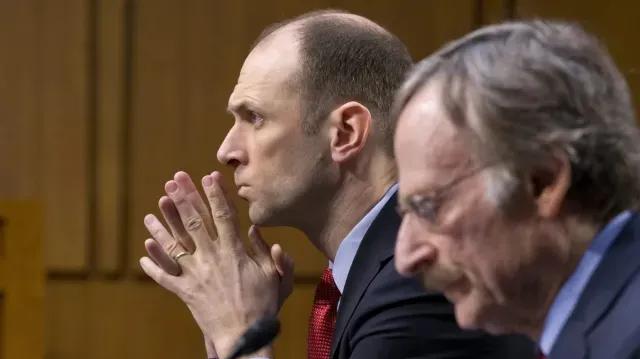
Source: The Hill
Federal Reserve Chair Kevin Warsh has acknowledged that central bank officials "care much about the implications" of AI technology "on the demand side"
1
. Shortly after taking over in May, Warsh formed a dedicated task force to assess AI's economic impact, with Andreessen Horowitz co-founder Marc Andreessen and Stanford University economist Charles Jones overseeing the effort. Warsh expects the task force to deliver its initial report by year's end1
. Watch for how this analysis shapes monetary policy as AI infrastructure continues its rapid expansion and whether aggressive rate actions can contain demand-driven inflation without derailing broader economic growth.References
Summarized by

Navi
Related Stories
Fed Officials Clash Over AI Investment Risks as Spending Reaches $2.4 Trillion
05 Aug 2026•Policy and Regulation

Beth Hammack warns AI inflation could force Fed to raise interest rates as demand stays insatiable
01 Jul 2026•Policy and Regulation
AI Boom Fuels Inflation Concerns as Central Bankers Consider Higher Interest Rates
17 Oct 2026•Business and Economy

Recent Highlights
1
Jensen Huang's Affair with Suspected Chinese Spy Exposes $7 Billion AI Chip Smuggling Network
Policy and Regulation

2
Anthropic Launches Claude Meetings and AI-Powered Office Tools to Challenge Microsoft and Google
Technology

3
Anthropic launches Fable 5.2 and Mythos 5.2 with 20% price cut and 30% faster output
Technology

Recent Highlights
Today's Top Stories









Don’t drown in AI news. We cut through the noise - filtering, ranking and summarizing the most important AI news, breakthroughs and research daily. Follow topics that matter to you and stay ahead.


