Fig Security partners with Elastic to catch silent gaps in security detection coverage


2 Sources
[1]
Fig and Elastic team up to catch silent detection gaps
Security teams rely on detection rules to identify suspicious activity across increasingly complex technology environments. But even when those rules remain active, changes to the underlying data can quietly undermine their effectiveness. A vendor updating its log format, a new data source entering
[2]
Exclusive: Fig Security partners with Elastic to show how data changes affect detection coverage
Security operations startup Fig Security Inc. today announced an integration partnership with Elastic N.V. that it says gives security teams visibility into how data changes affect their detection coverage. The partnership sees Fig's capabilities for mapping detection dependencies now integrating
Share
Copy Link
Fig Security, an early-stage security operations startup founded in 2025, announced a partnership with Elastic on Nov. 19 that connects the startup's detection-dependency mapping to Elastic Security
2
1
. The point is to catch a failure security teams rarely see coming: a detection rule that stays switched on while the data feeding it quietly loses the fields it needs to catch an attack2
1
.Fig calls that problem drift. Detection rules depend on data arriving in expected structures. If someone changes a source, pipeline or field mapping in a tool outside the security team's control, the rule can keep running while the data underneath no longer supports it. There is no obvious warning
2
1
.What the integration does
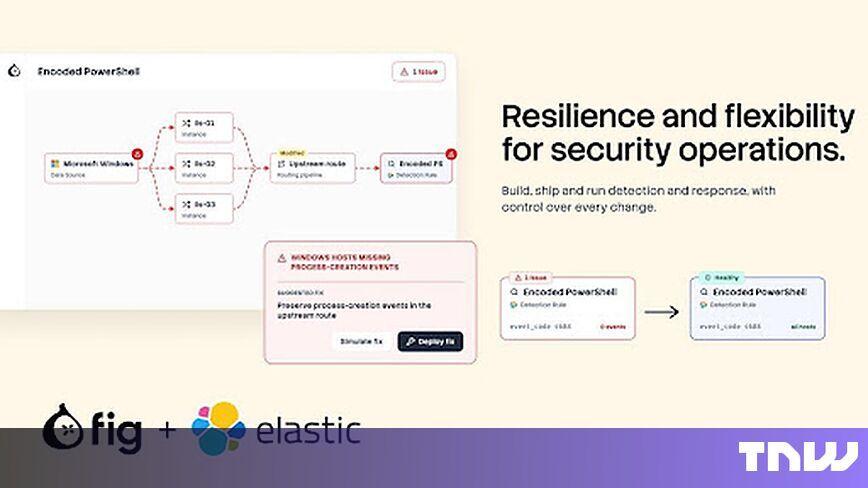
Fig's Security Data Lineage feature links to an Elastic environment with a read-only API key. As SiliconANGLE put it, it then maps every data source, pipeline and field mapping in that environment "to the detection rules that depend on them". When any of those changes, Fig spots the affected detections and proposes a repair
2
1
.
Source: The Next Web
Validated changes can then ship as code through standard software-engineering workflows, with version control and one-click rollback. Teams can test each change against their own environment before deploying it
2
1
."Elastic gives security teams control over their data, and Fig gives them control over the engineering around it," said Gal Shafir, Fig's co-founder and CEO
2
.Built for migrations too
The integration also targets teams migrating to Elastic Security from another security analytics platform. Fig also pairs with Elastic's Automatic Import and AI Agent, features for building new integrations and custom rules as needs grow
2
1
."Environments never stop changing, from vendor schemas and APIs to ETL tools and pipelines," said Jamie Hynds, director of product at Elastic. "Fig traces those changes to the detection rules that depend on them, so SecOps teams can adapt quickly and maintain detection coverage with Elastic Security"
1
.Founded in 2025, Fig launched in March with $38 million of seed and Series A backing from Team8 and Ten Eleven Ventures. In July it rolled out an AI agent plus software-style deployment tooling. Shafir previously ran global security architecture at Google Cloud
2
. The integration is available now, with demonstrations bookable through Fig's website2
1
.The changes that break detection rules are not necessarily mistakes. Organizations rework data pipelines for performance, new vendors or evolving infrastructure all the time, and changes made outside the security team's control can degrade detection engineering downstream
1
. The problem framing and the product's effectiveness rest on Fig's own claims; neither company has published customer results or independent testing yet2
1
.Related Stories

References
Summarized by

Navi
[1]
Related Stories
JFrog and Wiz Unite to Slash AI-Era Threat Remediation Time from Days to Hours
07 Sept 2026•Technology

Elastic and OpenAI Expand Collaboration to Unlock Enterprise AI with Unstructured Data
31 Jul 2026•Technology

Elastic Acquires Deductive AI to Automate Production Incident Investigation with Reinforcement Learning
25 Aug 2026•Technology

Recent Highlights


Recent Highlights
Today's Top Stories











Don’t drown in AI news. We cut through the noise - filtering, ranking and summarizing the most important AI news, breakthroughs and research daily. Follow topics that matter to you and stay ahead.


