Flora raises $42 million to unify generative AI design tools in one creative platform


2 Sources
[1]
Node-based design tool Flora raises $42M from Redpoint Ventures
Flora, a design tool used by designers at Alibaba, Brex, creative agency Pentagram, and entertainment company Lionsgate, has hit a new milestone. The startup has raised $42 million in Series A led by Redpoint Ventures, it announced on Tuesday. Generative AI models can be used in the design process
[2]
Flora raises $42M to unify generative AI design in a single platform
Flora raises $42M to unify generative AI design in a single platform Flora, the creator of an "intelligent canvas" platform for creative professionals, has raised $42 million in an early-stage round with a goal to tackle the fragmentation around generative artificial intelligence design
Share
Copy Link
Flora has secured $42 million in Series A funding led by Redpoint Ventures to expand its node-based design platform. The startup unifies multiple generative AI models from OpenAI, Google, and others into a single creative workflow, serving designers at Nike, Levi's, and Pentagram. Flora plans to scale enterprise sales and add traditional editing capabilities.
Flora Secures $42 Million to Transform AI Design Workflows
Flora has closed a $42 million Series A funding round led by Redpoint Ventures, bringing its total funding to $52 million
1
2
. The round attracted notable participants including Vercel CEO Guillermo Rauch, Twitch founder Justin Kan, Frame.io CEO Emery Wells, Hanabi Capital's GP Mike Volpi, Menlo Ventures, a16z Games, and Fal co-founders Gorkem Yurtseven, Burkay Gur, and Batuhan Taskaya1
. The node-based design tool addresses a critical challenge facing creative professionals: the fragmentation of generative AI design tools across multiple platforms.Unified Platform Brings Multiple AI Models Together
Flora operates as an intelligent canvas platform that provides access to multiple text, image, and video creation models in a single environment
2
. Rather than developing proprietary models, Flora integrates third-party offerings including Google's Gemini 2.5 Pro, Gemini 2.5 Flash Image, Imagen 4 and Veo 3, OpenAI's GPT-5 and GPT Image, Runway's Aleph and Gen-4 Turbo, Stability AI's Stable Diffusion 3.5, and ByteDance's Seedream 4.02
. This approach allows creative professionals to test capabilities across different generative AI models without switching between separate applications.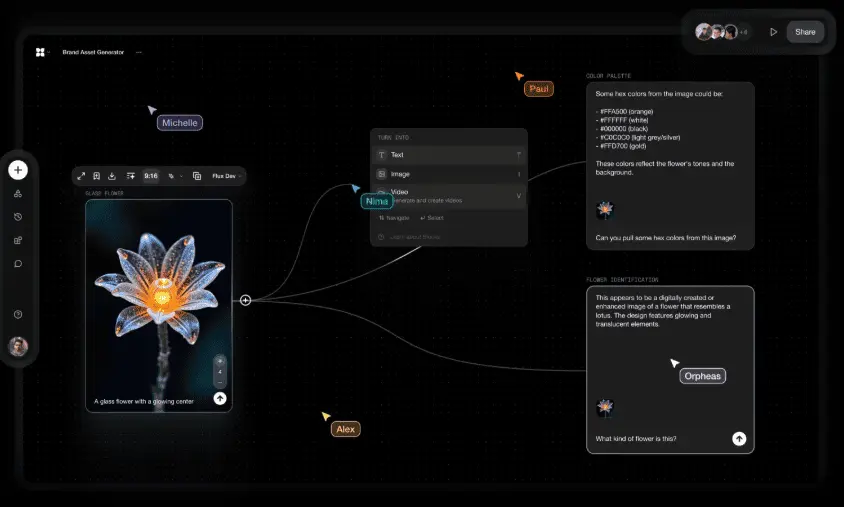
Source: SiliconANGLE
CEO and founder Weber Wong, previously an investor at Menlo Ventures, built Flora after recognizing that existing AI tools were "built by non-creatives for other non-creatives to feel creative," leaving professional creators underserved
2
. The platform launched its alpha version in 2024 through New York University's Interactive Telecommunications Program, which fuses technology and art, before releasing a more stable version last year1
.How Nodes Enable Rapid Creative Iteration
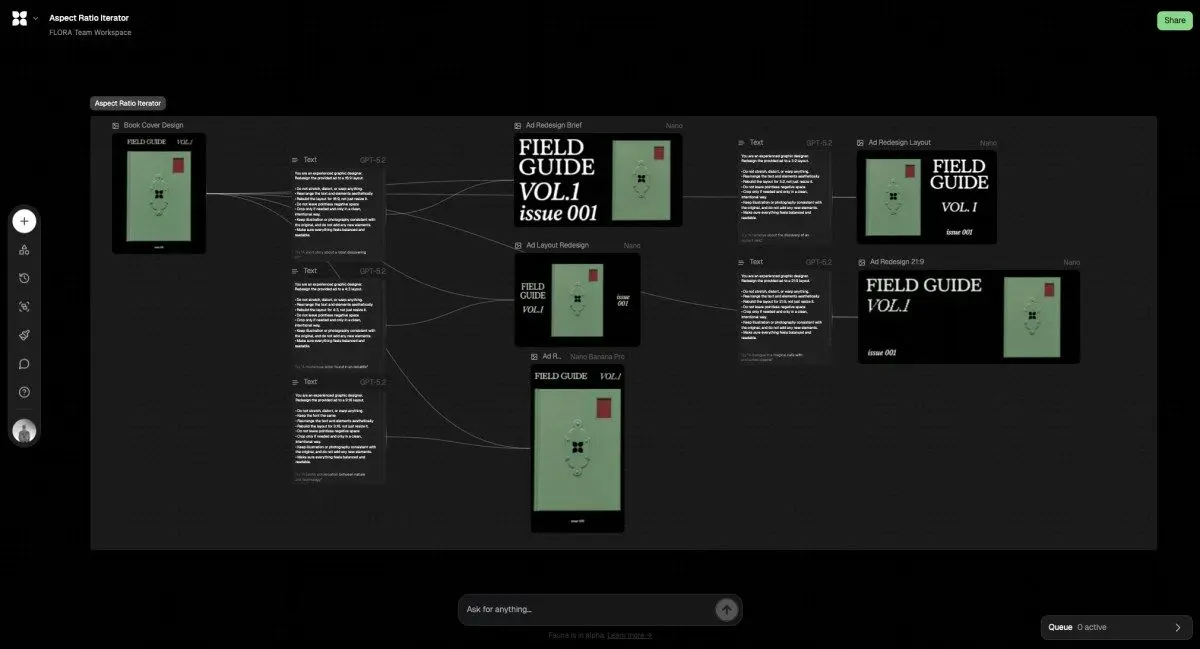
Flora's distinctive approach centers on nodes, which enable users to create multiple iterations of the same design concept. Each project begins with an initial node, and users can branch out to generate new versions mapped together on a canvas, providing a tractable creative workflow
1
2
. Users can employ text, image, or video as prompts to create media assets, then add different prompts to build new nodes with multiple iterations. For instance, when creating a marketing video, designers can provide reference images and text prompts to establish a concept, then experiment with contrasting styles to determine the most effective approach1
.
Source: TechCrunch
Wong explained that "the generative computing paradigm needed a new creative interface," contrasting it with Adobe's pixel-level control approach from the personal computing era. "You now have these models that can make entire pieces of media like that. So the natural creative opportunity is to take a step back and design the entire creative workflow," he noted.
Related Stories

Growing Adoption Among Major Brands
Flora has already attracted designers from Nike, Levi Strauss, Starz Entertainment, Pentagram Design, Alibaba, Brex, and Lionsgate
1
2
. These creative professionals typically use the platform during initial asset design stages to rapidly test concepts and ideas before scaling preferred options into full brand executions. Flora enables them to visualize new products across different scenarios, accelerating the early ideation phase.While targeting creative professionals, Flora remains accessible to business owners and individual users through plans starting at $16 per month when paid annually, with scaled options for agencies and enterprises. The company deploys creatives to work with organizations and improve user education, which Wong considers essential for broader adoption of AI-driven design solutions.
Strategic Expansion Plans and Market Positioning
Flora will deploy the Series A funding to scale enterprise sales capabilities and expand its marketing efforts
2
. On the product side, the company aims to build enhanced creative controls and add traditional editing capabilities so professionals can complete entire projects within Flora without switching to other tools. The startup currently employs 25 people and plans to double or triple that headcount by year's end.Redpoint Ventures Managing Director Alex Bard emphasized that Flora represents "an architectural change in creative tooling, not an incremental one." He noted the team's elegant product design and how it democratizes the design process, similar to Figma's impact on product design
2
. Bard sees Flora impacting broader creative processes across fashion, advertising, photography, and branding industries.The competitive landscape has intensified as generative AI transforms design workflows. In October, OpenAI acquired Sequoia-backed Visual Electric, and Figma acquired node-based editor Weavy. Separately, Krea, which also features a node-based editor, raised $83 million in April
1
. Meanwhile, established players like Adobe, Figma, and Canva have integrated AI features into existing products. Flora's strategy of enabling creatives to encode creative judgment directly into workflows positions it to compound quality over time as the platform improves with use2
.References
Summarized by

Navi
Related Stories
Roboflow Secures $40M Series B Funding to Advance Vision AI Development
20 Nov 2024•Technology

Figma Acquires AI Design Startup Weavy for $200M+, Launches Figma Weave Platform
30 Oct 2025•Business and Economy

Black Forest Labs, Powering Grok's Image Generation, Reportedly Raising $100M at $1B Valuation
21 Sept 2024

Recent Highlights



Recent Highlights
Today's Top Stories



Don’t drown in AI news. We cut through the noise - filtering, ranking and summarizing the most important AI news, breakthroughs and research daily. Follow topics that matter to you and stay ahead.


