5 Sources
[1]
Ford's new AI assistant can check your fuel levels and tire pressure
Ford is rolling out a new AI-powered assistant that can answer questions about your Ford or Lincoln vehicle, such as how much fuel you'll need for your next road trip or whether your truck can tow that new motor boat. The app is rolling out first to the Ford and Lincoln mobile apps, where it will work as a chatbot that can answer questions about the vehicle's capabilities or future service needs. Since the app is linked to the customer's vehicle, the assistant knows many of the details about the particular make and model, including fuel levels, cargo capacity, and towing capabilities. Ford plans on rolling out a voice-powered assistant that works inside the vehicles themselves sometime in 2027 -- but for now, customers will have to make do with the app-based assistant. The announcement comes as automakers scramble to add more AI-powered features for their customers in a race to stay on top of the fast-moving technology. Rivian recently launched its own voice assistant, as did Mercedes-Benz. Other automakers are turning to established suppliers, like BMW with Amazon's Alexa and General Motors with Google's Gemini. Meanwhile, cars with Google's built-in operating system, like Volvo and Polestar, will also be getting Gemini. Ford first announced its plans to introduce a chatbot earlier this year, alongside promises for a future Level 3 "eyes off" driver assist system. At the time, the automaker didn't disclose which AI developers it was working with, noting that it was designing its assistant to be chatbot-agnostic so it can work with a variety of different large language models. As a stopgap measure, the company will be integrating Gemini into its vehicles as an "opt-in alternative" to Google Assistant, a partnership that was first previewed earlier this year. Ford says that by starting with its mobile app, it can introduce more customers to its assistant than it could through a software update. The new assistant is being rolled out to customers in waves, with the goal of making it available to 8 million owners of Ford and Lincoln vehicles, the company said. "By taking an app-first approach, we are bringing the future of Ford intelligence directly to customers instantly," Mike Aragon, Ford's president for integrated services, wrote in a blog post. "You don't have to wait to buy a brand-new vehicle; we're upgrading the ownership experience you already have, starting today." Aragon said that Ford's assistant can answer questions from the owner's manual, as well as offer live updates provided by the vehicle's telemetry system. Owners can even upload pictures to check whether their vehicle is capable of carrying or towing certain payloads. But the "true magic" will be when the assistant migrates from owners' phones to their dashboard screens, Aragon predicts. This won't be through phone mirroring, like Apple CarPlay or Android Auto, but through "deep, thoughtful intelligence embedded directly into the driving experience." The automaker's Android-based Ford and Lincoln Digital Experiences will feature Gemini in the meantime, which can help with navigation, sending text messages, or playing media. In the future, Ford envisions all these tasks handled by the new assistant, merging vehicle-specific requests with infotainment-level queries to enable vehicle owners to create their own custom system tailored to their preferences. Ford said the assistant will be free to use, rather than placed behind a paywall or subscription -- though the company wouldn't say whether that will remain the case after the assistant becomes available through the vehicle's own operating system.
[2]
Ford's AI assistant is rolling out to 8 million owners through the mobile app before it reaches the car
Ford deploying AI assistant via Ford and Lincoln apps to 8M owners. Hosted on Google Cloud, uses LLMs with deep vehicle data access. Can answer "how many bags of mulch can my truck bed hold?" Moves into cars in 2027 with Fathom. Ford is rolling out an AI assistant to up to 8 million vehicle owners through the Ford and Lincoln mobile apps. The assistant is hosted on Google Cloud and built using off-the-shelf large language models with deep access to vehicle-specific information. Owners can ask high-level questions like "how many bags of mulch can my truck bed support?" as well as granular, real-time queries about oil life, tyre pressure, and maintenance schedules. Ford announced the assistant at CES in January and is now deploying it through the app before embedding it in vehicles. The app-first strategy is deliberate. Launching in the mobile app lets Ford test how customers interact with the assistant, refine its responses, and address reliability issues before putting it inside the car's native infotainment system. The in-vehicle version arrives in 2027, debuting with the $30,000 Fathom electric truck on Ford's Universal EV Platform. That timeline gives Ford at least a year of real-world usage data from the app before the assistant needs to work reliably while someone is driving. Ford is not the only automaker adding an AI brain to its vehicles. GM brought Google Gemini to four million vehicles and is building its own assistant that can access data Google's model cannot. Rivian and Mercedes-Benz have their own AI integrations. The race is to become the interface between a driver and everything the car knows. Ford's advantage is scale: 8 million app users is a testing population most AI startups would envy. The assistant also connects to Ford's broader tech stack. The Fathom will ship with native Apple Maps for EV route planning, BlueCruise hands-free driving, and bidirectional charging. The AI assistant ties those systems together through natural language, letting owners ask about range, charging stops, and vehicle status in a conversation rather than navigating menus. Whether drivers will actually talk to their cars depends on whether the answers are good enough to be worth asking. Ford is betting the app will prove that before the car has to.
[3]
Ford's new AI assistant may make your owner's manual obsolete
The days of digging through your car's owner's manual might soon be over. Ford is now broadly rolling out an AI assistant that can answer questions about your car, including some that would normally involve thumbing through a book or talking to a service technician. When you're using the updated mobile app for Android and iOS, you'll see a blue oval and spark icon that launches the AI helper. From there you can ask about simple solutions, your car's real-time status (such as warning lights and EV charge levels), and even whether you'll have room to carry that new furniture. Next step: Ford AI in your car You won't talk to Google alone Ford touts "secure access" as the AI helper is built into the app. Just be ready for potential rough spots. The gradual release is meant to receive feedback and "improve answers and quality" over time. The assistant arrived in the first half of 2026, but the expanded release makes it available to about 8 million Ford and Lincoln owners. Ford isn't limiting its new AI assistant to your phone. The automaker plans to integrate the technology into "select" Ford and Lincoln cars by 2027, and promises the feature will tie "directly into the driving experience." While it didn't name vehicles, we'd expect future EVs like the Fathom pickup truck to offer the feature. The AI will also serve as a complement to Google Gemini in the company's vehicles. Where Gemini helps with top-level tasks like navigation and car control, the Ford system will address model-specific questions. In theory, your car will always have an answer. A more personal experience is coming Ford adds that its built-in AI assistant will be used for in-car voice assistance, and will further draw on "Ford data and services" to customize the experience. While the company isn't saying just what that entails, it's safe to say the AI will know more about you, not just the car you're driving.
[4]
Ford's new AI assistant saves you from googling that dashboard warning light
Ford's new AI assistant rolls out today through its mobile apps. If you've stared blankly at your car's dashboard warning light, searching the internet for what it means, Ford has something for you. The company has officially begun rolling out an AI assistant today through its Ford and Lincoln apps. As the automaker says, it is built specifically to answer real questions about your own vehicle. So what can this assistant actually do? Unlike a general chatbot, Ford's AI assistant is tied directly to your specific vehicle. In other words, it can pull real-time data, like your current fuel level, oil life, or tire pressure, the moment you ask. Recommended Videos You can even type a question or capture a photo of an error blinking on the dashboard or a flat tire (through your smartphone), and it'll walk you through fixes for common annoyances. As I mentioned in the beginning, not everyone reads a car's manual while purchasing it or is aware of all the possible error lights on the dashboard. More than anything, Ford's AI assistant can help owners with day-to-day warning lights and troubleshooting, figuring out new features, and helping people understand their cars better. How do you access it? The AI assistant supports 2021 and newer connected Ford and Lincoln vehicles. To access it, you have to press the Blue Oval icon with a small spark next to it in the top corner of your Ford or Lincoln app. The automaker is rolling this out in waves rather than all at once, so there's a chance that you might not get access immediately. Eventually, Ford aims to cover roughly 8 million eligible owners while catching bugs early. Right now it's an app-only experience. By next year, the company wants to fold it directly into the dashboard, where it would work alongside navigation and media. Ford hasn't committed to one single AI model either. Vehicles running its Android-based infotainment system are still going to offer Google's Gemini as a separate option in the meantime. All the use cases and the company's plans to integrate it within the dashboard aside, I am most interested to see whether the in-car version of the AI assistant stays free once it fully lands next year.
[5]
Ford's New AI Assistant Can Read Your Car's Manual And Diagnostics
* Ford has launched an AI assistant to help owners better understand their cars. * The assistant is built into the Ford and Lincoln smartphone apps, but it will eventually be integrated into the automakers' cars as well. * The chatbot can summarize information from the owner's manual and can offer tailored answers to each specific vehicle. Ford has entered the AI assistant game with a new chatbot designed to offer answers to specific questions from owners. The American automaker has started rolling out the feature to the Ford and Lincoln smartphone apps, with a total of eight million customers slated to get the new feature soon. The company announced earlier this year that it would integrate artificial intelligence into its software products, and now it has done just that. Ford says that its new AI assistant can explain specific features like its BlueCruise hands-free highway driving assistant system, effectively acting as a little robot that reads the owner's manual for you. Additionally, the chatbot can tell the owner if a certain piece of furniture fits in the cargo space, how far they can drive their EV between charging stops on a long road trip, and what type of EV charger can be used to top up the batteries. Because the assistant is baked into the smartphone app, it has immediate and secure access to the vehicle that's set up in the app. This way, it can offer answers without the owner having to manually input the car's specs, including what features are available. As an added bonus, Ford's chatbot can suggest how to troubleshoot quick fixes, based on the telemetry received from the car's sensors. For now, owners need to write their questions into the smartphone app, but this is just the beginning. Ford said it will gradually integrate more AI features directly into the operating systems of its vehicles, so drivers will have access to all of the available information via the infotainment screen. The first step in this direction is the addition of Google's Gemini assistant, which is available as an opt-in alternative to Google Assistant on compatible vehicles. With Gemini, drivers can ask naturally sounding questions that include more than one prompt, and the system will respond without sounding like a robot. Volvo and Polestar also offer Gemini in their cars. The AI assistant that's rolling out right now to the Ford and Lincoln smartphone apps works with 2021 and newer cars that have an active internet connection, including the all-electric F-150 Lightning pickup and the Mustang Mach-E crossover. Multiple gas-powered Ford and Lincoln models are also compatible.
Share
Copy Link
Ford has begun rolling out its AI assistant to up to 8 million owners through the Ford and Lincoln mobile apps. The chatbot answers vehicle-specific queries, interprets dashboard warning lights, and accesses real-time vehicle data like fuel levels and tire pressure. Built on Google Cloud using large language models, the assistant will move into vehicles in 2027 with the Fathom electric truck.
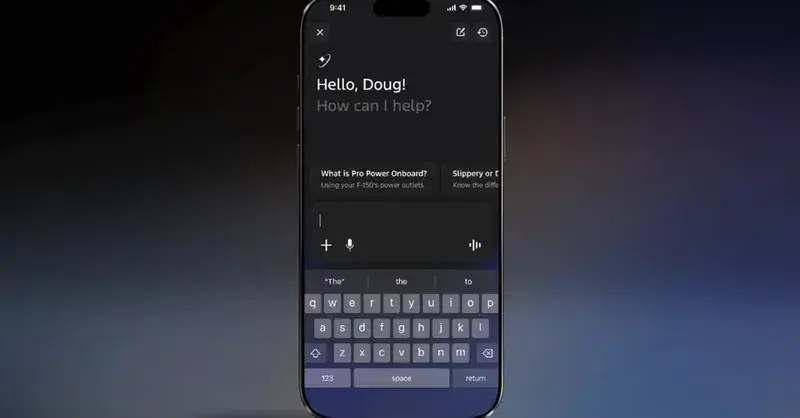
Ford has officially launched its AI assistant through the Ford and Lincoln mobile apps, bringing AI-powered vehicle support to up to 8 million owners of Ford and Lincoln vehicles
1
2
. The assistant, which Ford first announced at CES in January, is now rolling out in waves to customers with 2021 and newer connected vehicles3
5
. Accessible through a blue oval and spark icon in the updated mobile app for Android and iOS, the Ford AI assistant represents the automaker's strategic entry into the competitive landscape of automotive AI4
.Unlike generic chatbots, the Ford AI assistant connects directly to each owner's specific vehicle, pulling real-time vehicle data including fuel levels, oil life, tire pressure, and cargo capacity
1
4
. Owners can ask vehicle-specific queries such as "how many bags of mulch can my truck bed support?" and receive immediate answers based on their vehicle's actual specifications2
. The assistant can interpret dashboard warning lights, eliminating the need to search the internet for explanations4
. Users can even upload pictures to check whether their vehicle can carry or tow specific payloads1
. The system leverages telemetry data from the vehicle's sensors to suggest troubleshooting steps for quick fixes5
.Ford's deliberate app-first approach allows the company to test customer interactions, refine responses, and address reliability issues before embedding the technology into in-vehicle infotainment systems
2
. Hosted on Google Cloud and built using large language models with deep access to vehicle-specific information, the assistant can answer questions from the owner's manual while providing live updates through the vehicle's telemetry system1
2
. Mike Aragon, Ford's president for integrated services, emphasized this strategy: "By taking an app-first approach, we are bringing the future of Ford intelligence directly to customers instantly. You don't have to wait to buy a brand-new vehicle; we're upgrading the ownership experience you already have, starting today"1
. The gradual release is designed to receive feedback and improve answer quality over time3
.Related Stories
The in-vehicle version of the Ford AI assistant arrives in 2027, debuting with the $30,000 Fathom electric truck on Ford's Universal EV Platform
2
. This timeline gives Ford at least a year of real-world usage data from the mobile app before the assistant needs to work reliably while someone is driving2
. The Fathom will ship with native Apple Maps for EV route planning, BlueCruise hands-free driving, and bidirectional charging, with the AI assistant tying these systems together through natural language2
. In the meantime, Ford is integrating Gemini into its Android-based Ford and Lincoln Digital Experiences as an opt-in alternative to Google Assistant1
3
. While Gemini helps with top-level tasks like navigation and car control, the Ford system will address model-specific questions3
.Ford joins an intensifying race among automakers to add AI-powered features, competing with Rivian and Mercedes-Benz who have launched their own voice assistants, BMW partnering with Amazon's Alexa, and GM working with Google's Gemini
1
2
. Ford's advantage lies in scale: 8 million app users represents a testing population most AI startups would envy2
. The automaker designed its assistant to be chatbot-agnostic, enabling it to work with various large language models rather than committing to a single AI model1
4
. Aragon predicts the "true magic" will emerge when the assistant migrates from phones to dashboard screens through "deep, thoughtful intelligence embedded directly into the driving experience"1
. Ford envisions merging vehicle-specific requests with infotainment-level queries, enabling owners to create custom systems tailored to their preferences1
. The assistant will further draw on Ford data and services to customize the user experience, though the company hasn't detailed what that entails3
. Ford says the assistant will remain free to use, though the company hasn't confirmed whether this will continue after the assistant becomes available through the vehicle's operating system1
4
.Summarized by
Navi
[2]
08 Jan 2026•Technology

11 Mar 2026•Technology

12 May 2026•Technology

1
Science and Research

2
Technology

3
Technology