Gartner predicts 60% of organizations will adopt smaller software engineering teams by 2029


2 Sources
[1]
Gartner Predicts 60% of Organizations Will Adopt Smaller Software Engineering Teams by 2029
The exact size of tiny teams will vary by organization and the needs of the feature set or product they are developing. By 2029, 60% of organizations will adopt smaller software engineering teams at scale, up from 15% in 2026, according to Gartner, Inc., a business and technology insights
[2]
How AI and Automation Are Shrinking the Modern Dev Team by 2029
By 2029, 60% of organizations will adopt smaller software engineering teams at scale, up from 15% in 2026, according to Gartner, Inc., a business and technology insights company. "AI is reshaping software engineering. It is redefining roles, reinventing teams, and fueling the demand for more
Share
Copy Link
Gartner forecasts that 60% of organizations will shift to smaller software engineering teams by 2029, up from just 15% in 2026. These 'tiny teams' of 2-5 members leverage AI and automation to focus on high-value work, but experts warn against cutting junior roles, which could hollow out the software engineering talent pipeline and limit knowledge transfer.
AI Drives Major Shift in Software Engineering Teams
Gartner has issued a striking forecast that will reshape how organizations structure their development operations. By 2029, 60% of organizations will adopt smaller software engineering teams at scale, a dramatic increase from just 15% in 2026
1
2
. This transformation reflects how AI is fundamentally altering the software development landscape, enabling leaner structures without sacrificing output or quality.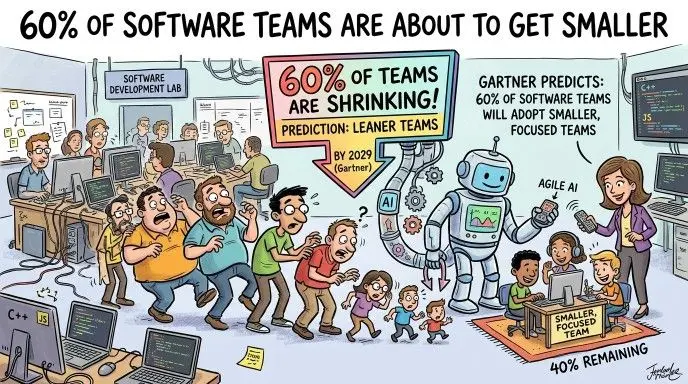
Source: CXOToday
"AI is reshaping software engineering. It is redefining roles, reinventing teams, and fueling the demand for more software engineers, not fewer," said Aliyah Camacho, Principal Analyst at Gartner
1
. She emphasized that the resources required to meet growing demand for software and complex AI-enabled applications will outpace the efficiency gains from AI itself.Understanding the Tiny Teams Model
These so-called tiny teams typically consist of 4-5 members today, though some require as few as 2-3 people, a configuration that will become more common as employee skills and AI capabilities mature
2
. The exact size varies by organization and the needs of the feature set or product under development. Camacho notes that tiny teams should be small enough to stay nimble and effective, yet big enough to promote diversity of ideas or alternate viewpoints1
.Crucially, this shift is not about cost-cutting. "Tiny teams are not a cost optimization tactic," Camacho clarified. "This is a restructuring of teams to best take advantage of both human and AI capabilities and strengths"
2
. As AI and automation handle more routine technical tasks, engineers gain freedom to focus on complex problem-solving and innovation.Platform Engineering Enables Focused Work
The success of smaller software engineering teams depends heavily on robust platform engineering support. These tiny teams can concentrate on high-value work by leveraging standardized, automated workflows and self-service AI tools and capabilities provided by platform engineering teams
2
. This infrastructure allows developers to work more efficiently without getting bogged down in repetitive tasks.In this new structure, traditional software engineering role boundaries collapse. Each team member manages a variety of responsibilities, from understanding business goals to product design and overseeing AI agent oversight
1
. Tiny teams typically require versatile and skilled engineers such as a product manager, a user experience (UX)/agent experience (AX) designer, and at least one AI-native software engineer2
.
Source: DT
Related Stories

The Critical Warning About Junior Roles
Despite the efficiency gains, Gartner issues a stark warning about talent pipeline issues. Software engineering leaders should not stop hiring and developing junior-level talent, even as teams shrink
2
. "Slowing junior-level hiring could lead to significant pitfalls, including inhibiting knowledge transfer, restricting the internal talent pipeline, and limiting recruitment to more expensive and competitive senior roles," Camacho cautioned1
.Gartner predicts that by 2028, organizations that rely on AI to cut junior roles will hollow out their own software engineering talent pipeline
2
. This creates a critical tension: while AI enables smaller teams, organizations must resist the temptation to eliminate entry-level positions that serve as the foundation for future leadership and expertise. The short-term efficiency gains from AI could create long-term strategic vulnerabilities if companies fail to maintain robust knowledge transfer mechanisms and career development pathways.References
Summarized by

Navi
Related Stories
Gartner Predicts 80% of Engineers Will Need AI Upskilling by 2027
07 Oct 2024•Technology

Tech Leaders Predict Surge in Software Engineering Jobs Despite AI Advancements
12 Apr 2025•Business and Economy

AI's Impact on Software Engineering: Industry Leaders Predict Shift in Coding Landscape
22 Mar 2025•Technology

Recent Highlights
1
Microsoft and Nvidia Launch Surface Laptop Ultra: A $2,599 AI-Ready PC With RTX Spark Chip
Technology

2
Trump Consulted Grok AI Before Ordering Venezuela Invasion and Capture of Nicolás Maduro
Policy and Regulation

3
Scientists Build AI Model That Reconstructs Images From Brain Scans in Record Time
Science and Research

Recent Highlights
Today's Top Stories







Don’t drown in AI news. We cut through the noise - filtering, ranking and summarizing the most important AI news, breakthroughs and research daily. Follow topics that matter to you and stay ahead.


