GitHub Copilot Fusion Slashes AI Development Costs by Half as Agents Drive 40% of Pull Requests


9 Sources
[1]
GitHub powering up four million extra cores to stop its service going down
GitHub's Universe conference kicked off in San Francisco on Wednesday with news that its infrastructural universe is expanding to address staggering demand from AI agents. GitHub recorded 7.4 billion code commits in September 2026, five times more than hit its servers a year earlier. This surge in
[2]
GitHub bets on multi-agent software development with Copilot overhaul
A revamped Copilot app and new Projects feature would let organizations coordinate multiple AI coding agents, manage development context, and automate work across repositories. endif; ?> GitHub is expanding Copilot beyond code generation and developer assistance, launching a redesigned Copilot app
[3]
GitHub Universe: Copilot Fusion launches as agents start 40% of PRs
At GitHub Universe, Enterprise customers got every Copilot feature without a separate subscription. GitHub also says developers pushed code 17.9 billion times this year, more than in 2024 and 2025 combined. GitHub launched Copilot Fusion at GitHub Universe, its developer conference, on Wednesday.
[4]
GitHub Copilot Fusion mixes models to achieve near-Opus 5.5 coding performance at half the per-task cost
Microsoft subsidiary and popular code repository hosting service GitHub is rolling out a system that decides which AI models should handle a software development task -- and, according to independent testing, can approach the performance of a leading coding agent for roughly half the expense. At
[5]

Does the World Need a New GitHub?
Technological advancements suggest that current coding practices may only represent a fraction of future developments. Everything that humanity has coded to date -- every operating system, transfer protocol, open-source library -- may only represent 1% of what's about to be built. We're living
[6]

GitHub is adding four million CPU cores to its infrastructure to deal with the demand from AI
To handle the massive influx of AI or vibe-coded projects GitHub is planning to expand its infrastructure with 4 million new CPUs and 160 PB of storage. Microsoft-owned GitHub is the go-to repository for developers to share code, collaborate, and distribute projects. With the meteoric rise of
[7]
GitHub Expands Infra With 4 Mn Cores, Debuts Copilot Fusion
Copilot Fusion features different effort tiers to improve task completion rates while managing costs effectively. After provisioning more than 3 million CPU cores and 120 petabytes of high-speed storage in August following a series of reliability incidents, GitHub is now doubling down on expanding
[8]

GitHub Universe 2026: Evolving every layer of the stack
Our jobs as developers are changing. In a couple of years, we've gone from writing every line of code to working with AI assistants to orchestrating fleets of agents. But the goal hasn't changed: ship completed software work. A feature, a bug fix, a security fix. Completed work, not more code, is
[9]

GitHub Copilot Adds New AI Agent Features to VS Code in 2026
GitHub Copilot expands VS Code with cloud agents, multi-agent sessions, Copilot Fusion, Computer Use, and remote tools that help developers handle complex coding tasks with greater speed and control. Cloud agents let developers delegate coding tasks and review results across multiple
Share
Copy Link
GitHub unveiled Copilot Fusion at its Universe conference, an AI orchestration engine matching Claude Opus 5.5 performance at 50% lower cost. With AI agents now initiating 40% of pull requests, GitHub is deploying 4 million CPU cores and 160 petabytes of storage to handle surging demand.
GitHub Copilot Fusion Transforms AI Software Development Economics
GitHub launched Copilot Fusion at GitHub Universe 2026, introducing an AI orchestration engine that routes coding tasks across multiple models to optimize performance and cost
3
4
. According to independent testing by Artificial Analysis, Copilot Fusion Max scored within two points of Claude Opus 5.5 Max on the Coding Agent Index while completing tasks at half the cost—$5.59 per task compared to $11.42—and 40% faster1
4
. Microsoft CEO Satya Nadella highlighted potential savings of up to 77% in company evaluations, positioning task-level costs rather than individual model pricing as the central value proposition for enterprise customers3
.
Source: VentureBeat
The system evaluates tasks across reasoning, code generation, debugging, and tool use, then determines whether to route requests to a single model or coordinate multiple models
1
. GitHub Chief Product Officer Mario Rodriguez explained that Copilot Fusion operates as an orchestration engine, not another AI model, using three execution patterns: Single for direct routing, Cascade for escalating complexity, and Critique for iterative refinement4
. The system draws from models including Claude Opus 5.5, Claude Sonnet 5.5, GPT-6 Astra, and open-weight options like Moonshot AI's Kimi K3 and Alibaba Qwen 2.54
5
.Autonomous AI Agents Reshape Software Development Lifecycle
The Octoverse report reveals that by September 2026, more than 40% of pull requests on GitHub started with drafts from AI agents, surging from 17% in March
3
5
. This represents 110 million agent-initiated pull requests in September alone3
. Developers pushed code 17.9 billion times in the 12 months ending September 30, exceeding the combined totals of 2024 and 2025, with commits reaching 34.3 billion and merged pull requests hitting 1.3 billion3
5
. Jay Parikh, EVP of CoreAI at Microsoft, stated that all software written to date may represent less than 1% of what will be developed in the next five years1
.
Source: AIM
The shift toward multi-agent software development became evident when three Anthropic engineers ported their core Messages API from Python to Rust in one month without knowing the language, relying entirely on Claude's capabilities
5
. Angela Jiang, Head of Product for Claude Platform at Anthropic, confirmed that the team had no Rust developers and trusted Claude to write the code while building systems around it5
. This demonstrates how the software development lifecycle is collapsing from a linear process into a system where autonomous AI agents handle implementation and verification while humans focus on defining tasks and reviewing output5
.Infrastructure Upgrades Address Capacity Crisis
GitHub recorded 7.4 billion code commits in September 2026, five times more than the previous year, causing a series of outages throughout 2026
1
. AI-driven code commits became problematic starting in December 2025, leading to availability issues in February, April, and August, with the site's 90-day availability hitting approximately 84% on May 71
. In response, GitHub deployed 4 million CPU cores, 160 petabytes of high-speed storage, and 50 Tb/s of network capacity to support its 225 million developers and half a billion public repositories1
5
.
Source: TweakTown
The Microsoft-owned platform is redesigning its technical architecture to separate compute and storage, targeting 35x more throughput and completing migration to multi-region deployment in Azure by early 2027
1
5
. Parikh acknowledged that GitHub struggled with performance and reliability due to unprecedented growth, stating the company must do better5
. The infrastructure investments specifically address GitHub Actions, the company's continuous integration and continuous delivery platform that bore the brunt of increased compute demands1
.Related Stories

Copilot Projects Enables Parallel Agent Coordination
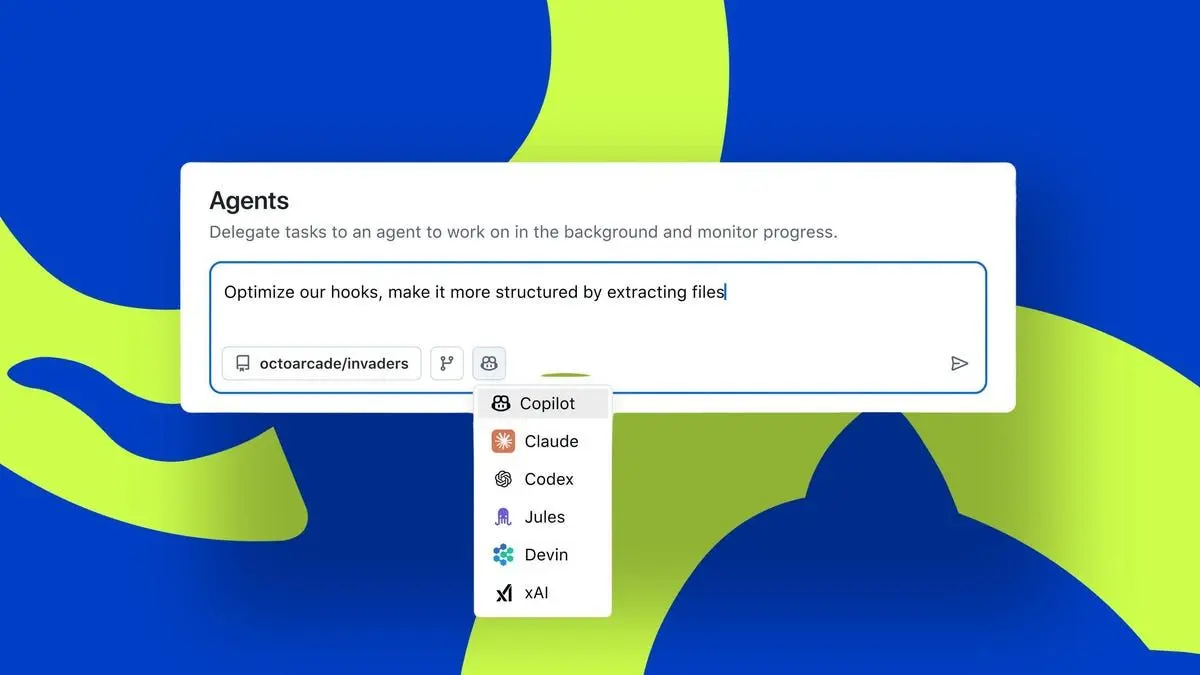
GitHub introduced Copilot Projects to coordinate multiple AI agents working across repositories simultaneously
2
3
. The feature allows developers to assign agents broader goals spanning multiple repositories, providing context from design mockups, Slack conversations, and meeting notes, after which Copilot distributes work across parallel agent sessions and returns results as pull requests for review2
. Amit Kumar Jena, AI development head at Kanerika, noted this could shift developers from writing code directly toward defining tasks, providing context, and validating agent output2
.The revamped GitHub Copilot app now serves as a central workspace for managing AI software development, extending beyond code generation to specifications, design discussions, and application telemetry analysis
2
. Session continuity enables cloud agent sessions to move between the app, VS Code, command line, and web interfaces3
. However, Abhishek Satapathy, principal analyst at Avasant, warned that coordinating parallel agent changes across repositories could create challenges as agents may modify the same files or introduce conflicting architectural assumptions2
.Enterprise Access Model Eliminates Per-Seat Licensing
GitHub extended Copilot access to all GitHub Enterprise users without requiring additional per-seat purchases, shifting to a token-based billing model
1
3
. The offer currently runs through GitHub's sales team with self-serve options coming soon, while existing Copilot Business and Copilot Enterprise customers can maintain their plans or switch at their discretion3
. This commercial restructuring aims to boost Copilot usage in workplaces by removing licensing friction while maintaining revenue through consumption-based pricing1
.GitHub also launched Copilot Automations with self-improvement capabilities that monitor human intervention and automatically refine prompt sequencing and tool usage
5
. Copilot Connectors simplify how Copilot connects to MCP servers, while Copilot Dreaming automatically opens pull requests to update outdated instruction files when codebases change languages or frameworks1
5
. For vulnerability detection, GitHub introduced AI Scans for checking pull requests in languages not covered by rule-based scanning, plus reachability analysis tools and a package firewall that validates enterprise policy settings before fetching npm packages1
.References
Summarized by

Navi
[4]
Related Stories
GitHub Copilot Introduces Agent Mode and Advanced AI Features to Boost Developer Productivity
07 Feb 2025•Technology

GitHub Launches Agent HQ: Unified Platform for Managing Multiple AI Coding Agents
29 Oct 2025•Technology
GitHub Copilot's Multi-Model Approach Challenges AI Coding Assistant Market
30 Oct 2024•Technology

Recent Highlights


Recent Highlights
Today's Top Stories












Don’t drown in AI news. We cut through the noise - filtering, ranking and summarizing the most important AI news, breakthroughs and research daily. Follow topics that matter to you and stay ahead.


