Google Builds $200bn AI Chips Infrastructure With Broadcom, Apollo & Blackstone to Power Anthropic


2 Sources
[1]
Inside Google's $200bn Wall Street finance machine for Anthropic
Google has assembled one of the largest infrastructure financing programmes in history to sell more than $150bn of AI chips destined for Anthropic. The effort brings together Google, Broadcom, Apollo, Blackstone, Morgan Stanley and a slew of crypto miners in a web of transactions that stretches
[2]
Google Trails NVIDIA in AI Chip Sales, yet a Broadcom-Backed Pivot Could Unlock $252 Billion
In a fresh report, Bank of America claims that Google can earn as much as $252 billion in sales of its tensor processing units (TPUs) by shifting its business model. Google's TPUs are among the most widely used custom AI chips in the industry, and BofA believes that the firm can further expand its
Share
Copy Link
Google has assembled one of the largest infrastructure financing programmes in history—worth roughly $200 billion—to sell Tensor Processing Units to Anthropic. The effort brings together Broadcom, Apollo, Blackstone, and Morgan Stanley in a web of transactions spanning chip manufacturing to data centre development, potentially unlocking $252 billion in TPU revenue by 2028.
Google Assembles Historic $200bn Infrastructure Financing for AI Chips
Google has built one of the largest infrastructure financing programmes ever assembled, worth approximately $200 billion, to sell more than $150 billion of AI chips destined for Anthropic
1
. The sprawling effort brings together Google, Broadcom, Apollo, Blackstone, Morgan Stanley, and even crypto miners in a complex web of transactions that stretches from AI chip production to AI data centers development. These arrangements reveal how Big Tech is creating funding models for AI infrastructure that reach far beyond traditional corporate spending and tie more of the financial system to the industry's growth.At the centre of this infrastructure financing sits Google's Tensor Processing Units, or TPUs—AI chips the company has co-developed with Broadcom since 2016. Once used largely inside Google's own AI data centers, these AI chips have begun to be sold externally, challenging Nvidia's dominance of the AI processor market
1
. Google sells them in "pods"—server racks taller than a person that connect thousands of chips into a single computing system. "AI chips are some of the most valuable goods ever produced," said a senior banker close to the deals. "It's a scale like we've never seen before because it's a product we've never seen before."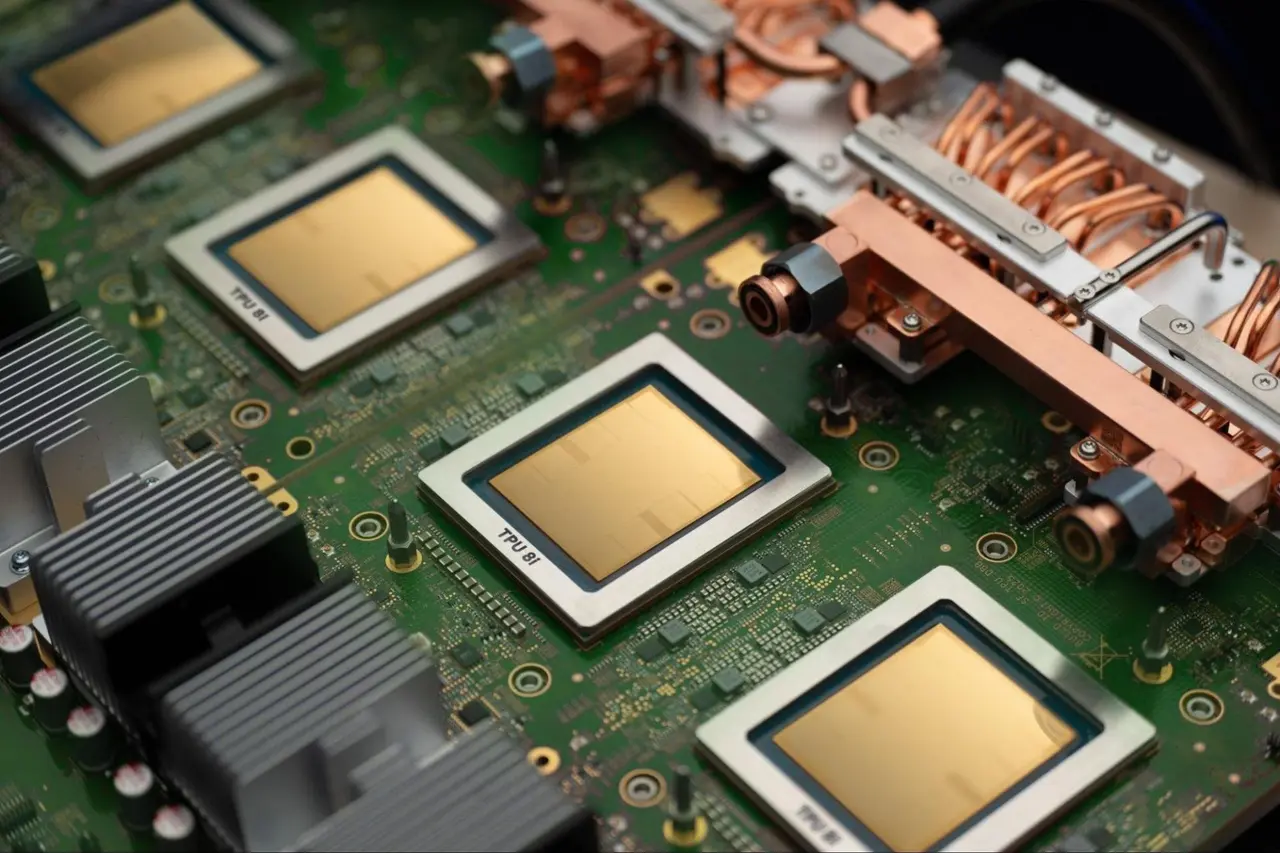
Source: Wccftech
How the $200bn Financing Structure Works
Surging demand from Anthropic required a sprawling financing operation to support sales to a start-up without a credit rating. To support that expansion, Google, Broadcom, and Wall Street investors each took on different pieces of the financial risk. Google, which is also an investor in Anthropic, guarantees the AI data centers. Broadcom commits to buying the AI chips and helps finance them. Apollo and Blackstone provide much of the private-credit capital that purchases the hardware before leasing it to Anthropic
1
."This is each of us putting our balance sheet to work," said a Google executive involved in the effort. "We're doing it on the data centre side, [Broadcom's] doing it on the chip side." The web of contracts underpinning these arrangements adds up to about $200 billion, with roughly four-fifths tied to the chips themselves, making it one of the largest infrastructure financings ever assembled.
None of the companies involved wanted to carry tens of billions of dollars of AI chips on their balance sheets. Google, which is already funding record capital spending, would prefer not to add them. So Broadcom agreed to buy the AI hardware from it. But Broadcom, too, would rather deploy its capital elsewhere. "Broadcom is the financing provider, but they don't want to be in the financing business," said one person familiar with the effort
1
.Morgan Stanley's Private-Credit Vehicle Enables Vendor-Financing Model
That challenge produced an unusual solution. Morgan Stanley helped arrange a private-credit vehicle, funded by outside investors, that buys the chips and leases them to Anthropic in an adaptation of the vendor-financing model Boeing and GE built to sell aircraft and engines. In June, the first tranche of TPU hardware passed from Google through Broadcom into this financing blender. A special-purpose vehicle known as Compute SPV paid $35 billion for roughly 1GW of the AI hardware, representing around 1 million TPUs
1
.The SPV's cash came from three tranches of debt anchored by Apollo and Blackstone. Broadcom, in effect, guaranteed the two senior tranches by agreeing to cover any shortfall if Anthropic stopped paying and the SPV could not sell the hardware for enough to make the senior investors whole. The arrangement, known as residual value support, covers about $30 billion of the $35 billion financing, with Broadcom's exposure declining as Anthropic makes its lease payments.
Broadcom's $128bn Purchase Commitments Signal Massive Expansion
That structure is the template expected to finance Tensor Processing Units worth hundreds of billions more. The largest deal yet came together in April when Google agreed to sell another 3.5GW of TPU hardware to Broadcom for deployment by Anthropic. Broadcom's filings disclose $128 billion of purchase commitments, with $55.2 billion of deliveries scheduled for its 2027 fiscal year and $72.9 billion for 2028. People familiar with the arrangements said those commitments relate almost entirely to its agreed purchase of 3.5GW of TPU hardware from Google
1
.Crypto Miners Transform Into AI Infrastructure Developers
Financing the chips solved only half of Google's problem. The company also needed enough powered AI data centers to house them. "We have a schedule and we're looking for capacity that will fit the schedule," the Google executive said. "Crypto miners with excess capacity were helpful." This has helped transform several crypto miners with secured power into a new breed of AI infrastructure developers, with a small outfit called TeraWulf the first to land a Google backstop to add a 360MW data centre on its campus in upstate New York. Google guaranteed the lease payments on the Anthropic-bound site, which Morgan Stanley packaged into a construction bond that in October raised $3.2 billion to get it built
1
.Related Stories

Bank of America Projects $252bn Revenue Potential From Merchant Model Shift
Bank of America claims that Google can earn as much as $252 billion in sales of its Tensor Processing Units by shifting its business model
2
. Google's TPUs are among the most widely used custom AI chips in the industry, and BofA believes the firm can further expand its platform by entering into joint ventures with asset managers Blackstone and Apollo Global, as well as chip designer Broadcom.Google's TPUs are among the oldest AI chips in the market, and unlike Nvidia, which sells its products to data center firms such as CoreWeave, the firm offers the TPUs through its Google Cloud business. Google's second-quarter earnings saw revenue from the Cloud business grow by a whopping 82% annually to touch $24.8 billion
2
. The firm had made inroads into the AI computing infrastructure race before ChatGPT's public release. Google started using its in-house AI processors in 2015 to beat Amazon to the punch by three years. It made the TPUs available to external customers in 2018.Off-Platform Merchant Model Could Generate $67bn by 2027
A report from Bank of America claims that Google can generate as much as $252 billion from shifting its TPU business from Google Cloud to an off-platform merchant model. This model should likely see Google create joint ventures with asset managers Apollo Global and Blackstone, along with custom AI chip designer Broadcom, to outsource TPU capacity and enable the combined entity to offer the chips for computing capacity. Such a move could lead to Google operating 11.5 gigawatts of TPU capacity by 2028 to generate the aforementioned revenue
2
.The heavy lifting will be done by Google's joint venture with Apollo and Blackstone, says the report. In June, Apollo and Blackstone led a $35 billion AI infrastructure funding platform with Broadcom to deploy the TPUs. As per BofA's estimates, the deal could contribute $20 billion to Google's revenue by the year's end and grow the contribution to $67 billion in 2027 courtesy of 3.2 gigawatts of deployed TPU capacity
2
. This shift positions Google to compete more directly in the AI processor market while leveraging financial partners to manage balance sheet risk and accelerate deployment at unprecedented scale.References
Summarized by

Navi
Related Stories
Google deploys billions to turn TPU chips into serious challenge against Nvidia's AI dominance
22 Jun 2026•Business and Economy

Google's custom AI chips draw billions from Meta and Anthropic, challenging Nvidia's dominance
28 Nov 2025•Technology

Anthropic Secures Massive Google Cloud Deal for AI Computing Power
22 Oct 2025•Technology

Recent Highlights



Recent Highlights
Today's Top Stories






Don’t drown in AI news. We cut through the noise - filtering, ranking and summarizing the most important AI news, breakthroughs and research daily. Follow topics that matter to you and stay ahead.


