Google's TPUs Challenge NVIDIA's AI Chip Dominance as Demand Surges


2 Sources
[1]
Omdia: Demand for Google's TPU chips accelerates challenging NVIDIA's dominance By Investing.com
, /PRNewswire/ -- Omdia's latest research highlights the rapid growth in demand for Google (NASDAQ:GOOGL)'s Tensor Processing Unit (TPU) AI chips, a trend that may be strong enough to start chipping away at NVIDIA (NASDAQ:NVDA)'s market dominance in GPUs. 3Q results from Broadcom (NASDAQ:AVGO),
[2]
Omdia Research: Google's Tensor Processing Units (TPUs) Are Eating NVIDIA's Lunch
This is not investment advice. The author has no position in any of the stocks mentioned. Wccftech.com has a disclosure and ethics policy. NVIDIA has reigned uncontested over the AI chip sphere for far too long. However, now it seems that some much-needed competition is finally putting up a
Share
Copy Link
Omdia research reveals Google's Tensor Processing Units (TPUs) are gaining significant market share in the AI chip industry, potentially challenging NVIDIA's long-standing dominance.

Google's TPUs Gain Ground in AI Chip Market
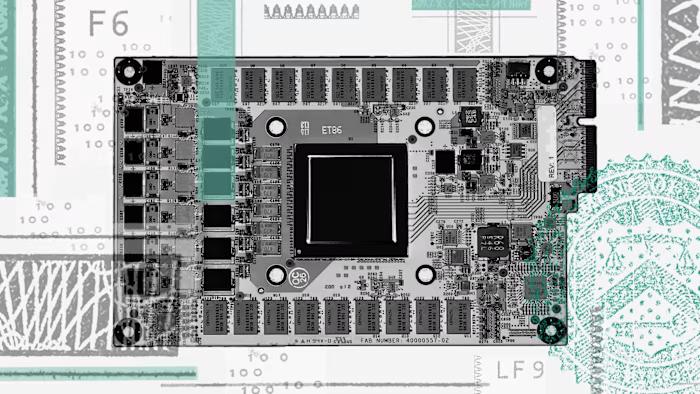
Recent research by Omdia has highlighted a significant shift in the AI chip market, with Google's Tensor Processing Units (TPUs) experiencing rapid growth and potentially challenging NVIDIA's long-standing dominance in the field
1
. This development marks a crucial turning point in the AI hardware landscape, as it represents the first time NVIDIA's market share might be notably impacted by a competitor.Broadcom's Role and Revenue Projections
Broadcom, acting as a custom chip outsourcing partner for major tech giants including Google and Meta, has provided insights into the growing demand for AI chips. The company's CEO has repeatedly revised upward the target for AI semiconductor revenue, now aiming for between $6 billion and $9 billion this year
1
. A substantial portion of this revenue is attributed to Google's TPUs, with estimates ranging from $6 billion to $9 billion, depending on the mix between compute and networking devices2
.Impact on Google Cloud and Market Dynamics
The surge in TPU demand appears to be driving growth in Google's Cloud Platform business. Alexander Harrowell, Principal Analyst at Omdia, noted that Google Cloud's increasing share of Google's revenue and improving profitability could indicate that TPU-accelerated instance types or AI products running on TPUs are fueling this growth
1
. This trend suggests that Google's custom AI chips are not only gaining market share but also enhancing the company's cloud services offerings.The Broader AI Chip Landscape
While Google's TPUs are making significant strides, the AI chip market remains dynamic and competitive. Microsoft and Meta continue to be major customers for NVIDIA's GPUs, with Microsoft reportedly purchasing 485,000 units of NVIDIA's Hopper GPUs in 2024, and Meta acquiring 224,000 units
2
. NVIDIA is also preparing to launch its next-generation Blackwell GPUs, aiming to maintain its market leadership.Related Stories
Future Market Projections
The AI chip market is poised for substantial growth in the coming years. Morgan Stanley estimates that the custom AI chip market, primarily driven by cloud providers, will grow from $120 billion in 2024 to $300 billion by 2027, outpacing the growth rate of the GPU market
2
. Citi projects an even larger total addressable market of $380 billion by 2028, with AI GPUs (primarily NVIDIA) controlling 75% of the market and ASICs accounting for the remaining 25%2
.Implications for the AI Industry
The rise of Google's TPUs and other custom AI chips represents a significant shift in the AI hardware landscape. This trend towards custom chips or ASICs is driven by cloud providers seeking cost-effective solutions for optimizing internal workloads
2
. As competition intensifies, it may lead to increased innovation, potentially benefiting the broader AI industry through improved performance, efficiency, and cost-effectiveness of AI computations.References
Summarized by

Navi
[1]
Related Stories
Google deploys billions to turn TPU chips into serious challenge against Nvidia's AI dominance
22 Jun 2026•Business and Economy

Google's custom AI chips draw billions from Meta and Anthropic, challenging Nvidia's dominance
28 Nov 2025•Technology

Google Unleashes Ironwood TPU v7: Seventh-Generation AI Chips Challenge Nvidia's Dominance
06 Nov 2025•Technology
Recent Highlights



Recent Highlights
Today's Top Stories







Don’t drown in AI news. We cut through the noise - filtering, ranking and summarizing the most important AI news, breakthroughs and research daily. Follow topics that matter to you and stay ahead.


