Google DeepMind's Decoupled DiLoCo transforms distributed AI training with resilient architecture


2 Sources
[1]
Decoupled DiLoCo: Resilient, Distributed AI Training at Scale
Our new distributed architecture helps to train LLMs across distant data centers - with lower bandwidth and more hardware resiliency. Training a frontier AI model traditionally depends on a large, tightly coupled system in which identical chips must stay in near-perfect synchronization. This
[2]
Google's DeepMind's New Approach to Distributed Training of AI Models
It isolates local disruptions such as hardware failures and network issues so that other parts of the system can continue the learning processes Google's AI research arm DeepMind has introduced a decoupled distributed low-communication (DiLoCo) training architecture that could train advanced AI
Share
Copy Link
Google DeepMind unveiled Decoupled DiLoCo, a new architecture that trains AI models across geographically distant data centers without tight synchronization. The system maintains 90% efficiency even during hardware failures by dividing training into decoupled compute islands with asynchronous data flow, addressing a critical challenge as frontier models scale.
Google DeepMind Introduces Decoupled DiLoCo for Distributed AI Training
Google DeepMind has unveiled Decoupled DiLoCo (Distributed Low-Communication), a novel architecture designed to train AI models across geographically distant data centers while maintaining exceptional hardware resiliency
1
. The approach addresses a fundamental challenge in modern machine learning: as frontier models grow larger, maintaining near-perfect synchronization across thousands of chips becomes increasingly difficult. Traditional training methods rely on tightly coupled systems where identical chips must operate in lockstep, but this approach struggles at global scale.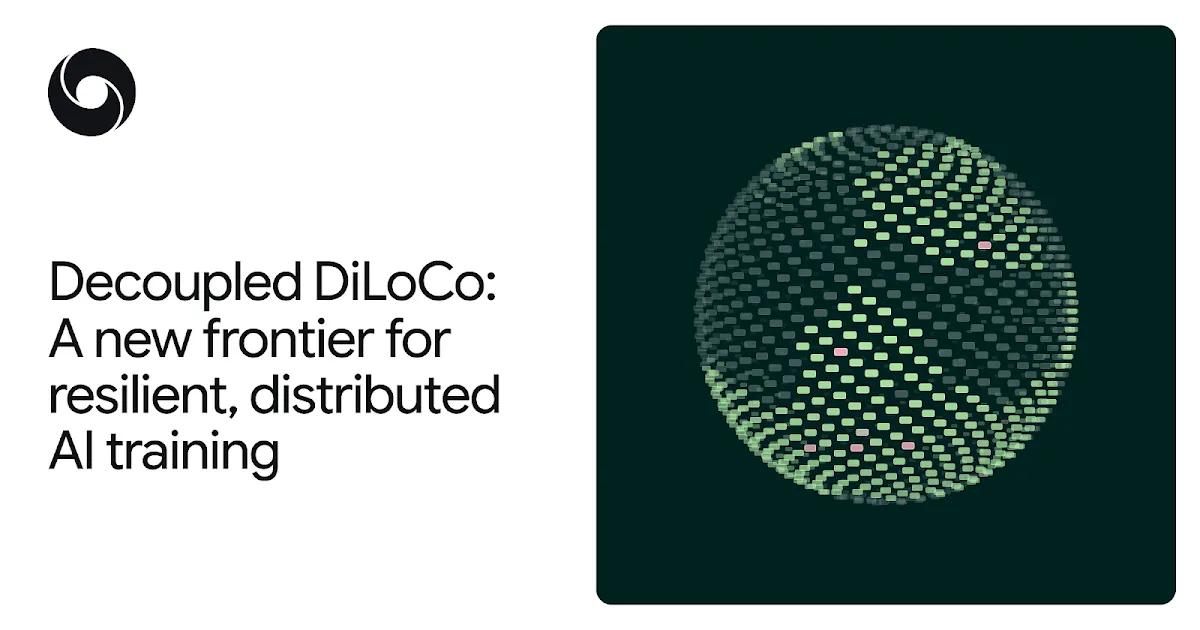
Source: DeepMind
The new system divides large-scale training workloads into decoupled compute islands that communicate through asynchronous data flow, effectively isolating local disruptions so other parts of the system continue learning efficiently
2
. This architecture enables large language model pre-training without requiring the tight synchronization that makes conventional approaches brittle at scale.How Decoupled DiLoCo Achieves Resilient Distributed Pre-Training
The architecture breaks down global clusters into independent asynchronous learners, with each group processing its own data at its own pace
2
. These learner units communicate parameter fragments to a central lightweight synchronizer that aggregates them asynchronously. The system employs a "minimum quorum" strategy, defining a threshold for the minimum number of independent trainers required to complete tasks before moving training forward.This approach is supported by an adaptive grace window—a buffer designed to maximize sample efficiency without sacrificing speed—and token-weighted merging, which appropriately weights faster learners capable of processing more data. DeepMind claims the system maintains training goodput of nearly 90% even when hardware failures are simulated aggressively, contrasting sharply with traditional elastic methods where goodput can fall up to 40% during runtime
2
.
Source: CXOToday
Training Across Geographically Distant Data Centers Without Bandwidth Constraints
Decoupled DiLoCo builds on two earlier advances: Pathways, which introduced distributed AI systems based on asynchronous data flow, and the original DiLoCo, which dramatically reduced bandwidth requirements between distributed data centers
2
. Crucially, the system does not suffer the communication delays that made previous distributed methods like Data-Parallel impractical at global scale1
.In testing with Gemma 4 AI models, researchers successfully trained a 12-billion parameter model across four separate U.S. regions using just 2-5 Gbps of wide-area networking—achievable with existing internet connectivity rather than requiring custom network infrastructure between facilities
2
. The system achieved this more than 20 times faster than conventional synchronization methods.Related Stories

Self-Healing Infrastructure Withstands Hardware Failures
The infrastructure demonstrates self-healing capabilities through chaos engineering tests, where researchers deliberately introduced artificial hardware failures during training runs
2
. Decoupled DiLoCo continued training after losing entire learner units, then seamlessly reintegrated them when they came back online. This enables zero global downtimes, as a chip failure in one compute island doesn't interrupt progress in others.As frontier LLMs continue expanding in scale and complexity, this architecture offers a practical path for training across more compute, locations, and varied hardware
1
. The ability to leverage globally distributed resources without custom infrastructure could accelerate development timelines while reducing dependency on concentrated computing clusters, particularly relevant as organizations face growing challenges in securing sufficient hardware capacity for next-generation models.References
Summarized by

Navi
Related Stories
DeepSeek unveils mHC architecture that could reshape how developers train advanced AI models
02 Jan 2026•Science and Research

DeepSeek's AI Breakthrough: Expertise Trumps Raw Compute in Model Development
28 Jan 2025•Technology

Google DeepMind releases DiffusionGemma AI model with 4x speed boost using image generation techniques
10 Jun 2026•Technology
Recent Highlights



Recent Highlights
Today's Top Stories









Don’t drown in AI news. We cut through the noise - filtering, ranking and summarizing the most important AI news, breakthroughs and research daily. Follow topics that matter to you and stay ahead.


