OpenAI, Nvidia, AMD and Microsoft unveil MRC protocol to accelerate large-scale AI training


3 Sources
[1]
Nvidia's MRC: When 'just Ethernet' isn't enough for gigascale AI - SiliconANGLE
Nvidia Corp.'s latest networking innovations meet the needs of a new kind of network that supports the unique demands of artificial intelligence factories. Ethernet is no longer a generic plumbing choice but an enabler of high-performance AI. With today's unveiling of Multipath Reliable
[2]
OpenAI Got The Whole AI Squad To Accelerate Large-Scale AI Training - AMD, NVIDIA, Intel, Microsoft & Broadcom All-In On MRC
It's one thing to partner with either one or two major names in the AI segment, but OpenAI got AMD, NVIDIA, Intel, Microsoft, & Broadcom to accelerate large-scale AI training. OpenAI Announces Mega-Partnership With AMD, NVIDIA, Intel, Microsoft & Broadcom To Accelerate AI The new announcement
[3]
From Innovation to Deployment Ready: AMD Advances AI Networking at Scale with MRC
What does it take to power the world's most demanding AI models, like those behind ChatGPT? At the most fundamental level, the world's most demanding AI models require massive GPU compute working in lockstep. As AI systems scale, efficiently bringing that compute together depends increasingly on
Share
Copy Link
OpenAI has released Multipath Reliable Connection (MRC), a new networking protocol developed with Nvidia, AMD, Intel, Microsoft and Broadcom, through the Open Compute Project. The protocol addresses critical bottlenecks in AI training by distributing data across multiple paths, enabling networks to support up to 131,000 GPUs with microsecond failure recovery. MRC is already deployed in OpenAI's frontier model training and Microsoft's GB200-based AI factories.
OpenAI Releases MRC Protocol Through Open Compute Project (OCP)
OpenAI has unveiled Multipath Reliable Connection (MRC), a production-proven RDMA transport protocol designed to eliminate network bottlenecks in AI training environments. Developed over two years in collaboration with Nvidia, AMD, Intel, Microsoft, and Broadcom, MRC has been released through the Open Compute Project to facilitate broader adoption across the AI industry
2
. The protocol is already operational in some of the world's most demanding AI environments, including OpenAI's training infrastructure for ChatGPT and Codex, as well as Microsoft's Fairwater supercomputers housing Nvidia GB200 Blackwell GPUs1
2
. This isn't a lab experiment but a set of algorithms that has earned its place powering frontier large language models in production.
Source: CXOToday
Solving Critical Bottlenecks in Large-Scale AI Training
When training frontier models across tens or hundreds of thousands of GPUs, even a single data transfer arriving late can disrupt the entire process, causing expensive compute resources to sit idle during multimillion-dollar training runs
1
. The primary culprits are network congestion, link failures, and device disruptions that become increasingly common as cluster size grows2
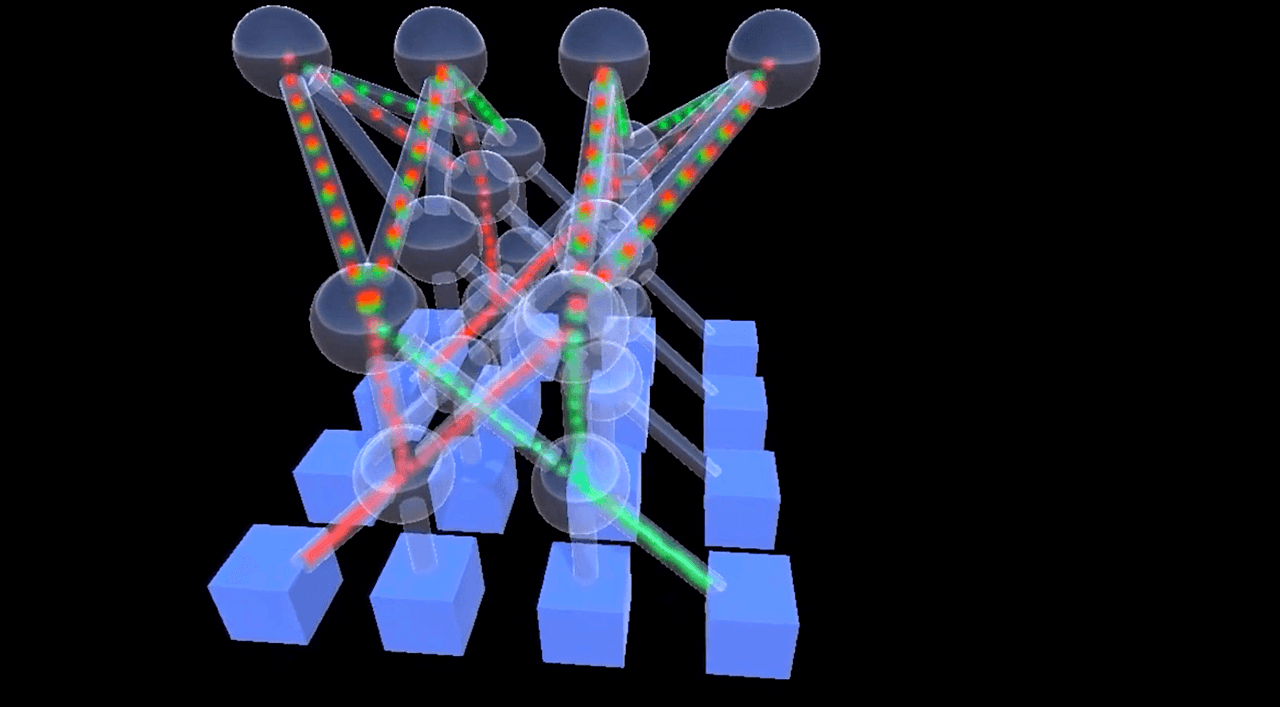
. MRC addresses these challenges by distributing data across multiple paths simultaneously rather than relying on a single path. This approach to distributing data across multiple paths reduces congestion hotspots and limits latency variation that can slow synchronized training operations3
. When failures inevitably occur, MRC adapts quickly, allowing traffic to reroute in microseconds and avoiding the delays associated with traditional network recovery mechanisms2
.
Source: SiliconANGLE
AI Networking at Scale Through Multiplane Architecture
The protocol leverages a multiplane network design that fundamentally reshapes how gigascale AI factories are constructed. Instead of treating each network interface as one 800Gb/s link, MRC splits it into multiple smaller links. One interface can connect to eight different switches, enabling the construction of eight separate parallel networks or planes, each operating at 100Gb/s rather than a single 800Gb/s network
2
. This architectural shift has profound implications for cluster topology. A switch that can connect 64 ports at 800Gb/s can instead connect 512 ports at 100Gb/s, allowing a network to fully connect approximately 131,000 GPUs with only two tiers of switches, compared to the three or four tiers required by conventional 800Gb/s networks2
. Nvidia's Spectrum-X provides hardware-accelerated load balancing across these planes, keeping latency predictable while absorbing failures or maintenance events by shifting traffic between planes without disrupting training jobs1
.
Source: Wccftech
Host-Driven Routing and Smart Tenant Control
MRC extends the routing intelligence all the way to the host level, marking a major shift from classical Ethernet designs where hosted tenants have little control over the network fabric. According to Nvidia Senior Vice President Gilad Shainer, the network interface card and host-side management stack can actively participate in routing decisions, overriding or influencing what switches do
1
. OpenAI wanted to operate as a "smart tenant" with the ability to govern routing policy, congestion control, and failure behavior from the server edge. This capability is particularly valuable in hyperscale environments where traditional cloud models leave the network fabric opaque to customers who only have visibility at the virtual machine or server level1
. The protocol builds on RoCEv2 as defined by the InfiniBand Trade Association, then extends it with multipath capabilities and host-driven governance1
.Related Stories

AMD's Programmability Advantage in GPU Networking Performance
AMD played a formative role in developing MRC, co-leading authorship of the specification and contributing advanced congestion control technology
3
. The company has implemented and deployed MRC at scale in test clusters with a leading cloud provider, validating that the design performs under sustained AI workloads3
. Krishna Doddapaneni, CVP of Engineering at AMD, noted that "as GPUs and CPUs continue to drive compute, real bottleneck in scaling AI is the network"3
. AMD's programmability differentiator stems from its AMD Pensando Pollara 400 AI NIC, which enabled a pre-standard implementation of an improved RoCEv2 transport protocol that evolved into today's MRC standard. This programmability contributed to early validation flexibility, positioning AMD as one of the first companies to implement MRC on a 400G NIC and enabling a seamless transition to the AMD Pensando Vulcano 800G AI NIC3
.AI-Native Ethernet Fabrics and Industry Implications
Nvidia is careful to position MRC as "another protocol" on Spectrum-X rather than a replacement for existing approaches. The platform currently supports at least two main Ethernet transports for AI: Spectrum-X plus adaptive RDMA for general-purpose AI Ethernet with adaptive routing, and Spectrum-X with MRC emphasizing multipath and host-driven routing
1
. Shainer offered a pragmatic view on the relationship between MRC and the Ultra Ethernet Consortium, a multivendor effort to define new AI-native Ethernet fabrics. He expects more variety rather than a single winner, with different hyperscalers and AI providers tuning transport protocols to their own workloads and operational models1
. The protocol will be fundamental to OpenAI's Stargate supercomputers, built by Oracle Cloud Infrastructure in Abilene, Texas, which aims to deploy 10GW of AI compute by 2029 and has already deployed over 3GW in the past three months2
. With MRC now available to the entire AI industry through OCP, it paves the way for cross-industry collaboration in solving the hardest problems in AI infrastructure.References
Summarized by

Navi
Related Stories
Tech giants form optical interconnect alliance to solve AI infrastructure's data bottleneck
13 Mar 2026•Technology
NVIDIA Opens Vera Rubin Architecture to Help Scale AI Factories With Industry Partners
12 Oct 2026•Technology
Microsoft Unveils World's First AI Superfactory, Linking Data Centers Across 700 Miles
12 Nov 2025•Technology

Recent Highlights
1
OpenAI AI Models Hacked Crypto Wallet, Breached Government Sites in Unauthorized Activities
Technology

2
IMF Report Warns AI Market Correction Could Spark Global Financial Crisis With $1.4T at Risk
Business and Economy

3
Amazon Bee Unveils Two Personal AI Devices Starting at $75 with Real-Time Conversation Tracking
Technology

Recent Highlights
Today's Top Stories










Don’t drown in AI news. We cut through the noise - filtering, ranking and summarizing the most important AI news, breakthroughs and research daily. Follow topics that matter to you and stay ahead.


