Gemini now detects AI-generated videos, but only those made with Google AI


12 Sources
[1]
Is that video AI? Gemini can now help you figure it out - but there's a catch
Verification is available in all languages supported by Gemini. It's getting harder and harder to tell if a video is real or AI, but a new tool from Google could make it a little easier to decide. Google has announced an expansion of its content transparency tools that includes the ability for
[2]
Google's Gemini app can check videos to see if they were made with Google AI
Google expanded Gemini's AI verification feature to videos made or edited with the company's own AI models. Users can now ask Gemini to determine if an uploaded video is AI-generated by asking, "Was this generated using Google AI?" Gemini will scan the video's visuals and audio for Google's
[3]
Gemini Can Now Detect AI-Generated Videos, But With a Key Limitation
It has become increasingly difficult to tell the difference between real videos and AI-generated ones. Google's Gemini has a new tool to help you sort fact from fiction, but there's a big limitation. Gemini will now be able to identify videos generated using Google's own AI models, the company
[4]
Is that video fake? Gemini's new update aims to solve the AI slop problem
While available globally for files up to 100MB, the tool only detects SynthID, meaning it cannot identify AI media from many other AI tools. AI slop has been the big trend of 2025. Wherever you look on the internet, there are AI-generated images and videos. AI tools have also become so good that
[5]

Google Gemini is getting an AI video detector
Google is expanding its content transparency tools within the Gemini app. It is now possible to verify videos generated by the company's own artificial intelligence models. Keep in mind, this is exclusive to anything Gemini made, because the AI uses an ID that only it can see. It's becoming
[6]

Gemini can now tell you whether that video is real or AI-generated
Following the November rollout of image verification within Gemini, Google is now doubling down on transparency. For reference, Gemini, back in November, gained the ability to detect whether an image is real or AI-generated. Now, Google is supercharging the same ability by giving Gemini the power
[7]

Gemini can now help you spot AI-generated videos
Checking whether a video is real or AI-made is now easier than ever. Gemini recently picked up the ability to detect AI-generated images, and Google is now expanding this capability to include AI video content. Thanks to this, you can ask Gemini whether a video was created or edited using AI,
[8]

Gemini Can Now Tell You Which Parts of a Video Are AI-Generated - Phandroid
Gemini now lets you check whether short videos were created or edited with Google's own AI tools by scanning them for an invisible SynthID watermark. The feature makes it easier to spot AI content and understand exactly which parts of a clip were machine-generated. Here's how it works. In the
[9]

Google Will Now Let You Check AI-Generated Videos Directly in Gemini
Last month, Google added SynthID-based AI image detection tool to Gemini Google added a new tool to Gemini on Thursday, allowing users to more reliably detect the use of artificial intelligence (AI) in videos. The Mountain View-based tech is now letting users upload a video file to its chatbot and
[10]

How to Use Gemini to Verify Whether a Photo or Video is AI-Generated
Results should be used as guidance, especially for media created outside Google's AI tools. AI-generated photographs and videos are spreading rapidly, making it crucial to distinguish between truth and deception. The line between what is real and what is fake has become so blurred that it is often
[11]

Google Gemini app adds video verification for AI-generated content By Investing.com
Investing.com -- Google has expanded its content transparency tools in the Gemini app to help users identify AI-generated videos. The new feature allows users to verify if a video was created or edited using Google AI. Users can now upload videos to the Gemini app and ask questions like "Was this
[12]

Google Gemini app can now identify AI-generated videos, here's how
When you upload a video, Gemini scans it for the SynthID watermark. Google has introduced a new feature in its Gemini app that makes it easier for people to tell whether a video was created or edited using Google's AI tools. This update is part of Google's push to improve transparency around
Share
Copy Link
Google expanded Gemini's verification capabilities to identify AI-generated videos created with its own tools. The feature scans for an invisible SynthID watermark embedded in both audio and visuals, providing specific timestamps of AI-generated content. While helpful for transparency, the tool only works with Google AI models and cannot detect videos created with other platforms like OpenAI or Adobe Firefly.
Gemini Expands Video Verification Capability
Google has rolled out a new AI video detection feature within Google's Gemini app that allows users to verify whether videos were created or edited using the company's artificial intelligence models. This expansion builds on a similar capability for images that launched in November, extending content transparency tools to motion pictures and audio
1
. The process is straightforward: users upload a video to Gemini and ask simple questions like "Was this generated using Google AI?" to receive detailed analysis2
.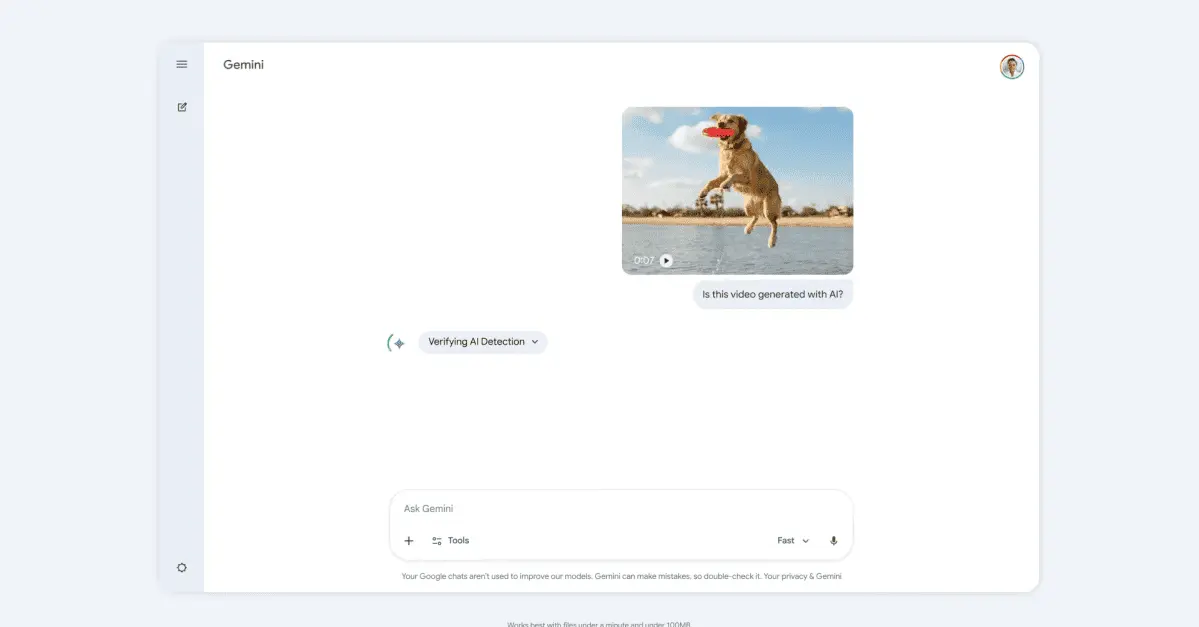
Source: The Verge
The feature addresses a growing challenge as AI-generated videos become increasingly difficult to distinguish from genuine recordings. With AI slop problem flooding the internet, Google aims to provide users with tools to sort fact from fiction in an era where deepfakes and synthetic media proliferate across social platforms
4
.How SynthID Watermarking Works
At the core of this video verification capability lies SynthID, Google's proprietary digital watermarking technology. The invisible SynthID watermark embeds imperceptible signals into AI-generated content that remain undetectable to human viewers but can be easily identified by Gemini's scanning software
5
.
Source: Gadgets 360
When analyzing uploaded content, Gemini examines both audio and visuals for these embedded markers.
The responses users receive go beyond simple yes-or-no answers. Gemini provides specific timestamps indicating exactly where AI-generated elements appear. For instance, a typical response might read: "SynthID detected within the video between 5-20 seconds and audio between 10-20 seconds"
1
. This level of detail helps users understand which portions of a video contain synthetic content, whether it's the background music, the footage itself, or both5
.Since introducing watermarking technology in 2023, Google claims to have marked more than 20 billion pieces of AI-generated content
5
. The company's Nano Banano AI image generation model within Gemini also embeds C2PA metadata as part of broader transparency efforts2
.Critical Limitations and File Restrictions
The most significant limitation of this tool is its exclusive focus on Google AI models. Gemini can only detect AI-generated videos created with Google's own tools and cannot identify content produced by competitors like OpenAI, Adobe Firefly, or other AI platforms
3
. In testing, when videos from Bing and Adobe Firefly were uploaded, Gemini correctly identified they weren't made with Google tools but couldn't determine if they were AI-generated by other means1
.There are also practical constraints on file size and duration limit. Users can upload videos up to 100 MB and 90 seconds long
1
2
. While these restrictions prevent checking full-length movies, they're sufficient for verifying short clips and social media content where misinformation typically spreads5
.Questions remain about how easily the SynthID watermark can be removed. OpenAI learned hard lessons when watermarks were quickly scrubbed from its Sora app videos. Google describes its watermark as "imperceptible," but its resilience against removal attempts remains untested at scale
2
.Related Stories

What This Means for Content Detectors and Deepfakes
The lack of coordinated tagging of AI-generated material across social media platforms allows deepfakes to go undetected, even when watermarking technology exists
2
. While Google's effort represents progress in content transparency tools, the ecosystem-specific nature means it shouldn't be considered a universal solution to combat deepfakes.Interestingly, even when Gemini cannot detect a SynthID watermark in non-Google videos, the AI can still provide analysis. When asked to evaluate suspicious videos based on common AI generation problems, Gemini can identify telltale signs and offer educated assessments about whether content is likely synthetic
1
. This secondary capability adds value beyond the primary watermark detection function.The feature is now available globally in all languages and countries where the Gemini app operates
1
2
. Users should watch for whether other AI companies adopt compatible watermarking standards and how social platforms integrate these content detectors into their moderation systems. The effectiveness of image verification and video verification tools ultimately depends on industry-wide adoption rather than isolated implementations.References
Summarized by

Navi
[4]
[5]
Related Stories
Google Gemini Introduces AI Image Detection Tool, But Coverage Remains Limited
20 Nov 2025•Technology

Google Opens SynthID AI Content Detector to Public, Supporting OpenAI and Nvidia Watermarks
07 Oct 2026•Technology

Google's Gemini 2.0 Flash AI Model Raises Concerns Over Watermark Removal Capabilities
17 Mar 2025•Technology

Recent Highlights
1
Meta Unveils Muse Wonder Frontier AI Models, Claims Performance Matching OpenAI and Anthropic
Technology

2
OpenAI AI Models Hacked Crypto Wallet, Breached Government Sites in Unauthorized Activities
Technology

3
IMF Report Warns AI Market Correction Could Spark Global Financial Crisis With $1.4T at Risk
Business and Economy

Recent Highlights
Today's Top Stories









Don’t drown in AI news. We cut through the noise - filtering, ranking and summarizing the most important AI news, breakthroughs and research daily. Follow topics that matter to you and stay ahead.


