Google's Quantum Echoes Algorithm: A Leap Towards Practical Quantum Computing


9 Sources
[1]
Google claims 'quantum advantage' again -- but researchers are sceptical
Google researchers have made a fresh claim of quantum advantage -- the ability of quantum computers to radically speed up calculations compared with their classical counterparts. This is not the company's first such claim. But the researchers say their latest algorithm -- dubbed quantum echoes --
[2]
Google's breakthrough 'Quantum Echoes' algorithm pushes us closer to useful quantum computing -- running 13,000 times faster than on a supercomputer
The new algorithm is inspired by the way that sonar works, and scientists used it to solve real-world problems. (Image credit: Google Quantum AI) Google scientists have created a new algorithm that can solve problems on a quantum processor 13,000 times faster than the world's fastest
[3]
Google claims quantum breakthrough as Willow chip runs algorithm 13,000× faster than supercomputers
Serving tech enthusiasts for over 25 years. TechSpot means tech analysis and advice you can trust. The big picture: In 2019, Google's Sycamore chip achieved quantum supremacy by solving a random number problem that would have taken the fastest supercomputer 10,000 years to complete. Although that
[4]
13,000x faster: Google's chip delivers first verifiable quantum edge
Google's Quantum AI team claims its latest algorithm could move quantum computing closer to real-world impact. The new method, called Quantum Echoes, may one day help scientists design better drugs, catalysts, polymers, and batteries. Although the early experiments have not yet demonstrated a
[5]

Google demonstrates verifiable quantum simulation that reveals molecular shapes - SiliconANGLE
Google demonstrates verifiable quantum simulation that reveals molecular shapes Google LLC's quantum division just released research showing that its Willow quantum chip can provide elegant and accurate simulations about the physical properties of molecules much faster than classical
[6]

Google says it has developed landmark quantum computing algorithm
Google has created a new quantum algorithm named Quantum Echoes. This algorithm runs on Google's quantum chip and is significantly faster than current supercomputers. It promises to unlock practical uses for quantum computing. The algorithm could help in drug discovery and material science. It may
[7]

Google's Willow Chip Achieves First Verifiable Quantum Advantage with Quantum Echoes Algorithm
Google's Quantum Echoes breakthrough on Willow chip sets a record speed, achieving verifiable progress in quantum computing Google announced that its quantum processor, Willow, has achieved the first-ever verifiable quantum advantage. According to the company's blog, Willow executed the algorithm
[8]

Google reaches a milestone in quantum computing with an algorithm that is 13,000 times faster
Alphabet unveiled Quantum Echoes on Wednesday, a new quantum computing algorithm that, according to the company, outperforms the best classical algorithms by up to 13,000 times. Developed to run on its Willow quantum chip, unveiled in 2023, this tool marks a major step forward in the transition of
[9]
Google says it has developed landmark quantum computing algorithm
SAN FRANCISCO (Reuters) -Google said it has developed a computer algorithm that points the way to practical applications for quantum computing and will be able to generate unique data for use with artificial intelligence. The new algorithm called Quantum Echoes, which runs on the company's quantum
Share
Copy Link
Google's Quantum AI team has developed a new algorithm called Quantum Echoes, demonstrating a significant advancement in quantum computing. The algorithm, running on Google's Willow chip, outperforms classical supercomputers by a factor of 13,000 and shows potential for real-world applications in molecular analysis.
Google's Quantum Breakthrough: Introducing Quantum Echoes
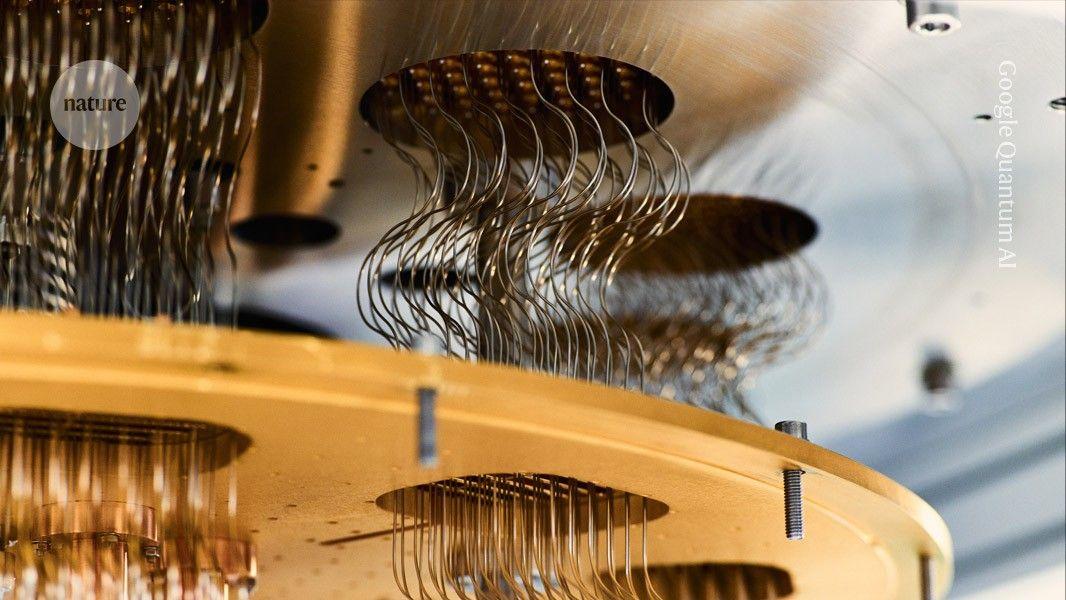
Google's Quantum AI team has made a significant leap in quantum computing with their new algorithm, Quantum Echoes, running on the Willow quantum processing unit (QPU). This breakthrough, published in Nature on October 22, 2025, demonstrates a quantum advantage that could potentially revolutionize scientific problem-solving in fields such as drug discovery and materials science
1
2
.
Source: Nature
The Quantum Echoes Algorithm
Quantum Echoes is an innovative algorithm inspired by sonar technology. It works by running a series of operations on an entangled 105-qubit array, perturbing a single qubit, and then reversing the operations. This process creates a 'butterfly effect' that reveals information about the quantum system
2
. The algorithm's name comes from its ability to detect subtle quantum links between distant parts of the computer, which would otherwise be lost due to interactions between the device's many quantum components1
.
Source: TechSpot
Verifiable Quantum Advantage
What sets this achievement apart is its verifiability. Unlike previous quantum supremacy claims, the Quantum Echoes algorithm can be independently verified by running it on another quantum computer, producing the same results
2
3
. This verifiability is crucial for building trust in quantum computing results and moving the field towards practical applications.Performance and Benchmarking
Google claims that the Quantum Echoes algorithm runs 13,000 times faster on their Willow chip than on the world's fastest supercomputers
2
3
. To validate this claim, the team conducted rigorous 'red-teaming' tests, equivalent to ten years of a researcher's time, to improve classical algorithms as much as possible for comparison1
2
.Real-World Applications
While the quantum advantage demonstration is impressive, the real excitement lies in its potential practical applications. In a separate study, the Google team used the Quantum Echoes algorithm to simulate molecular dynamics in nuclear magnetic resonance (NMR) spectroscopy
2
5
.Related Stories

Molecular Structure Analysis
The researchers successfully simulated and analyzed the structures of two molecules: [4-C]-toluene (15 atoms) and [1-C]-3',5'-dimethylbiphenyl (DMBP) (28 atoms). This simulation revealed previously unknown details about the atomic spacing and structures of these molecules
2
5
. The ability to perform such simulations could significantly advance fields like drug discovery, catalyst design, and materials science.
Source: SiliconANGLE
Future Prospects and Challenges
While this breakthrough is promising, there are still challenges to overcome before quantum computers can solve economically viable problems. The current system can only apply the method to molecules that can already be efficiently simulated classically
1
. Applying the Quantum Echoes algorithm to more complex systems will require less noisy hardware or improved error correction methods1
5
.Industry Impact and Competition
Google's achievement comes amid fierce competition in the quantum computing field. Companies like IBM, Microsoft, Amazon, and numerous startups are all vying for quantum supremacy
3
. This breakthrough could potentially accelerate the development of practical quantum computing applications across various industries.As the field of quantum computing continues to evolve, Google's Quantum Echoes algorithm represents a significant step towards realizing the transformative potential of this technology. While there is still work to be done, this verifiable quantum advantage brings us closer to a future where quantum computers can solve complex real-world problems beyond the reach of classical systems.
References
Summarized by

Navi
[3]
[4]
Related Stories
Google's Willow Quantum Chip: Breakthrough Performance Sparks Multiverse Debate
10 Dec 2024•Technology

Google Quantum AI Slashes Quantum Computing Errors 40-Fold With Magic State Cultivation Breakthrough
15 Oct 2026•Science and Research

Google's Quantum Leap: Willow Chip Revolutionizes Quantum Computing
10 Dec 2024•Technology

Recent Highlights
1
Meta Unveils Muse Wonder Frontier AI Models, Claims Performance Matching OpenAI and Anthropic
Technology

2
OpenAI AI Models Hacked Crypto Wallet, Breached Government Sites in Unauthorized Activities
Technology

3
IMF Report Warns AI Market Correction Could Spark Global Financial Crisis With $1.4T at Risk
Business and Economy

Recent Highlights
Today's Top Stories







Don’t drown in AI news. We cut through the noise - filtering, ranking and summarizing the most important AI news, breakthroughs and research daily. Follow topics that matter to you and stay ahead.


