Google Unveils TPU 8tx and 8i Max: Specialized AI Chips for Secure and Long-Context Workloads


6 Sources
[1]
Google reportedly adds two TPU variants for secure and long-context AI
Google is introducing two new versions of its in-house AI chips, known as tensor processing units (TPUs), Bloomberg News reported on Monday. The chips are called the TPU 8tx and the TPU 8i Max. Amin Vahdat, Google's chief technologist for AI infrastructure, told Bloomberg they are reworked
[2]
Google is unveiling two specialized AI chips to challenge Nvidia
The TPU 8tx and 8i Max, due to be available next year, target confidential computing and long-context AI workloads Google $GOOGL is launching a pair of tailored tensor processing units, or TPUs, to expand its AI chip lineup against Nvidia $NVDA, according to Bloomberg. The TPU 8tx and TPU 8i Max
[3]
Our newest TPUs: 8tx and 8i Max, built for the agentic era
Summaries were generated by Google AI. Generative AI is experimental. We first designed TPUs more than a decade ago motivated by Google's internal demands, including voice recognition and language translation. Eight generations of TPUs later, the use cases have exploded, covering: i) training and
[4]
Google advances agentic AI custom silicon expanding TPU family with 8tx and 8i Max
Google LLC today introduced two new specialized silicon chips for artificial intelligence to its eighth-generation Tensor Processing Unit architecture family, aimed at higher compute density and secure inference. At Google Cloud Next 2026 in April, Google introduced two specialized TPUs in the
[5]

Google to introduce two variants of in-house chips: Bloomberg News
Alphabet's Google is introducing two new variations of its in-house tensor processing units, Bloomberg News reported on Monday. The search giant's shares were up more than 2% in premarket trading. Through last close, the stock has fallen 9% so far this year. Alphabet did not immediately respond
[6]

Google Turns Up the Heat on NVIDIA With New Offerings - Alphabet (NASDAQ:GOOGL), Alphabet (NASDAQ:GOOG)
Alphabet Inc. (NASDAQ:GOOG) stock gained Monday as investors weighed Google's latest push into artificial intelligence chips and a broader rally in technology stocks. Google plans to introduce two specialized versions of its tensor processing units (TPUs), stepping up competition with NVIDIA Corp.
Share
Copy Link
Google introduces two specialized Tensor Processing Units—TPU 8tx for confidential computing and TPU 8i Max for massive context windows. The eighth-generation AI chip variants target regulated industries and agentic AI custom silicon needs, marking the first time Google has released four TPU systems in a single year.
Google Expands Eighth-Generation AI Chip Portfolio
Google has unveiled two specialized Tensor Processing Units—TPU 8tx and 8i Max—expanding its eighth-generation AI chip lineup to four systems in a single year
1
3
. Amin Vahdat, Google's chief technologist for AI infrastructure, confirmed these are reconfigured versions of existing silicon designed to address specific customer demands rather than entirely new chip designs2
. The move signals Google's strategic shift toward specialized AI chips that can be deployed rapidly—in months rather than years—by adjusting packaging, memory, and networking around foundational chip architectures3
.These new variants join the TPU 8t and TPU 8i, which Google introduced at Cloud Next in April for large-scale training and real-time reasoning respectively
1
. The TPU 8t and 8i deliver up to 2.7 times better training performance and 80% better inference price performance compared to previous generations3
. Google's accelerated release schedule marks a departure from its previous cadence of launching one new processor every two years1
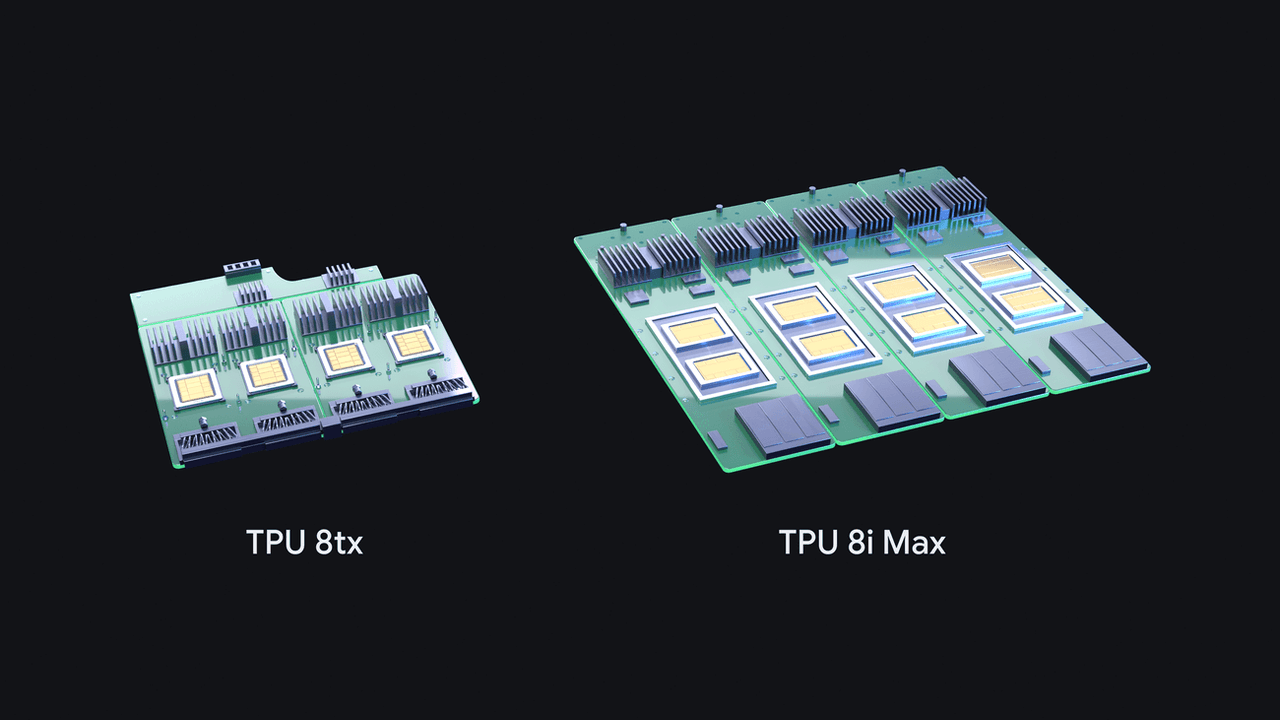
.TPU 8tx Brings Hardware-Level Encryption for Regulated Industries
Source: Google
The TPU 8tx targets secure and confidential AI workloads for government agencies and companies in regulated industries
1
4
. Built on the same silicon as TPU 8t and paired with 5th Generation AMD EPYC CPU hosts, the 8tx implements confidential computing by keeping sensitive data and model weights encrypted even during active processing3
. Normally, data must be decrypted in memory while computers work on it, creating security vulnerabilities2
.The chip encrypts data at the hardware layer through a secure enclave, eliminating the need to expose information during processing
4
. By adopting the same low-latency Boardfly network created for real-time reasoning, TPU 8tx delivers up to 2x lower latency compared to TPU 8t with near-zero performance penalty3
. This combination of training-grade compute with fast inference networking allows organizations to simultaneously run and customize models on a single confidential system, enabling regulated services to fine-tune models using private data without migrating between separate clusters4
.TPU 8i Max Scales Memory for Massive Context Windows
The TPU 8i Max addresses the growing demand for long-context AI applications by delivering double the compute, double the SRAM, and double the high-bandwidth memory of TPU 8i
4
. Vahdat emphasized this matters particularly for drug discovery, mathematics, and coding applications that require processing vast amounts of information in a single request2
. The chip packs two TPU chips together, providing extra processing muscle and memory to handle data without constant swapping2
.Google developed the 8i Max alongside pushing massive context windows for its Gemini frontier model, which supports the 1 million-token industry standard—roughly equivalent to 750,000 words or 1,500 pages of text
4
. The system fits twice the silicon in the same rack footprint, achieving the highest compute density per rack while lowering floor space requirements per square foot and per watt in data centers3
4
. Adding more on-chip memory reduces the need to move data between processors, lowering latency and reducing power consumption as AI models process information4
.Related Stories

Positioning Against Nvidia in the Agentic Era
Google's in-house chips have emerged as credible alternatives to Nvidia's graphics processors, which dominate AI computing
1
5
. The company rents out Tensor Processing Units through its cloud business rather than selling them as standalone chips1
. Anthropic holds the right to acquire up to $150 billion of TPUs from 2028 through 2031, according to regulatory filings2
. Google's TPU customer base has grown to nearly 100 organizations, including frontier labs, trading firms, retailers, and universities3
.
Source: The Next Web
Vahdat explained the strategic rationale: "We could build a single chip that tries to address the whole market, or by building specialized versions of the chips, we actually can deliver much more value"
2
. The new variants are positioned specifically for the agentic era, as businesses deploy autonomous agents that carry out tasks on users' behalf while facing growing security risks1
. Google has also announced plans to make TPUs available through Oracle Cloud Infrastructure in 2027, marking the first time the chips will be offered on a hyperscale cloud platform beyond Google's own infrastructure2
.Supply Constraints and Manufacturing Strategy
Demand for Google AI chips remains intense. Every TPU unit Google produces is already committed to a customer, according to the company's earnings reports
2
. Google faces shortages of memory and manufacturing capacity and is actively working to diversify its suppliers2
. The company currently works with four design partners, including Broadcom and MediaTek, to build its Tensor Processing Units, with manufacturing handled by TSMC1
2
. Vahdat declined to comment on the specific roles of Marvell Technology or MediaTek in the TPU business2
. The new TPU 8tx and 8i Max systems are expected to become available next year2
.References
Summarized by

Navi
Related Stories
Google splits eighth-gen TPU into training and inference chips to challenge Nvidia dominance
20 Apr 2026•Technology

Google deploys billions to turn TPU chips into serious challenge against Nvidia's AI dominance
22 Jun 2026•Business and Economy

Google Unleashes Ironwood TPU v7: Seventh-Generation AI Chips Challenge Nvidia's Dominance
06 Nov 2025•Technology
Recent Highlights
1
Anthropic AI Development Doubles Speed as Self-Improving Systems Near Breakthrough
Technology

2
Google's AI Policy Forces Schools to Accept AI Overviews or Lose Search Access Entirely
Technology

3
Nvidia Opens Investigation as Jensen Huang Faces Chinese Spy Allegations Linked to $2B Chip Smuggling
Policy and Regulation

Recent Highlights
Today's Top Stories







Don’t drown in AI news. We cut through the noise - filtering, ranking and summarizing the most important AI news, breakthroughs and research daily. Follow topics that matter to you and stay ahead.


