Google Unveils AI Co-Scientist: A Revolutionary Tool for Scientific Discovery


14 Sources
[1]
Google's AI Co-Scientist : The Future of Scientific Breakthroughs?
Google has introduced an advanced AI system known as the "AI Co-Scientist," designed to reshape the way researchers approach scientific challenges. Acting as a virtual collaborator, this system uses innovative computational techniques to generate hypotheses, refine ideas, and propose innovative
[2]
How Google's New AI Co-Scientist Tool Gives Us a Taste of Tomorrow's Workplace
In a post announcing the tool, Google explained how the new system would be used in a research setting. Essentially a scientist who has a specific topic to investigate -- like, say, discovering a new drug to tackle a particular disease -- would input that into the tool using natural language. The
[3]
Google's AI 'Co-Scientist' Helps Unearth Research Ideas | PYMNTS.com
Scientific discovery is often a laborious, multi-step process that involves making observations, forming a hypothesis, conducting experiments, analyzing the data and drawing conclusions. One of the hardest steps in the process is coming up with a new idea to test. Now, Google has introduced an
[4]
Google Goes Beyond Deep Research Tools, Introduces a New Co-Scientist System
The tool uses a multi-agent framework, powered by test time compute to aid scientists in research. Google today announced a new multi-agent AI system called 'AI co-Scientist' - a tool built with its Gemini 2.0 model. The system is designed to function as a 'virtual scientific collaborator' to help
[5]

Google's New Multi-Agent AI Tool Can Collaborate With Scientists
Google unveiled a new artificial intelligence (AI) system on Wednesday that can assist scientists in the scientific discovery process. Dubbed AI co-scientist, the tool is powered by the Gemini 2.0 AI model and includes a multi-agent system that specialises in different tasks in the discovery
[6]

Google's new AI generates hypotheses for researchers
Over the past few years, Google has embarked on a quest to jam generative AI into every product and initiative possible. Google has robots summarizing search results, interacting with your apps, and analyzing the data on your phone. And sometimes, the output of generative AI systems can be
[7]

Google builds AI 'co-scientist' tool to speed up research
Google has built an artificial intelligence laboratory assistant to help scientists accelerate biomedical research, as companies race to create specialised applications from the cutting-edge technology. The US tech group's so-called co-scientist tool helps researchers identify gaps in their
[8]

Google researchers develop AI co-scientist based on Gemini 2.0 - SiliconANGLE
Google LLC today introduced a new artificial intelligence tool designed to help researchers study scientific phenomena more efficiently. The company describes the tool as an AI co-scientist. It's powered by Gemini 2.0, the latest iteration of Google's flagship large language model family. The LLMs
[9]

Google Launches AI Co-Scientist to Assist Researchers
Employs an Elo-based auto-evaluation metric for enhanced output quality. Google has launched an AI co-scientist, a new AI system powered by Gemini 2.0, designed to assist researchers in generating hypotheses, summarising scientific literature, and proposing experimental approaches. The system
[10]

Can Google's new research assistant AI give scientists 'superpowers'?
Researchers who have been given access to Google's new AI "co-scientist" tool are enthusiastic about its potential, but it isn't yet clear whether it can make truly novel discoveries Google has unveiled an experimental artificial intelligence system that "uses advanced reasoning to help scientists
[11]

Google builds AI 'co-scientist' tool based on Gemini 2.0 for biomedical scientists. Here's what it can do
After quantum breakthrough Willow, Google has now built AI co-scientist tool based on Gemini 2.0 to help biomedical scientists. This new artificial intelligence tool has been designed to help researchers study scientific phenomena more efficiently. Researchers interact with Google's AI co-scientist
[12]

Google develops AI co-scientist to aid researchers
LONDON (Reuters) - Google has developed an AI tool to act as a virtual collaborator for biomedical scientists, the U.S. blue chip said on Wednesday. The new tool, tested by scientists at Stanford University in the U.S. and Imperial College London, uses advanced reasoning to help scientists
[13]

We're launching a new AI system for scientists.
Today Google is launching an AI co-scientist, a new AI system built on Gemini 2.0 designed to aid scientists in creating novel hypotheses and research plans. Researchers can specify a research goal -- for example, to better understand the spread of a disease-causing microbe -- using natural
[14]

Google's AI Co-scientist is 'test-time scaling' on steroids. What that means for research
Google on Wednesday said it has tweaked its Gemini 2.0 large language model artificial intelligence offering to make it generate novel scientific hypotheses in a fraction of the time taken by teams of human lab researchers. The company bills the "AI Co-scientist" version of Gemini as "a promising
Share
Copy Link
Google introduces an advanced AI system called "AI Co-Scientist," designed to assist researchers in generating hypotheses, refining ideas, and proposing innovative research directions across various scientific disciplines.

Google Introduces AI Co-Scientist: A New Era in Scientific Research
Google has unveiled a groundbreaking artificial intelligence system called the "AI Co-Scientist," designed to revolutionize the scientific discovery process
1
. This advanced tool, powered by Google's Gemini 2.0 model, aims to assist researchers in generating novel hypotheses, refining ideas, and proposing innovative research directions across various scientific disciplines2
.How the AI Co-Scientist Works
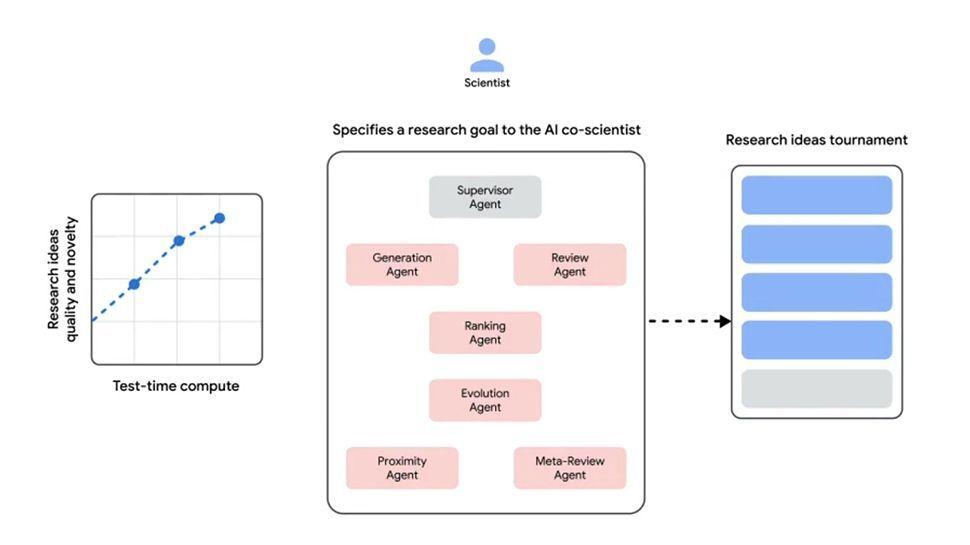
The AI Co-Scientist functions as a multi-agent system, employing specialized AI agents to tackle different aspects of the research process
3
. These agents, including Generation, Reflection, Ranking, Evolution, Proximity, and Meta-review, work collaboratively to generate, critique, and refine scientific hypotheses1
4
.Key features of the system include:
- Natural language interaction: Scientists can input research goals or seed ideas using natural language
2
. - Iterative self-improvement: The system employs a self-critique mechanism to continuously evaluate and improve its outputs
1
. - ELO-based evaluation: A ranking system is used to measure the quality of outputs with precision
1
. - Test-time compute scaling: This capability allows the AI to second-guess and verify its responses, leading to improved outputs
5
.
Applications and Early Results
The AI Co-Scientist has already demonstrated its potential across various scientific fields:
- Biomedicine: The system has shown promising results in areas such as liver fibrosis treatments, antimicrobial resistance, and drug repurposing
4
. - Antibiotic resistance: In a test case, the AI Co-Scientist successfully hypothesized a novel mechanism for the spread of antibiotic resistance among bacteria within two days
3
. - Cancer research: The tool has been used to identify potential cancer treatments
1
.
Related Stories

Implications for Scientific Research
While the AI Co-Scientist shows great promise, Google emphasizes that it is designed to be a collaborative tool, not a replacement for human scientists
2
3
. The system's ability to accelerate research timelines and tackle complex problems could have far-reaching implications:- Faster breakthroughs: By significantly reducing research timelines, the AI Co-Scientist could accelerate progress in addressing critical health issues and other scientific challenges
1
. - Interdisciplinary applications: The tool's versatility allows it to be applied across various scientific disciplines
1
. - Enhanced efficiency: Researchers can focus more on creative and conceptual aspects of their work while the AI handles repetitive tasks
4
.
Future Developments and Accessibility
Google is currently evaluating the AI Co-Scientist's strengths and limitations through a Trusted Tester Program, allowing select research organizations to access the tool
5
. As the system continues to evolve, future iterations are expected to enhance its capabilities further, potentially redefining the boundaries of scientific discovery1
.While the AI Co-Scientist represents a significant advancement in integrating AI into scientific research, it's important to note that the tool's true capabilities and limitations will only be fully understood once it becomes more widely available to the scientific community
5
.References
Summarized by

Navi
[1]
Related Stories
Google's AI Co-Scientist: A Controversial Step Towards AI-Assisted Scientific Research
06 Mar 2025•Science and Research
Google's Co-Scientist AI system generates novel hypotheses to accelerate scientific discovery
20 May 2026•Science and Research
AI agents identify promising drug candidates in hours as Google and FutureHouse debut research systems
19 May 2026•Science and Research

Recent Highlights



Recent Highlights
Today's Top Stories




Don’t drown in AI news. We cut through the noise - filtering, ranking and summarizing the most important AI news, breakthroughs and research daily. Follow topics that matter to you and stay ahead.


