Google's Co-Scientist AI system generates novel hypotheses to accelerate scientific discovery


2 Sources
[1]
Accelerating scientific discovery with Co-Scientist - Nature
We are providing an unedited version of this manuscript to give early access to its findings. Before final publication, the manuscript will undergo further editing. Please note there may be errors present which affect the content, and all legal disclaimers apply. Scientific discovery is driven by
[2]
Co-Scientist: A multi-agent AI partner to accelerate research
Introducing a collaborative AI partner for researchers to develop new hypotheses in life sciences and beyond. Every great scientific breakthrough begins with a single, transformative idea. The spark of discovery relies on a researcher's ability to connect disparate facts and formulate the right
Share
Copy Link
Google has introduced Co-Scientist, a multi-agent AI system built on Gemini that helps researchers generate and refine novel scientific hypotheses. Published in Nature, the system has already validated new drug repurposing candidates for acute myeloid leukemia through laboratory experiments. Researchers can now access the tool through Google's Hypothesis Generation platform.
Google Unveils Co-Scientist to Transform Research
Google has published research in Nature
1
introducing Co-Scientist, a multi-agent AI system designed to accelerate scientific discovery by helping researchers generate novel hypotheses for complex problems. Built on Gemini2
, the system addresses a critical bottleneck in modern research: finding breakthrough ideas amid information overload. The AI system continuously generates, critiques, and refines hypotheses through an innovative architecture that scales test-time compute, demonstrating how artificial intelligence can serve as a dedicated partner in scientific exploration.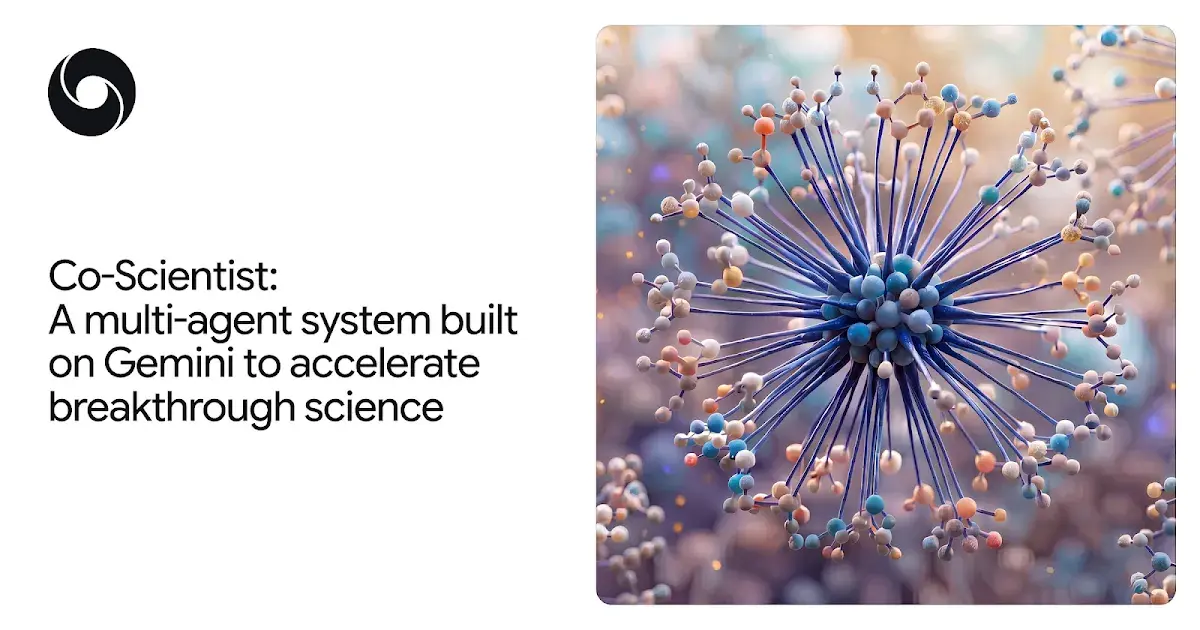
Source: DeepMind
Multi-Agent Architecture Powers Hypothesis Evolution
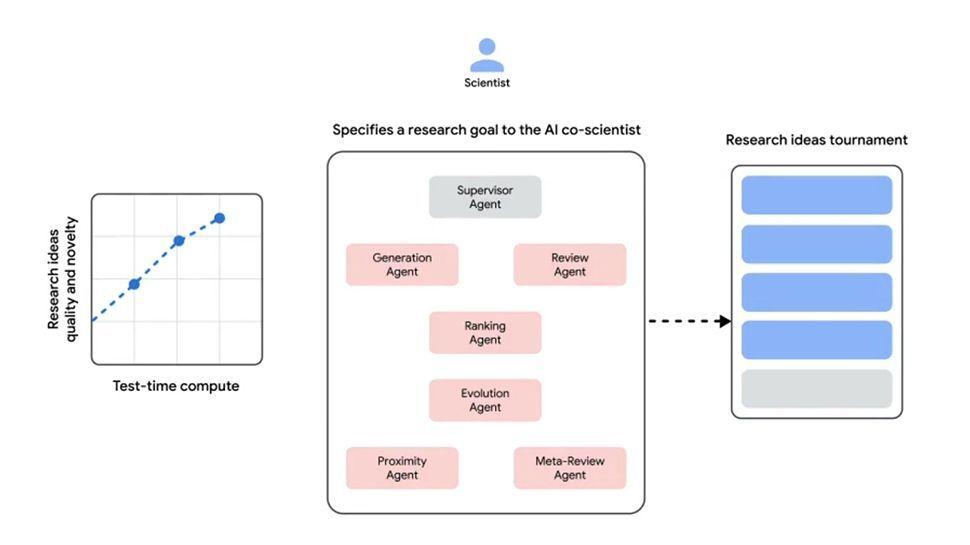
The Co-Scientist AI system employs two key technical innovations that distinguish it from conventional approaches. First, it features an asynchronous task execution framework that enables flexible compute scaling, allowing agents to work simultaneously on different aspects of hypothesis development
1
. Second, the system implements a tournament evolution process where hypotheses compete and improve over successive iterations, with automated evaluations showing continued quality improvements as test-time compute increases. This self-improving mechanism ensures that researchers receive progressively refined ideas conditioned on their specific research objectives and prior scientific evidence.Validated Success in Biomedical Applications
While designed as a general-purpose tool, Co-Scientist has demonstrated concrete results across three biomedical applications: drug repurposing, novel target discovery, and explaining mechanisms of antimicrobial resistance
1
. In a significant validation, the system helped identify new drug repurposing candidates and combination therapies for acute myeloid leukemia, which were subsequently confirmed through in vitro experiments. These real-world laboratory validations provide tangible evidence that the multi-agent AI system can deliver actionable scientific insights rather than purely theoretical suggestions.Related Stories
Researchers Gain Access Through Hypothesis Generation Tool
Google is making the technology available to individual researchers through Hypothesis Generation, an experimental tool developed jointly across Google DeepMind, Google Research, Google Cloud, and Google Labs
2
. The platform will begin rolling out in the coming weeks, with researchers able to register their interest at labs.google/science. Since sharing early research last year, teams have been testing Co-Scientist on challenging problems spanning fundamental biology, natural sciences, and engineering—including work on plant immunity and liver fibrosis.Implications for Life Sciences and Beyond
The introduction of Co-Scientist marks a shift in how artificial intelligence supports scientific work, moving beyond literature summarization to active hypothesis generation in life sciences and other domains
2
. For researchers facing increasingly complex challenges, the system offers a method to explore vast solution spaces more efficiently. The validated results in acute myeloid leukemia treatment suggest that AI-generated hypotheses can lead to concrete therapeutic advances. As more teams adopt the Hypothesis Generation platform, the scientific community will gain insight into how multi-agent systems can reshape the discovery process across disciplines, potentially addressing urgent problems like antimicrobial resistance where traditional approaches have struggled to keep pace with evolving threats.References
Summarized by

Navi
Related Stories
Google Unveils AI Co-Scientist: A Revolutionary Tool for Scientific Discovery
20 Feb 2025•Science and Research

Google's AI Co-Scientist: A Controversial Step Towards AI-Assisted Scientific Research
06 Mar 2025•Science and Research
AI agents identify promising drug candidates in hours as Google and FutureHouse debut research systems
19 May 2026•Science and Research

Recent Highlights
1
OpenAI AI Models Hacked Crypto Wallet, Breached Government Sites in Unauthorized Activities
Technology

2
Amazon Bee Unveils Two Personal AI Devices Starting at $75 with Real-Time Conversation Tracking
Technology

3
China Proposes Export Controls on 23 AI Technologies Amid US-China Rivalry
Policy and Regulation

Recent Highlights
Today's Top Stories







Don’t drown in AI news. We cut through the noise - filtering, ranking and summarizing the most important AI news, breakthroughs and research daily. Follow topics that matter to you and stay ahead.


