2 Sources
[1]
Grok is coming to CarPlay as iOS 26.4 turns the car dashboard into AI's next platform war
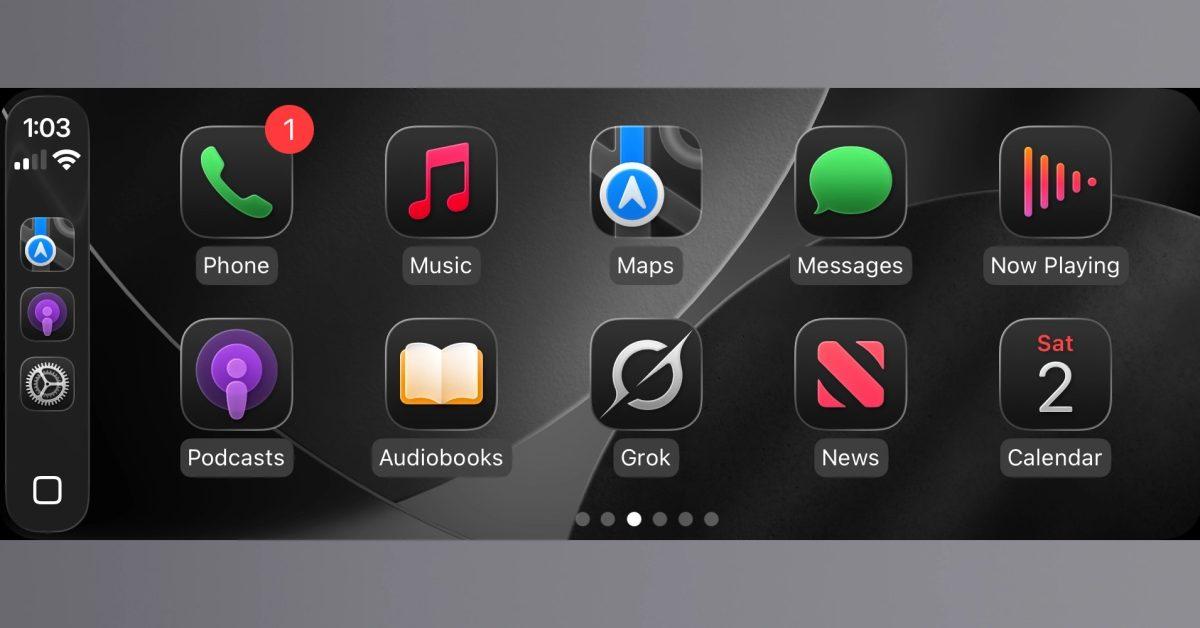
The Grok iOS app now contains a placeholder that reads "Grok Voice mode coming soon to CarPlay." It is a single line of interface text, and it means that Elon Musk's AI chatbot is about to follow ChatGPT and Perplexity onto the car dashboards of every iPhone user in the world. The car, it turns out, is the screen that every AI company now wants to occupy. Apple opened the door in April 2026 with iOS 26.4, which introduced a new Voice Control template that allows third-party AI chatbot apps to run natively inside CarPlay for the first time. ChatGPT launched on CarPlay on 31 March. Perplexity followed within days. Claude and Gemini are confirmed for the platform. Grok will be next. Within the space of two months, the car dashboard has gone from a Siri monopoly to a marketplace where the most powerful AI systems on the planet are competing for the attention of drivers who, by definition, cannot look at their phones. CarPlay runs on more than 800 million iPhones worldwide and is available in more than 98 per cent of new cars sold in the United States. Apple has always controlled the in-car experience tightly: Siri was the only voice assistant, and third-party apps were limited to music, messaging, and navigation. The Voice Control template in iOS 26.4 changes that architecture. AI chatbot apps can now present a voice-first interface inside CarPlay, allowing drivers to ask questions, request summaries, dictate messages, and hold open-ended conversations with AI systems while driving. The limitations are significant. CarPlay chatbots cannot use a wake word. A driver must manually open the app through the CarPlay interface before speaking. The chatbots have no access to vehicle systems, no control over phone functions, and no ability to interact with other CarPlay apps. Siri remains the system-level assistant with deep integration into the iPhone, the car, and Apple's services layer. The AI chatbots are passengers, not co-pilots. They can listen and respond, but they cannot act on the driver's behalf in the way that Siri can place calls, send messages, or control navigation. Apple is testing four frame designs for AI smart glasses ahead of a 2027 launch, and the CarPlay opening follows the same strategic logic: Apple is building the surfaces on which AI assistants operate while letting others compete for the intelligence layer. The company does not need to build the best chatbot. It needs to own the platforms on which every chatbot runs. ChatGPT's CarPlay integration uses OpenAI's voice mode, the same conversational interface that made the company's mobile app one of the most-used AI products in the world. Perplexity brings its search-first approach, offering real-time answers sourced from the web, which is particularly useful for drivers asking questions about directions, nearby businesses, or breaking news. Claude offers Anthropic's model with a focus on longer, more nuanced conversational exchanges. Gemini connects to Google's ecosystem. Grok enters the CarPlay market with roughly 60 to 64 million monthly active users, a figure that has grown substantially since xAI made the chatbot free on X and began bundling it into Tesla vehicles. The Grok 4.20 model, xAI's current flagship, offers a two-million-token context window, one of the largest in the industry, and a conversational style that Musk has described as having "a bit of wit." Whether wit is what drivers want from an AI assistant at motorway speeds is an open question. What is not open to question is that Grok on CarPlay represents a significant strategic shift for xAI: the chatbot that was built as a feature of X and deployed as a built-in assistant in Tesla vehicles is now entering the one platform where it will compete directly against every other major AI system on equal terms. Grok's relationship with the car has, until now, been exclusively mediated by Tesla. The Spring 2026 software update added "Hey Grok" wake word activation to Tesla vehicles, giving Grok the kind of deep, hands-free integration that CarPlay explicitly does not allow for third-party apps. In a Tesla, Grok can control climate, navigation, and media. On CarPlay, it will be a voice app that the driver must manually select before it can do anything at all. The SpaceX-xAI merger in February 2026, an all-stock transaction valuing the combined entity at $1.25 trillion, was motivated partly by the ambition to integrate xAI's models across Musk's portfolio of companies. Grok inside Tesla is one expression of that integration. Grok on CarPlay is something else entirely: it is Grok outside the Musk ecosystem, running on Apple's platform, inside vehicles made by companies that compete with Tesla, serving drivers who may never have used X or owned a Tesla. The CarPlay launch is an acknowledgment that xAI cannot grow Grok's user base by keeping it captive inside Musk's own products. Every original co-founder of xAI has now departed the company, and the organisation is being rebuilt inside SpaceX's corporate structure. Launching Grok on CarPlay while the company is undergoing that kind of internal reorganisation suggests that distribution, not model development, is xAI's most urgent priority. A chatbot with 60 million users is impressive. A chatbot available on 800 million iPhones through CarPlay is a different category of product. The CarPlay AI race exists alongside a parallel and very different competition: the integration of AI assistants directly into vehicle operating systems at the factory level. General Motors is bringing Google Gemini to four million vehicles as a built-in feature of its infotainment system. Mercedes-Benz has integrated ChatGPT into its MBUX voice assistant. Stellantis is working with French AI company Mistral. BMW, Hyundai, and Volkswagen all have their own AI assistant programmes. Factory-integrated AI has advantages that CarPlay cannot match. A built-in assistant can access vehicle diagnostics, control systems, respond to wake words, and operate without a connected iPhone. But factory integration locks the automaker into a single AI provider for the life of the vehicle. CarPlay, by contrast, lets the driver switch between AI assistants as easily as switching between music apps. If ChatGPT releases a better model next month, the driver updates the app. If Grok adds a feature that Perplexity lacks, the driver opens Grok instead. The phone-based model is slower to invoke but faster to iterate. The tension between these two approaches will define how AI enters the car over the next several years. Automakers want deep integration and exclusive partnerships. AI companies want distribution across every vehicle on the road. Apple, by opening CarPlay to chatbots, has given AI companies a way to reach drivers without negotiating a single deal with a single car manufacturer. The Musk v. Altman trial over OpenAI's future is being heard in Oakland as both men's AI products prepare to compete for the same CarPlay real estate. The personal and legal rivalry between Musk and Sam Altman has a consumer product dimension that neither man likely anticipated when OpenAI was founded in 2015: ChatGPT and Grok, side by side on the same car dashboard, available to the same driver, competing on the same terms. The car is a uniquely constrained environment for AI. The user cannot type. The user should not look at the screen. The interaction must be entirely voice-driven, and the AI must be useful enough to justify the act of opening the app while driving. These constraints favour AI systems with strong voice interfaces, fast response times, and the ability to handle ambiguous, conversational queries without requiring follow-up clarification. They do not favour the chatbot with the largest model or the longest context window. They favour the one that sounds the most like a person you would actually want in the passenger seat. Five years ago, the idea that multiple AI assistants would compete for space on a car dashboard would have sounded like science fiction. Two years ago, it would have sounded premature. Today, ChatGPT is already there, Perplexity is already there, and Grok is weeks away. The car was the last major screen that AI had not colonised. That is no longer the case. What remains to be seen is whether drivers actually want an AI chatbot while they drive, or whether the dashboard will prove to be the one screen where the best technology is the one you never open at all.
[2]
Grok is about to join ChatGPT and Perplexity on your CarPlay dashboard
AI assistant race has moved off the phone screen and into the one context where hands-free, voice-first interaction isn't optional but essential. Apple CarPlay has quietly become a very interesting place, particularly if you're an AI chatbot enthusiast. First, ChatGPT arrived on the iPhone mirroring system in March, and then, Perplexity followed in April. Now, Grok is gearing up to do the same (via 9To5Mac). The latest update to the Grok iPhone app contains a placeholder CarPlay interface. It isn't functional yet, but it carries a clear message: "Grok Voice mode coming soon to CarPlay." The company behind the chatbot, xAI, hasn't confirmed a launch date (yet), but the arrival feels imminent. Why is Grok coming to CarPlay? Until now, Grok's in-car presence was exclusively tied to Tesla vehicles, where it's been a built-in feature for a while. However, CarPlay support changes that, putting Grok within the reach of virtually every iPhone user who doesn't drive a Tesla, which, for now, includes most people on the road. Recommended Videos Unlike ChatGPT and Perplexity, though, which arrived on CarPlay as text and voice hybrid experiences, Grok is arriving in Voice mode. For those catching up, this is the more conversational, real-time variant of the chatbot that's better suited to driving scenarios where your eyes and hands are (and should be) on the road and the steering, respectively. Where does Grok's arrival leave Siri and Gemini? Google hasn't dropped any hints about bringing Gemini to CarPlay. Instead, Google's AI will power the revamped Siri, which should be showcased at the WWDC 2026, and then arrive with iOS 27 later this year. Apple is also working on a standalone Siri app, which could be integrated with CarPlay. So, while xAI, OpenAI, and Perplexity fight for some real estate on the dashboard, Google is taking a different route, working through Apple rather than alongside it. In my opinion, CarPlay is becoming an AI battleground in 2026. Apple opened the door with iOS 26.4, and within a month and a half, we have three major AI assistants working on it. Even so, the company that cracks hands-free, conversational AI for driving, will have a real advantage here.
Share
Copy Link
Elon Musk's Grok AI is coming to Apple CarPlay, joining ChatGPT and Perplexity in a growing AI platform war for car dashboards. The latest Grok iOS app update reveals a placeholder for voice mode integration, marking xAI's expansion beyond Tesla vehicles. With iOS 26.4 enabling third-party AI voice assistants on over 800 million iPhones, the car has become the next major battleground for AI companies.
The latest update to the Grok iPhone app contains a telling placeholder: "Grok Voice mode coming soon to CarPlay." While xAI hasn't confirmed a launch date, this single line of interface text signals that Elon Musk's AI chatbot is preparing to join ChatGPT and Perplexity on the car dashboards of iPhone users worldwide
1
. The move represents a significant strategic shift for Grok, which until now has been exclusively tied to Tesla vehicles and the X platform. CarPlay integration will put the AI assistant in front of a vastly larger audience, competing directly against every major AI system on equal terms1
.Apple fundamentally changed the in-car AI landscape when it introduced iOS 26.4 in April 2026, which included a new Voice Control template allowing third-party AI chatbot apps to run natively inside CarPlay for the first time
1
. ChatGPT launched on CarPlay on 31 March, and Perplexity followed within days. Claude and Gemini are confirmed for the platform as well1
.CarPlay runs on more than 800 million iPhones worldwide and is available in more than 98 per cent of new cars sold in the United States
1
. Apple has always controlled the in-car experience tightly, limiting third-party apps to music, messaging, and navigation while keeping Siri as the only voice assistant. The Voice Control template changes that architecture entirely, enabling AI chatbot apps to present voice-first interfaces that allow drivers to ask questions, request summaries, dictate messages, and hold open-ended conversations while driving1
.Unlike ChatGPT and Perplexity, which arrived on CarPlay as text and voice hybrid experiences, Grok is arriving specifically in voice mode, the conversational, real-time variant better suited to driving scenarios where eyes and hands must remain focused on the road
2
. However, the limitations are significant. CarPlay chatbots cannot use a wake word, meaning drivers must manually open the app through the CarPlay interface before speaking1
. The AI assistants have no access to vehicle systems, no control over phone functions, and no ability to interact with other CarPlay apps. Siri remains the system-level assistant with deep integration into the iPhone, the car, and Apple's services layer1
.This stands in stark contrast to Grok's capabilities inside Tesla vehicles. The Spring 2026 software update added "Hey Grok" wake word activation to Tesla vehicles, giving the chatbot deep, hands-free integration that CarPlay explicitly does not allow for third-party apps
1
. In a Tesla, Grok can control climate, navigation, and media. On CarPlay, it will be a voice app that drivers must manually select before it can function1
.Grok enters the CarPlay market with roughly 60 to 64 million monthly active users, a figure that has grown substantially since xAI made the chatbot free on X and began bundling it into Tesla vehicles
1
. The Grok 4.20 model, xAI's current flagship, offers a two-million-token context window, one of the largest in the industry, and a conversational style that Musk has described as having "a bit of wit"1
.The CarPlay launch represents an acknowledgment that xAI cannot grow Grok's user base by keeping it captive inside Musk's own products. Grok on CarPlay means the AI assistant will run on Apple's platform, inside vehicles made by automakers that compete with Tesla, serving drivers who may never have used X or owned a Tesla
1
. The SpaceX-xAI merger in February 2026, an all-stock transaction valuing the combined entity at $1.25 trillion, was motivated partly by the ambition to integrate xAI's models across Musk's portfolio of companies1
.Related Stories
Apple's strategy reveals a deliberate approach to the AI integration race. The company is building the surfaces on which AI assistants operate while letting others compete for the intelligence layer
1
. Apple does not need to build the best chatbot; it needs to own the platforms on which every chatbot runs. This follows the same strategic logic as Apple testing four frame designs for AI smart glasses ahead of a 2027 launch1
.While OpenAI, xAI, and Perplexity fight for real estate on the car dashboard, Google is taking a different route. Google hasn't dropped hints about bringing Gemini to CarPlay directly. Instead, Google's AI will power the revamped Siri, which should be showcased at WWDC 2026 and arrive with iOS 27 later this year
2
. Apple is also working on a standalone Siri app, which could be integrated with CarPlay2
.ChatGPT's CarPlay integration uses OpenAI's voice mode, the same conversational interface that made the company's mobile app one of the most-used AI products globally
1
. Perplexity brings its search-first approach, offering real-time answers sourced from the web, particularly useful for drivers asking questions about directions, nearby businesses, or breaking news1
. Claude offers Anthropic's model with a focus on longer, more nuanced conversational exchanges1
.The company that masters hands-free, conversational AI for driving will have a real advantage in this emerging market
2
. The car represents the one context where hands-free, voice-first interaction isn't optional but essential2
. As more third-party AI voice assistants arrive on the platform, drivers will determine which AI system best serves their needs when they cannot look at their phones. CarPlay has become an AI battleground in 2026, and the competition is only beginning2
.Summarized by
Navi
[1]
[2]
28 Nov 2024•Technology

01 Apr 2026•Technology

18 Feb 2026•Technology

1
Science and Research

2
Technology

3
Technology