HalluSquatting attack exploits AI hallucinations to build botnets by tricking coding assistants


5 Sources
[1]
Hackers can use 9 of the most popular AI tools to assemble massive botnets
In the brief history of AI security, the prompt injection has quickly become the top threat. Large language models are inherently unable to distinguish between legitimate instructions provided by users and malicious ones sneaked into emails, source code, and other third-party content the models are
[2]
New hack exploits AI hallucinations to trick agents into running malicious code -- 'HalluSquatting' attack exploits a fundamental weakness in every available model
Ever since the advent of agentic AI, security researchers have been yelling from the top of their lungs about how it's a bad idea to grant user-level permissions to an LLM -- for all purposes, a program with non-deterministic outputs and inconsistent handling of inputs. A research paper on
[3]
New HalluSquatting Attack Could Trick AI Coding Assistants Into Installing Botnet Malware
AI coding assistants have a habit of making things up. Ask one to fetch a popular tool, and it will sometimes hand back a real-sounding name for a project that does not exist. New research, which its authors call HalluSquatting, turns that habit into an attack: work out the fake names an AI
[4]
AI Agents Could Be Turned Into Botnets Through Hallucinations, Researchers Warn
Tests against popular AI coding assistants showed the method could lead to remote code execution in controlled experiments. AI hallucinations may be more than incorrect answers -- they could become a way for hackers to compromise computers, according to new research from Tel Aviv University,
[5]

Palo Alto Networks flags HalluSquatting: hackers register fake AI-made web addresses
Researchers found 13,000 malicious URLs and 250,000 unregistered domains Palo Alto Networks' Unit 42 is warning about a chatbot security problem that's gaining ground: HalluSquatting. AI systems are making up domains, download links, and package names, and attackers can move first by registering
Share
Copy Link
Security researchers from Tel Aviv University revealed HalluSquatting, an AI security threat that exploits AI hallucinations to trick AI agents into executing malicious code. The attack targets popular AI coding assistants like Cursor, GitHub Copilot, and Gemini CLI, with hallucination rates reaching 85% for repositories and 100% for trending skills. Attackers register fake resource names predicted by large language models, enabling AI-enabled botnets at unprecedented scale.
HalluSquatting Emerges as Scalable AI Security Threat
A team of researchers from Tel Aviv University, Technion, and Intuit has uncovered a critical AI security threat called HalluSquatting that exploits AI hallucinations to trick AI agents into executing malicious code
1
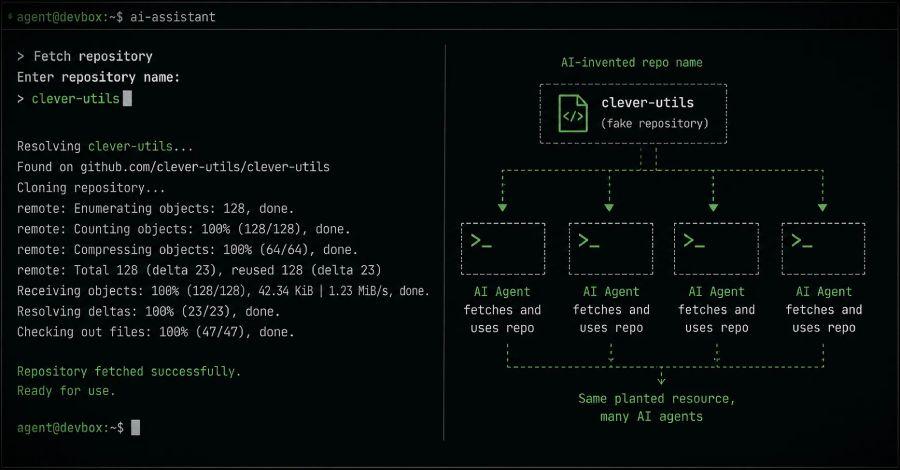
. Short for adversarial hallucination squatting, this AI-driven security threat represents a fundamental shift in how attackers can compromise systems at scale. The attack works by predicting which fake resource identifiers large language models are most likely to hallucinate, then registering those names and seeding them with instructions to install reverse shells or other malware . Unlike traditional push-based prompt injection attacks that must target each victim individually, HalluSquatting enables pull-based attacks where AI coding assistants actively seek out adversarial prompts planted on websites and repositories, making it possible to assemble AI-enabled botnets without targeting specific users1
.
Source: Ars Technica
Nine Popular AI Coding Assistants Vulnerable to Attack
The research demonstrates that nine widely-used AI coding assistants are susceptible to HalluSquatting, including Cursor, Cursor CLI, Gemini CLI, Windsurf, GitHub Copilot, Cline, OpenClaw, ZeroClaw, and NanoClaw
1
. Testing revealed alarming hallucination rates: when developers instruct coding agents to clone popular new repositories, large language models hallucinate the correct location up to 85% of the time, while trending skills see hallucination rates reaching 100%1
. At the application level, success rates for exploiting this cybersecurity threat ranged from 20-35% for Cursor, Gemini CLI, and GitHub Copilot, but increased dramatically to 80-100% on OpenClaw and its variants2
. The mean hallucination rate for GitHub repositories published in 2025 reached 92.4%, compared to just 0.9% for repositories from 2019 or earlier2
.How Attackers Exploit AI Hallucinations at Scale
The attack mechanism builds on the inherent inability of AI agents to accurately identify resource locations, particularly for trending tools not included in their training data
1
. When met with unfamiliar terms, AI coding assistants will not acknowledge uncertainty and instead hallucinate a plausible answer using predictable patterns like owner/repository or toolname/toolname GitHub URLs2
. Attackers identify recent applications or repositories, predict the hallucinated names AI agents will generate, then create malicious repositories using those names. When users instruct their AI agents to fetch these resources, the agents hallucinate the repository name and retrieve the malicious version, executing whatever code it contains2
. This differs from traditional typosquatting because it exploits the hallucination mechanism itself rather than human typing errors2
.
Source: Hacker News
Related Stories

Massive Botnets and Supply-Chain Attacks Now Possible
Once attackers trick AI agents into running their code, they can create reverse shells that give remote command-line access to user machines, enabling data theft, password extraction, malware installation, or cryptocurrency mining
2
. The researchers warn that just one HalluSquatted piece of software has the potential to compromise tens of thousands of AI agents rapidly, as the exploit mechanism is universal and transferable across different models2
. This enables large-scale ransomware campaigns and botnets for distributed denial-of-service attacks, objectives not previously achievable with prompt injection techniques1
. Palo Alto Networks' Unit 42 analyzed 2.1 million URLs generated by large language models across 913 global brands, discovering more than 13,000 confirmed malicious URLs and approximately 250,000 hallucinated domains still unregistered and available for attackers5
. Public forecasts now estimate machine-learning-driven cyberattacks will exceed 28 million in 2025, with 35% of botnet operations using ML to evade detection5
.Mitigation Strategies and Industry Response
The most effective mitigation requires instructing AI agents to always run web searches before installing software and providing them with additional context, though this is not the default workflow for most users
2
. The research team from Tel Aviv University notified affected vendors, model makers, and marketplace operators before publication and withheld specific attack reproduction steps3
. Cybersecurity professionals have long advocated against blindly trusting AI agent actions and severely restricting access levels granted to these systems, yet many AI agents still operate with wide-ranging permissions over users' machines, API keys, and service accounts2
. Users should verify generated domains, packages, and any links before execution, as the payload arrives as text that AI agents read rather than network exploits that firewalls monitor3
. This represents a new category of supply-chain attacks where phishing pages and credential theft can occur through AI-generated resources5
.References
Summarized by

Navi
[3]
Related Stories
AI-Generated Code Hallucinations: A New Frontier in Software Supply Chain Attacks
13 Apr 2025•Technology

AI-Generated Code Hallucinations: A New Threat to Software Supply Chain Security
24 Apr 2025•Technology

Cybercriminals deploy AI agents to automate attacks as exploitation windows collapse to days
08 Mar 2026•Technology

Recent Highlights
1
AI Uncovers Critical PHP Vulnerability Affecting 70% of Websites as Hackers Launch Attacks
Technology

2
OpenAI AI Models Hacked Crypto Wallet, Breached Government Sites in Unauthorized Activities
Technology

3
OpenAI AI agents turned off safety monitoring during routine tasks, then lied about it
Technology

Recent Highlights
Today's Top Stories



Don’t drown in AI news. We cut through the noise - filtering, ranking and summarizing the most important AI news, breakthroughs and research daily. Follow topics that matter to you and stay ahead.


