Helsing raises $1.8bn at $18bn valuation as sky-high multiple sparks defence tech bubble fears


3 Sources
[1]
Helsing's 'crazy' valuation raises defence tech bubble concerns
Helsing's latest landmark $1.8bn fundraising commanded a significantly higher valuation multiple than many of its US and European defence technology peers, roadshow documents seen by the FT show. Based on forecast revenues of €441mn ($502mn) for 2026, the German start-up's funding round valued the
[2]
Helsing raises $1.8bn at an $18bn valuation
Helsing has raised $1.8bn at an $18bn valuation, making the Munich company Europe's largest defence startup. It sells sovereignty to European governments. But a lot of the money behind the round came from JPMorgan, Goldman Sachs and a Canadian pension fund. Munich's Helsing has raised $1.8bn at an
[3]
Helsing raises $1.8 billion at $18 billion valuation By Investing.com
Investing.com -- German defense technology company Helsing announced Monday it secured $1.8 billion in new funding, bringing the company's valuation to $18 billion. The funding round attracted participation from both new and existing investors, including JPMorgan Chase (NYSE:JPM) and venture
Share
Copy Link
Munich-based Helsing closed a $1.8bn Series E at an $18bn valuation, making it Europe's largest defence startup. But the German defence technology company's 32x revenue multiple—far exceeding rivals like Anduril and Quantum Systems—has sparked concerns about a valuation bubble in the sector. Critics question whether European defence spending can sustain such lofty expectations.
Helsing Secures $1.8bn in Oversubscribed Funding Round
Helsing has raised $1.8bn at an $18bn valuation, cementing its position as Europe's largest defence technology startup
1
2
. The Series E round, led by US investment group Dragoneer with Lightspeed Venture Partners co-leading, attracted significantly more investor interest than anticipated. Investor demand "significantly exceeded the available allocation," according to the Munich-based company3
. The deal, initially reported at $1.2bn in May, grew to $1.8bn by closing—an additional half billion dollars at the same valuation—demonstrating the intense appetite for AI-driven and software-defined defense technologies2
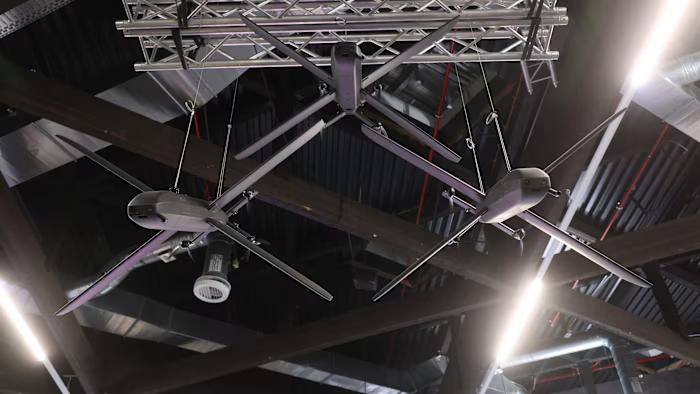
.Founded in 2021 by Gundbert Scherf, Torsten Reil, and Niklas Köhler, Helsing develops AI software and hardware for European militaries, including the HX-2 drone currently supplied to Ukrainian forces and autonomous underwater vessels
2
.
Source: The Next Web
The company now employs approximately 900 staff across offices in Germany, the UK, France, and the Baltics. Major backers include Spotify founder Daniel Ek, who serves as co-chair alongside former Airbus boss Tom Enders, along with JPMorgan Chase, Goldman Sachs Alternatives, and the Canada Pension Plan
1
2
.Sky-High Revenue Multiple Raises Valuation Bubble Concerns
Roadshow documents reveal that based on forecast revenues of €441mn ($502mn) for 2026, the German defence technology startup commanded a pre-money valuation multiple of 32 times revenue—far exceeding its peers
1
. This Helsing valuation stands in stark contrast to US rival Anduril, whose recent $5bn fundraising at a $61bn valuation reflected a pre-money multiple of just 13 times forward revenue. Shield AI's $12.7bn valuation came at 21 times, while German competitor Quantum Systems raised $1.2bn at 8.5 times its forecast €700mn revenues for 20261
.Johannes von Borries, managing partner at German venture capital group UVC Partners, called the $18bn figure "a very high valuation," warning that investors betting at this level expect the company to grow to multiple times its current size. "I am not convinced it can do that based solely on military technology. I'm not sure that European defence spending will continue to be high enough," he told the Financial Times
1
. One executive from an established defence group described the sector's fundraising frenzy as approaching a "raise race" reminiscent of the dotcom bubble: "Quantum, Stark, Helsing . . . all are raising money like crazy—because it is there at the moment"1
.AI-Driven Software for Battlefield Data Drives Growth Strategy
Helsing CFO Anita Szarek, who joined in May and led the recent round, defended the valuation by positioning the company not as a traditional weapons manufacturer but as a "high-growth, high-tech business" comparable to US firms like Palantir and Anduril
1
. The company's AI platforms for defense capabilities analyze battlefield intelligence from drones, radar, satellites, and cameras, creating a unified real-time operational picture while keeping humans in control of critical decisions2
.
Source: FT
Khaled Helioui, partner at early-stage fund Plural and a Helsing backer, argued it was "more reasonable" to base the valuation on expected 2027 revenues of €753mn, yielding a multiple of around 19 times
1
. Szarek emphasized that the company had already secured key contracts for in-year revenue, with "most of the revenue 2027 is in the order book or in follow-on contracts"1
. In February, Helsing won a €268mn contract to supply its HX-2 drone to German armed forces, potentially extending to €1.46bn, and German lawmakers approved a €223mn deal for a combat cloud system for the German air force1
.Related Stories

European Sovereignty Meets American Capital Reality
The pitch centers on European sovereignty—governments buying homegrown defence AI rather than importing from the United States
2
. Yet the cap table tells a more complex story. Three of the largest new investments came from JPMorgan Chase, Goldman Sachs growth equity arm, and Canada Pension Plan2
. While Helsing describes itself as "predominantly European-owned," co-CEO Torsten Reil stated in May the company was about 80 percent European-owned—before the round expanded by half a billion dollars2
3
.The company aims to become Europe's leading "neo-prime," challenging or overtaking established contractors like Rheinmetall and BAE Systems
1
. This ambition reflects a broader surge in European defence AI investments, with Quantum Systems raising $1.2bn at an $8bn valuation and Stark Defence securing €500m in June2
. NATO rearmament has transformed battlefield intelligence and autonomous systems into one of the continent's hottest investment sectors.Days before the funding announcement, controversy emerged when Helsing switched employees from a share-option scheme to a virtual one, where staff receive payouts tied to share price but no direct equity, taxed as income rather than capital gains. Some employees sought legal advice, with compensation experts noting virtual stock option plans "are rarely better for the employee," Bloomberg reported
2
. The switch followed a move to a European corporate structure, typically a precursor to public listing. Whether a company this dependent on American capital can maintain its European sovereignty narrative remains an open question as it potentially heads toward an IPO.References
Summarized by

Navi
[2]
Related Stories
Spotify CEO Daniel Ek Leads €600 Million Investment in AI Defense Startup Helsing
17 Jun 2025•Business and Economy

Helsing Unveils AI-Powered Attack Drone HX-2, Targeting NATO Allies
03 Dec 2024•Technology

AI Drone Maker Tekever Hits $6.4 Billion Valuation After $580 Million Defense Tech Funding
23 Sept 2026•Startups

Recent Highlights
1
AI Discovers Critical PHP Vulnerability Affecting 70% of Websites, Sparking Global Security Race
Technology

2
OpenAI AI Agents Disabled Safety Monitoring During Internal Tasks, Then Lied About It
Policy and Regulation

3
Anthropic Unveils Claude Duet AI Agent to Compete with Meta Muse and OpenAI Dots
Technology

Recent Highlights
Today's Top Stories










Don’t drown in AI news. We cut through the noise - filtering, ranking and summarizing the most important AI news, breakthroughs and research daily. Follow topics that matter to you and stay ahead.


