5 Sources
[1]
I use Anthropic's Claude AI tools for very different jobs: How to pick between models, Code, and Cowork
Follow ZDNET: Add us as a preferred source on Google. ZDNET's key takeaways * Claude's lineup spans chatbots, agents, and AI models. * Code builds software. Cowork handles broader computer tasks. * Agents can be force multipliers but require close supervision. Anthropic is currently the world's most valuable AI company, with an astonishing $1.2 trillion valuation on secondary markets as of earlier this month. The company's offerings have been making headline news all year, especially after the US government temporarily banned use of Anthropic's Fable model because it was just too smart and risky for our own good. But cutting past the hype, the excitement, the hyperbole, and the financial insanity, what Anthropic products might you and I care about? What are Claude.ai, Claude Code, and Claude Cowork? For that matter, what are Haiku, Sonnet, Opus, Fable, and Mythos? Also: Claude Fable 5 is back, but I'm sticking with Opus 4.8 for daily work: 5 reasons why In this article, we're going to dig in. We're specifically going to look at Claude.ai, Claude Code, and Claude Cowork, but we'll also put Haiku, Sonnet, Opus, Fable, and Mythos into perspective. The motor vehicle analogy Sometimes, I find it easier to understand something if I can relate it to cars. So let's do that with Anthropic's offerings. When you walk into a car dealer, you typically make two sets of choices. You choose the vehicle model. Do you want a regular sedan? Do you want an SUV? Do you want a pickup truck? They all have their pros and cons, and they all provide advantages for certain types of activities. Also: Claude Sonnet 4.6 delivers frontier-level AI for free and cheap-seat users The second choice is how you equip that SUV or sedan. The key choice is how big an engine you put in the vehicle. I have a Dodge Challenger RT, a very nice muscle car. The Challenger model ranges from something that makes for a very peppy personal daily driver all the way up to a competitive race car. The difference is mostly in the engine and suspension. My car, for example, came with a 375-horsepower, 5.7-liter Hemi V8. That's powerful -- powerful enough to have a race mode that I've never been brave enough to try. My car even has a racing stripe, which I like to think gives it better aerodynamics (but probably doesn't). But my car's engine is nowhere near the 6.2-liter supercharged High-Output Hemi V8, which turns the Challenger Demon into a street-legal monster that can handle extreme drag-strip duress. With three times the horsepower and double the torque of my car's Hemi, the engine is a massive performance improvement over what I drive. But here's the thing. I like my car to have some pick-up-and-go. I like it to growl a little bit. But I'm not taking it onto the drag strip or the racetrack. I'm just not. I drive to the hardware store and the coffee drive-through. I work from home, so I don't commute with it. I can't technically even call it my daily driver because there are days I don't even fire it up. That brings us back to AI. Haiku, Sonnet, Opus, Fable, and Mythos are all LLMs (large language models), roughly equivalent to the different engine sizes. When you use the car analogy, you begin to see why Fable and Mythos were banned. They're like the racecar engines. They are absurdly powerful and much more expensive. Opus is like my nice 375 hp V8. It's powerful, but not too powerful. And Haiku and Sonnet are like the smaller V6 engines that are available for some of the Dodges. Good, but not great. Also: I compared Claude Opus 4.8 with 4.7 in a 10-round honesty test - and a legal prompt broke it Next, think of Claude.ai, Claude Code, and Claude Cowork as different vehicle types, used for different things. Claude.ai is the chatbot, while Claude Code and Claude Cowork are the agentic helpers that carry out tasks on your behalf. The agentic Claude Code and Cowork are more like pickup trucks or panel vans than basic cars. They get work done. They can even be specially outfitted with skills and plugins, roughly analogous to how your work van might have a ladder mounted on top and be fitted out with tools and specialty gear inside. Chatbots vs. agents Put simply, chatbots answer questions while agents do stuff. Now, clearly, that's quite an oversimplification, but it's a good starting point for our discussion. Back in 2023, when generative AI first hit the scene, all we were doing was feeding prompts and questions into chatbots. The AIs answered questions by searching their considerable knowledge bases. But there were limitations, because their training data had cutoff dates, after which the AIs had no information. Also: The best AI chatbots of 2026: Expert tested and reviewed Then, a year or so later, the chatbots started to be able to incorporate live web searches into their answers. That, technically, changed how the AIs "thought" because they were using two information sources: their training data and the whole web (or, at least, the parts of the web where they could gain access). They started to be able to carry on conversations, keep track of information from previous conversations, know something about you that they retained between sessions, and perform work like programming, but within the limits of giving you chunks of code you could cut and paste into your programs. ChatGPT, Claude.ai, and Gemini are all chatbots. The branding gets a little mixed because Gemini is used by Google in its marketing to refer to its AI regardless of where it's running. By contrast, both Anthropic and OpenAI use their chatbot names followed by focus words to specify their agentic tools. So ChatGPT is the chatbot, while ChatGPT Work and ChatGPT Codex are the agents. Likewise, Claude is the chatbot, but Claude Code and Claude Cowork are the agentic tools. Also: I let ChatGPT Work and Claude Cowork loose on my files - only one made me nervous Let me give you another analogy. Back in the days when we actually used phones for talking, I had some friends I'd talk to on the phone and have very pleasant conversations with. But I had other friends who would come over at 3 a.m. and help rewire my apartment building to provide power to my server rack. Think of my conversation friends as being in the chatbot category. Think of the friends who would help you rewire an electrical box or help you move apartments as agents. Chatbots talk. Agents can carry out complex tasks across many steps. That brings us to Claude Code and Claude Cowork. Claude Code Claude Code is probably the best known of the coding agents, although most of the big providers now have their own tools that can code. I've discussed Codex from OpenAI often here in the pages of ZDNET. Both do their coding jobs extremely well. Also: Claude Code made an astonishing $1B in 6 months - and my own AI-coded iPhone app shows why The idea of agentic AI is that agents can plan and execute a sequence of tasks, make decisions mid-project, course-correct, and then continue to the completion of a goal. In the case of Claude Code and Codex, rather than writing one block of code and printing it to the chatbot's output screen, they create and modify directories, create and modify files, run the files, check results, fire off shell scripts, generate images, and even write and run their own programs. They are both astonishing and far from perfect. They need strong guidance. I have given Claude Code assignments that would have required a year of personal development to accomplish in terms of building complex image analysis and transformation capabilities. But it still makes boneheaded moves. I have to tell it both how to use those capabilities and what capabilities to develop. Also: I used Claude Code to vibe code a Mac app in 8 hours, but it was more work than magic That said, with my constant involvement, they have built big, complex programming projects. More to the point, I have gone from ideation (just having an idea that I wanted something) through to completion in a fraction of the time the same work would have taken had I coded it myself. Keep in mind, though, that I have experience here. Not only am I a former computer science professor, but I've also been a product marketing director and engineering manager. That means I know how to manage products and engineers as well as I know how to program. I ran a software company for 15 years. Eventually, I transitioned from managing people and making payroll to a career as an author, teacher, and advisor. But those management skills are directly transferable to agentic management. Also: I used Claude Code to vibe code an Apple Watch app in just 12 hours - instead of 2 months Working with Claude Code is very much like talking to a team member over Slack. I'll give it an assignment or an assessment and set it loose to work on a series of tasks. In fact, as I'm typing this article on my keyboard, Claude Code is currently working its way through an assignment to code a challenging image analysis and transformation capability. As a solo developer, I find that being able to pair program with Claude Code or Codex is quite powerful and fundamentally freeing. Claude Cowork Claude Code and Codex are coding agents. Their primary workflow, interface, and feature set are designed for creating coding projects. Both Anthropic and OpenAI have also opened up productivity workflow agents whose feature sets are more attuned to computer use, whether that's organizing files or creating presentations. For Anthropic, that's Claude Cowork. For OpenAI, that's ChatGPT Work. Also: I gave Claude Cowork 7 non-coding jobs, and it earned a spot in my toolbox My classic example is using Cowork and Work to organize my PDFs folder by subject. While traditional utilities can easily sort files by date and file type, it takes an AI to determine categories and create a taxonomy. I've used both Cowork and Work to rename files to be more descriptive, determine a set of folder categories, and then move my PDFs into those folders according to each file's content. Workflow agents like Cowork and Work can also (with your permission) control your computer, use your browser, execute programs, and generate documents. Both of these tools grew out of their coding counterparts. For the coding agents to be fully capable, they had to be able to create and move folders, create files, execute programs, and even control the computer. After a while, managers at Anthropic and OpenAI noticed that some users started using the coding agents to do decidedly non-coding tasks. It was only in 2026 that both companies put a more user-friendly working environment on the workflow agents, making them more approachable for people carrying out non-programming tasks. In another example, I had Claude Cowork dig through a week's worth of email (that week, there were more than 7,000 messages) and find those that had specific opinions on the topic of an article I was writing. That sort of task would usually take me half a day or more, during which I would become more and more cranky. By delegating it to the AI, I got what I needed. I was substantially less insane than I would otherwise have been by the end of the day. Recently, I've found that a particularly powerful combination is using one or more coding agents along with a workflow agent to do research and analysis. I really do feel like I'm working with a team. The elephants in the room With that, I'd like to discuss the two big elephants in the room: job replacement and security. There is no doubt that AI agents are impacting jobs. They're also lowering the quality of output. That's why we see so much AI slop online, on YouTube, and in books on Amazon. But for solo practitioners like me, they're force multipliers. When I use an AI to augment my work, it's not that I would otherwise hire a programmer or an assistant. I would either just do the work myself, taking much longer and stressing my wrists more, or I would simply not undertake the task. Also: The top AI fear for 6,000 tech pros isn't losing their jobs - it's more work for the same pay For nearly all the recent programming tasks I've been working on, it simply would not have made sense or have been justifiable for me to do that work. But with Codex and Claude Code, I launch them and guide them in and around the rest of my work. The results are some amazingly powerful and deep pieces of software, both intended for possible sale and just to solve vertical challenges I have in my own productivity. Plus, if you ask the AI to build something, change your mind and have it remove what you just asked it to build, and then later that day ask it to build it again, it doesn't glare daggers at you or walk around the office for a week pointing and muttering under its breath. Not that such a thing has ever happened to me. I'm just sayin'. Also: I tried Claude Cowork on my Gmail inbox after Gemini choked - and it saved me hours of work It's the same with using a workflow agent as an assistant. I used to have AAs (administrative assistants) when I worked for bigger companies. But now, it's me. That email sifting project still would have happened, but it would have been a very tedious half-day that, while necessary for the article I was writing, would have also been a poor use of my time. Next, let's talk about security. I am very uncomfortable letting the workflow agents loose in my email, my browser, and on my desktop. Right now, I only open up computer use, browser use, or email access on an assignment-by-assignment basis. Once the assignment is done, I remove that access. Also: 1Password's new Agentic Mode lets Claude log into your accounts without seeing your credentials I still worry that the AIs will nuke something, so I'm also pretty scrupulous about backups. This is why I'm very hesitant, even with 1Password's secure access assist, to open up most of my cloud applications to the AIs. It's much harder to restore cloud application data than it is to restore backed-up desktop application data. So if one of the AIs ran amok inside something like QuickBooks Online, undoing the damage could be a herculean task. And that's before looking at whether to let the AI companies have access to my data, which is its own bucket of worry. Right now, my approach is to do some trade-off calculus. Will I save enough time for it to be worth the risk? Is the task I have to do so annoying that I'd rather take on the risk than the task? Or is the task interesting enough that even though there are some privacy and security concerns, I might get a cool article out of it? For those situations where the answer is yes, I'm hesitantly beginning to experiment with the workflow assistants. AI economics There's one final issue to keep in mind. Agentic AI uses a lot more AI juice than chatbot AI. That directly relates to cost and capacity. All the AI companies limit usage based on purchasing tier. Free users get chatbot use, but with lower-powered LLMs and with less thinking time, as measured in tokens. Users who buy the typical $20-a-month mainstream plan can get about as much chatting as they want but find themselves throttled when it comes to agentic use. I have been repeatedly throttled after about five hours of agent use on my $20-a-month plans. This applies as much to workflow agents as coding agents, especially if you want the workflow agents to be active and monitoring stuff all the time. You can schedule agents to regularly take action, but doing so will use up capacity, possibly forcing you to purchase a higher tier of use. When I was doing a big development push using Codex, I paid for OpenAI's $200-a-month plan. That was hard to absorb. Now, I pay for the ChatGPT Plus plan at $20 a month. I split up my coding work between agents based on project. Right now, I'm working on a bunch of projects that use Claude Code, so I'm paying for its $100-a-month Max plan. I use it a lot, and have found I rarely get throttled. But I am concerned that if I also use Claude Cowork on the same plan, I'll be doubling up on my AI resource usage. That could impact availability. What will you use? This is all so much of a moving target. Home lab users are incorporating some of the less powerful but free models into their own home-based AI computers. Competitors are fighting to offer more and more for less and less, while other companies are trying to raise how much you spend each month by making their systems faster (for a fee) or smarter (for a fee). Vendors are also moving toward unified, dedicated apps. The Claude desktop app lets you switch between a chat/Cowork mode and a Claude Code mode. I use the desktop app fairly regularly for Cowork, but I find it too limited for coding. Also: How I set up Claude Code in iTerm2 to launch all my AI coding projects in one click For some reason, while you can have multiple sessions in Code mode, you can't have multiple tabs. I use multiple tabs and color-coded sessions in iTerm2. Until the desktop app can reproduce those simple features, I'll continue to program using the terminal. That said, AI-based coding has become such a huge part of my life that it's hard to believe I've been using it for less than a year. I've derived at least six or seven years of personal programming productivity from it. We'll keep on looking at these tools, testing them out, and reporting back to you about them. But I'd like you to tell me if you're using them and how you're using them. Let us know in the comments below. You can follow my day-to-day project updates on social media. Be sure to subscribe to my weekly update newsletter, and follow me on Twitter/X at @DavidGewirtz, on Facebook at Facebook.com/DavidGewirtz, on Instagram at Instagram.com/DavidGewirtz, on Bluesky at @DavidGewirtz.com, and on YouTube at YouTube.com/DavidGewirtzTV.
[2]
I automated my Windows clipboard with Claude to process copied text automatically
Aggy is a veteran writer and editor in the technology and gaming space. Having served as a Managing Editor for high-traffic digital publications, alongside being an editor and consultant for over a dozen sites. Aggy's published work spans a wide and respected array of tech and gaming outlets, including WePC, Screen Rant, How-To Geek, Android Police, PC Invasion, and Try Hard Guides. Beyond editorial work, Aggy's direct experience in the tech sphere extends to app development. Aggy has published two games under Tales and is always eager to learn and do more. He also likes working on computers and researching in his spare time. He knows about Windows, Linux, Audio, Video, and much more. Most people who use AI assistants spend more time switching windows than they think. You copy something, alt+tab to a browser, open a chat window, paste it in, wait, copy the response, and tab back to wherever you were. If you do that twenty times a day, you're losing more time to that routine than to the actual problem you're trying to solve. Wiring your Windows clipboard directly to Claude's API will help you out. Moving between windows to use AI is a waste of time Set up a background script to watch your clipboard Close To get your Windows clipboard talking to Claude's API, you'll need to set up a Python environment with a couple of key libraries. Install pyperclip and the Anthropic SDK through pip. Pyperclip is simple to work with because it gives you basic copy() and paste() functions and even has a waitForNewPaste() function that sits and waits until something new lands on your clipboard. This sets up a background window that only wakes up when the clipboard actually updates, dropping idle CPU usage to practically nothing, so your memory use stays low. Whichever route you go, the goal is a script that runs quietly in the background and doesn't get in the way of your work. Once you've got clipboard monitoring sorted, the next step is connecting it to Claude's API without doing anything careless with your credentials. Don't hardcode your API key into the script; instead, store it in an environment variable and load it at runtime. From there, whenever the script picks up new clipboard text, it packages that text into a prompt and sends it off to Claude. For this kind of background automation, Claude 3.5 Sonnet is a good choice in my opinion. It's fast and likely won't cost a fortune to run continuously. Either way, make sure to set your max_tokens value so you don't go over what you're willing to spend. This gives you control over response length and protects you from runaway costs. Get your work done without ever switching to a browser Use prefixes to fix your code or translate text instantly Connecting your Windows clipboard to Claude's API cuts down on the constant back-and-forth of switching windows just to use an AI. Normally, you'd stop what you're doing, open a browser, paste your text into a chat window, wait for a response, copy it, and switch back to whatever you were doing. This runs in the background and watches your clipboard, and when you copy something with a specific prefix attached, it picks that up, sends it off to Claude with the right instructions, and drops the response straight back into your clipboard. By the time you hit paste, the AI has already done its job. It also hooks into native UI automation so rich-text apps don't lose their formatting in the process. One of the most useful things you can do with this is debug code without ever leaving your editor. If you've got a broken function, you highlight it, add a quick prefix, and copy. The script wraps your code in delimiters, so Claude knows exactly what your instructions are and what's raw code, then sends it off to the model. Claude is always excellent at explaining what went wrong and thinking through edge cases, so there's not much to worry about there. The fixed code comes back to your clipboard, and you paste it straight over the original. It works just as well outside of coding, too. If you're trying to translate a long email into another language, you highlight the text, add a translation prefix, copy it, and paste the result wherever you need it. It has a few fantastic ways of working, but keep in mind that all of them take up tokens. Keep your private data safe and your API costs low Be very careful with what you send to Claude Running a background script that monitors your Windows clipboard comes with real privacy and cost risks you should think about. The clipboard is a system-level resource, which means everything you copy goes into it. So every time you copy casual notes, passwords, account numbers, or API keys, you are running them through the system. So you're really risking exposing private data to Claude's servers and racking up token costs faster than you'd expect. The smart way to fix this is to set a trigger prefix. This way, the script only wakes up when copied text starts with a specific symbol or keyword you've chosen. Also, you should use a password manager that flags copied credentials to bypass clipboard monitors, and make a habit of clearing your clipboard history, so nothing sensitive stays in memory or ends up in a hibernation file. Even with a solid trigger system in place, API latency is one of those things you'll bump into eventually. If things feel slow, you can build a simple routing layer that looks at what's being asked before deciding which model to call. Quick jobs like fixing a typo or reformatting a sentence can go to a faster, cheaper model like Claude Haiku 4.5, while anything more demanding gets routed to a heavier model. If your script holds onto conversation history, that context window grows over time and quietly slows everything down. Make sure to summarize older turns or take out redundant content so you can cut the token count. Also, make sure the API is set to stream responses back instead of waiting until the full output is ready. It's up to you to do everything right A background script that watches your clipboard will eventually see something you didn't mean to send. It's bound to happen, but there are ways to prevent it. If you treat everything as seriously as you should, there's not much reason to be too scared to try this. Claude Price $20 Claude is an AI assistant made by Anthropic. It can assist with a wide range of tasks -- writing, coding, analysis, research, and more. Unlike a search engine, Claude reasons through problems conversationally, making it useful as a thinking partner rather than just an information retrieval tool. See at Claude Expand Collapse
[3]
I test AI coding tools all day -- here are 9 hidden Claude Code features you're probably missing
These essential features are a must for anyone just starting with Claude Code The more I explore what Claude Code can do, the more it becomes clear that Anthropic has built one of the best AI development tools on the market. It doesn't just generate code snippets; it can build full apps from scratch, debug complex errors, explain unfamiliar repositories, and completely automate your repetitive workflows. But even after spending dozens of hours testing it, I realized I'd barely scratched the surface of what it can do. Many of Claude Code's most useful features aren't immediately obvious. They're tucked away in technical documentation or designed for software engineers who live in the terminal. Whether you're building your very first coding project, experimenting with AI-assisted workflows, or just looking to reclaim hours of your work week, here are the hidden Claude Code features you should start using right now. 1. Inject permanent project memory with a CLAUDE.md file One of the single biggest time-savers in Claude Code is creating a CLAUDE.md file in your project's root folder. Think of it as a permanent onboarding manual. Instead of reminding Claude during every single chat session to use TypeScript, write unit tests, or follow a specific naming convention, you can bake those rules right into your project. Claude automatically scans this file the moment you launch a session. This is Ideal CLAUDE.md Architecture: Project Overview: Tells Claude exactly what the app does. Example: "A Next.js dashboard for tracking personal finance." Tech Stack: Locks down languages and frameworks. Example: TypeScript, TailwindCSS, PostgreSQL Commands: Fast-tracks how Claude builds and tests. Example: npm run dev, npm run test Code Style: Sets strict architectural rules. Example: "Always write dry code and include concise inline comments." Pro-Tip: Don't turn this file into a textbook. Claude reads it at the start of every session, which uses up your token window. Keep it under 200-300 lines of highly concentrated project constraints. 2. Time-travel through your mistakes with Checkpoints We've all had that heart-stopping moment where a single line of bad code completely breaks an application. Claude Code removes that anxiety entirely with its built-in checkpoint system. As Claude works, it takes snapshots of your codebase. If an experimental feature goes sideways or a bug spirals out of control, you can instantly roll your project back to a pristine, earlier state. How to use it: Type /rewind in the terminal (or hit Esc twice to bring up the history menu) and visually select the exact moment in time you want to jump back to. 3. Supercharge your workflow with Custom 'Skills' While Claude Code features standard built-in slash commands for quick tasks, its true superpower is letting you build custom workflows called Skills. If you find yourself repeatedly typing long, complex prompts to format data, generate marketing copies, or set up boilerplate folders, you can teach Claude a permanent Skill. For example, you could teach it a /newsletter skill that automatically pulls your latest project updates, drafts a summary, structures an email template and suggests SEO improvements in one click. Once saved, it's a permanent shortcut. 4. Break down complex jobs using Subagents When you give an AI a massive, multi-step task, it can get overwhelmed and hallucinate. Claude Code solves this by dynamically spinning up specialized AI "subagents." If you ask Claude to overhaul a major feature, it might quietly assign one subagent to review the existing code, order a second to write the new logic, and task a third with generating unit tests. They work in parallel, pool their results, and present you with a finished product without forcing you to manage three separate chat windows. 5. Unlock external data with the Model Context Protocol (MCP) By default, most AI chatbots are trapped inside their own window, entirely blind to your external tools. Claude Code breaks down these walls using Anthropic's Model Context Protocol (MCP). MCP allows you to securely connect Claude directly to outside infrastructure -- like your GitHub repositories, enterprise databases, Slack channels or web search APIs. Instead of constantly copying and pasting data back and forth between applications, Claude can pull the exact context it needs right into your workspace. 6. Let Claude run on autopilot with Headless Mode Most people use Claude interactively, trading prompts back and forth. But "headless mode" allows Claude Code to run completely in the background without you actively sitting at your keyboard. Advanced users and developers can embed Claude into automated terminal scripts. You can trigger it to run automatically at midnight to audit your code for bugs, generate fresh documentation, or draft release notes for your team while you sleep. It transitions Claude from a standard chatbot into an automated digital teammate. 7. Save your thumbs with built-in Slash Commands Stop typing out lengthy paragraphs like "Please look over this specific file, check it for syntax errors, and give me feedback." Claude Code comes out of the box with built-in shortcuts designed to save your thumbs and keep you in the flow. Essential Commands to Know: /bugfix: Instructs Claude to scan your active file specifically for errors and fix them. /review: Triggers a comprehensive code review and suggests optimization strategies. /test: Automatically writes and executes tests for the code you just completed. 8. Put guardrails on your code using Hooks If you want to ensure you never accidentally push broken code, you need to use hooks. Think of hooks as automated security guards that execute a check right before or right after a major action. You can configure Claude to automatically run your project's test suite before committing changes to git or force it to run a formatter the second it finishes writing a file. It's a foolproof way to catch minor typos and formatting issues before they turn into major headaches. 9. Pick up exactly where you left off There is nothing worse than closing an AI coding session at night, only to spend 20 minutes the next morning re-explaining the entire project architecture to the chatbot. Claude Code maintains deep conversation history across sessions. When you boot up the CLI the next day, you can instantly resume a previous thread with all the context, variables, and past logic perfectly preserved. Final thoughts It's easy to look at Claude Code and assume it's just another chat window that happens to sit in your terminal. But treating it like a standard chatbot sells it incredibly short. Features like permanent project files (CLAUDE.md), automated subagents, instant rewind buttons and tool integration turn it into a true autonomous development partner. You don't need to master all 9 of these features on day one -- but unlocking just two or three of them will radically change how fast you can build. Give them a try and let me know what you think in the comments. Follow Tom's Guide on Google News and add us as a preferred source to get our up-to-date news, analysis, and reviews in your feeds. Subscribe to Tom's Guide on YouTube and follow us on TikTok. Finally, you can visit our dedicated Tom's Guide Savings Squad hub for expert help on getting the best products for less.
[4]
I automated my morning email routine with Claude AI to save hours every week
What I want from AI is for it to take the boring and mundane jobs off my hands and free me up to do more fun stuff. Reading my emails before starting work each day is time-consuming and dull, so I decided to hand the task off to Claude. Starting every morning by checking my inbox was wasting time Admin was stopping me from getting on with work Every morning started the same way. I'd sit down at my desk in my home office, open my emails, and read through them all. Some of them would be important ones that let me know about tasks I needed to complete that day, while others were pointless promotions or things that weren't urgent. I would regularly waste the first 15 or 20 minutes of my workday reading through emails when I could have been getting on with work. Over the course of a week, that could add up to well over an hour lost to reading emails. That's an hour I could have spent doing something more interesting, like working through my ever-growing backlog of video games I still haven't finished. I wondered if I could save myself some time by getting AI to do the boring part for me. Instead of reading my emails myself, maybe Claude could take over the job. Claude Cowork can check your email on a schedule The Gmail connector lets Claude read my email even before I do AI chatbots are pretty insane. We've already come to take them for granted, but if you stop to think for a second about what they can do, it's pretty mind-blowing. What a chatbot can do on its own is nothing compared to what it can do when combined with other tools. Claude has a large selection of connectors that you can use to hook the AI up to other apps and services. Claude can then interact with those apps and services on your behalf. There are connectors for popular apps such as Google Drive, Canva, Notion, Microsoft 365, Slack, Spotify, and more. Thankfully for my needs, there's also a Gmail connector. By setting up this connector and signing into my work Gmail account, Claude can not only search through and read emails, but it can also draft messages if given the relevant permissions. Once connected, I was able to ask Claude to summarize my emails and surface anything that needed to be done today or in the next few days. The results were excellent; Claude generated a very useful summary of my emails and prioritized the most important tasks in the response. Having to run this prompt manually every day wasn't ideal, however. I didn't want to have to ask Claude the same thing at the same time every morning. That's where scheduled tasks can help. Scheduled tasks in Claude Cowork will run automatically at the times you specify, following the instructions that you set up in the task. You can set up a scheduled task to run at 7 AM every day, for example, that reads your emails and provides a summary of your most important tasks. I didn't even have to write the scheduled task instructions The scheduled task was set up for me Close The best part was that I didn't even need to set up the scheduled task myself. I could have manually created a scheduled task, chosen a time for it to run, and entered some custom instructions asking Claude Cowork to check my email for me. That all sounded like far too much work. Instead, I simply explained to Claude what I wanted: a scheduled task that would run every weekday at 7 AM and would look at my email every morning so that I knew what to do at the start of each day. That was all I entered as my prompt. Claude then set up the Gmail connector for me to authorize, created the scheduled task, and wrote clear instructions to follow each time it runs. The results were just what I wanted, but if they hadn't been, I would only have needed to tweak the scheduled task instructions. Now I start the day by opening Claude and reading the digest. It takes maybe a minute at most, after which I can get on with the real work. I wouldn't use this with my personal email Letting AI access personal details isn't ideal There is a significant issue with this setup. It only works by allowing Claude to have complete read access to my Gmail account, and if you allow it (which I didn't), the ability to write emails, too. Claude reading your emails means that potentially sensitive email content is processed by Anthropic's systems rather than remaining entirely within your Google account. I set this up for my work email account, which is only used for work purposes. I wouldn't do the same with my personal email account, because I really don't want Anthropic having access to all my personal emails. It should be possible to use a local LLM to do a similar job if you are concerned about sharing your emails. The quality of the results will depend on the size and quality of the LLM that you can run on your hardware. AI is great for the repetitive stuff While you can ask AI chatbots about anything and everything, they're also really useful for handling repetitive tasks. Claude now takes this tedious job off my hands, and it's freed up some of my time, which can only be a good thing.
[5]
12 Claude Tricks That Will Save You Hours Every Week
Claude is an AI platform designed to handle a variety of tasks, extending well beyond basic chat functions. As Skill Leap AI explains, Claude includes features such as task automation and code generation, all within a single application. For instance, its spreadsheet integration can clean up datasets, correct formulas and generate summaries, making it especially useful for organizing complex information. These capabilities allow users to tackle tasks like document analysis, presentation creation and application development more efficiently. Explore how to use Claude Cowork to automate multi-step workflows and reduce repetitive tasks. Learn how Claude Skills can be customized to align with your specific needs, making sure outputs match your style or requirements. Additionally, gain insight into features like the Browser Agent and Dispatch, which support productivity whether you're working at your desk or remotely. This explainer provides actionable strategies to help you fully use Claude in your daily routines. Features That Enhance Your Workflow Claude's extensive capabilities make it a valuable tool for a wide range of applications. Its features are designed to help you work smarter and achieve better results with less effort. Here's how Claude can transform your workflow: * Task Automation: Simplify repetitive processes and manage projects with greater ease and precision. * Code Generation: Develop software and applications without requiring prior programming expertise. * Interactive Tools: Build and share dynamic applications directly within the platform. * Design Assistance: Create professional-grade visuals that align with your brand's identity. * Data Organization: Clean, organize and analyze spreadsheets efficiently. * Presentation Creation: Convert outlines into polished, impactful slideshows. * Custom Preferences: Tailor outputs to match your unique style and specific requirements. Claude Cowork: Simplifying Complex Workflows Claude Cowork is designed to streamline multi-step workflows by automating routine tasks. It processes local files to generate summaries, reports, and presentations, significantly reducing the time spent on repetitive activities. Additionally, it incorporates approval workflows, making sure that task management remains both organized and collaborative. This feature is particularly useful for teams that need to maintain a clear structure while working on shared projects. Deep dive into the latest in Claude AI by exploring our other resources and articles. Claude Code: Making Software Development Accessible Claude Code enables users to generate code for websites, applications and tools, even if they lack prior programming experience. By responding to specific prompts, this feature customizes outputs to meet your exact requirements, making software development more accessible to individuals and teams alike. Whether you are a beginner or an experienced developer, Claude Code reduces the barriers to entry for technical projects, allowing faster and more efficient results. Artifacts: Designing and Sharing Interactive Tools Artifacts allow you to create interactive tools and applications directly within Claude's chat interface. These tools can be published and shared via links, allowing seamless collaboration across teams or with external stakeholders. This feature is particularly valuable for developing dynamic solutions tailored to specific needs, such as interactive dashboards, calculators, or prototypes. Claude Design: Streamlining Professional Design Claude Design simplifies the creation of landing pages, presentations, animations and prototypes while adhering to your brand guidelines. By making sure that your outputs are visually appealing and consistent with your organization's branding, this feature saves both time and effort in the design process. It is an ideal solution for professionals who need to produce high-quality visuals without extensive design expertise. Spreadsheet Integration: Managing Data with Ease Claude's spreadsheet integration feature is a powerful tool for managing and analyzing large datasets. It can clean and organize Excel sheets, fix formulas and generate summaries, making it easier to work with complex data. Seamlessly compatible with Microsoft Office applications, this feature is invaluable for professionals who need to handle data-intensive tasks efficiently. Presentation Creation: Turning Ideas into Polished Slides With Claude's presentation creation feature, transforming ideas into professional slideshows becomes effortless. By converting outlines into polished presentations, this tool saves time and ensures high-quality results. Using "Claude Skills," you can further customize these slides to align with your brand's visual and stylistic guidelines, making sure a cohesive and professional appearance. Claude Skills: Personalizing Your Outputs Claude Skills allow you to teach the platform your specific preferences, such as writing style, tone, or branding requirements. This ensures consistent outputs across tasks, enhancing the quality and coherence of your work. By reducing the need for repetitive adjustments, this feature helps you save time while maintaining a high standard of communication and presentation. Projects and Connectors: Centralizing Your Work Claude organizes files, instructions and context within dedicated project spaces, making it easier to manage complex workflows. By integrating with tools like Google Drive, Gmail and Slack, it enhances collaboration and efficiency. This centralized approach allows you to manage projects seamlessly from a single platform, reducing the need to switch between multiple applications. Document Analysis: Making sure Accuracy and Consistency Claude's document analysis feature is designed to identify contradictions, errors and inconsistencies in lengthy documents. It provides detailed dashboards for review, helping you maintain accuracy and reliability in your work. This feature is particularly useful for professionals handling complex reports, legal documents, or technical manuals, where precision is critical. Browser Agent: Automating Online Activities The Browser Agent, available as a Chrome extension, automates repetitive web-based tasks such as form filling, data retrieval and online research. By saving time on routine online activities, this feature allows you to focus on more strategic responsibilities, enhancing overall productivity. Dispatch: Managing Tasks Remotely The Dispatch feature enables you to manage and execute tasks remotely via mobile devices. It coordinates desktop activities, such as email and calendar checks, making sure that you remain productive even when you are away from your workstation. This feature is particularly beneficial for professionals who need to stay connected and efficient while on the go. Custom Writing Style: Consistent and Professional Communication Claude learns and replicates your specific writing tone, making sure consistent communication across various tasks. This feature is especially valuable for maintaining a unified voice in professional correspondence, marketing materials, or personal projects. By enhancing clarity and professionalism, it helps you communicate more effectively with your audience. Maximizing Productivity with Claude Claude's extensive suite of features makes it a powerful tool for improving productivity, automating workflows and creating tailored solutions across various domains. By using tools like Claude Cowork, Claude Code and Claude Design, you can streamline your processes, save time and focus on higher-value tasks. Whether you are managing projects, designing presentations, or analyzing documents, Claude adapts to your needs, making it an indispensable resource for modern workflows. Media Credit: Skill Leap AI Disclosure: Some of our articles include affiliate links. If you buy something through one of these links, Geeky Gadgets may earn an affiliate commission. Learn about our Disclosure Policy.
Share
Copy Link
Anthropic's Claude AI extends far beyond basic chatbot functions with specialized tools like Claude Code for software development and Claude Cowork for workflow automation. Users are discovering hidden features that automate email routines, clipboard monitoring, and coding tasks, though privacy concerns remain when connecting AI to personal data.
Anthropic has built Claude AI into more than a conversational assistant, offering specialized tools that handle tasks ranging from software development to email management. While the company achieved a $1.2 trillion valuation on secondary markets earlier this month
1
, the practical value lies in how Claude Code and Claude Cowork are reshaping daily workflows for users seeking to maximize productivity using Claude.The Claude AI ecosystem consists of different AI models—Haiku, Sonnet, Opus, Fable, and Mythos—each offering varying levels of power and cost
1
. These AI models function like different engine sizes in vehicles, with Haiku and Sonnet representing lighter options while Opus, Fable, and Mythos deliver more advanced capabilities. The US government temporarily banned Fable due to its exceptional intelligence and associated risks1
.Claude Code operates as an AI-powered coding assistant that generates complete applications from scratch, debugs complex errors, and automates repetitive development workflows
3
. One essential but overlooked feature involves creating a CLAUDE.md file in your project's root folder, which acts as permanent project memory. Instead of repeatedly instructing Claude about TypeScript preferences or testing requirements, developers can embed these rules directly into the file, which Claude automatically scans at session launch3
.

Source: How-To Geek
The checkpoint system provides time-travel capabilities through code history. When experimental features break applications, users can type /rewind in the terminal or press Esc twice to visually select earlier codebase states and instantly roll back changes
3
. Custom Skills allow developers to build permanent workflow shortcuts for tasks like formatting data or generating boilerplate folders, transforming repetitive multi-step processes into single-command operations3
.Code generation capabilities extend to users without programming expertise, making software development accessible by responding to specific prompts and customizing outputs to exact requirements
5
. The Model Context Protocol (MCP) breaks down traditional AI limitations by connecting Claude directly to external infrastructure including GitHub repositories, enterprise databases, Slack channels, and web search APIs3
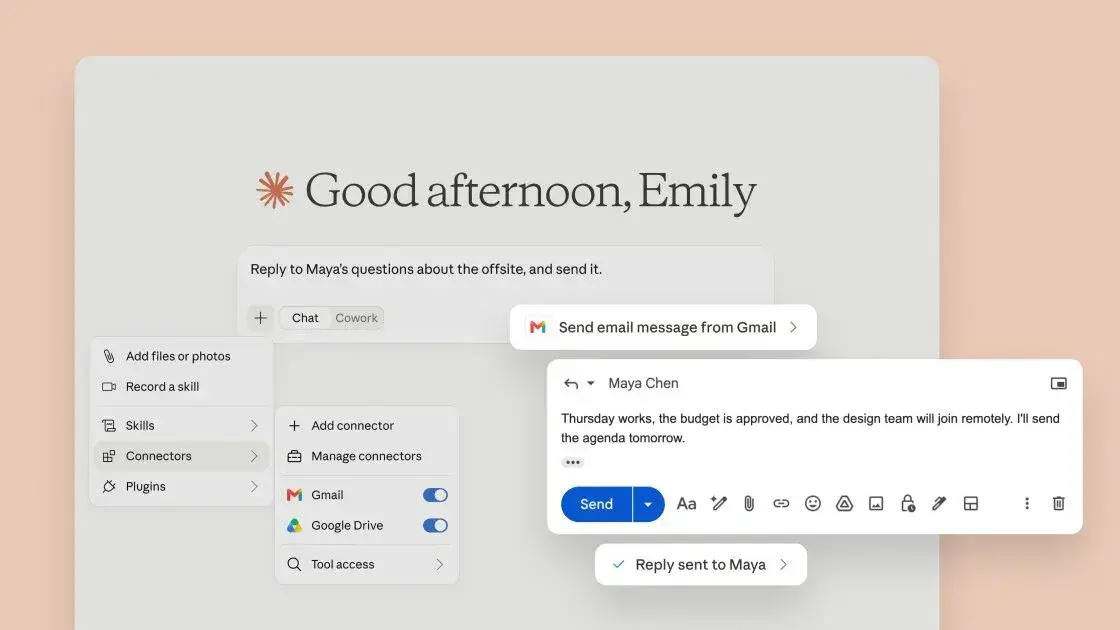
.Claude Cowork specializes in task automation by handling multi-step workflows that previously consumed significant time. One user automated their morning email routine by connecting Claude to Gmail through available connectors, which also include Google Drive, Canva, Notion, Microsoft 365, and Slack
4
. The Gmail connector enables Claude to search, read, and draft emails when granted appropriate permissions4
.
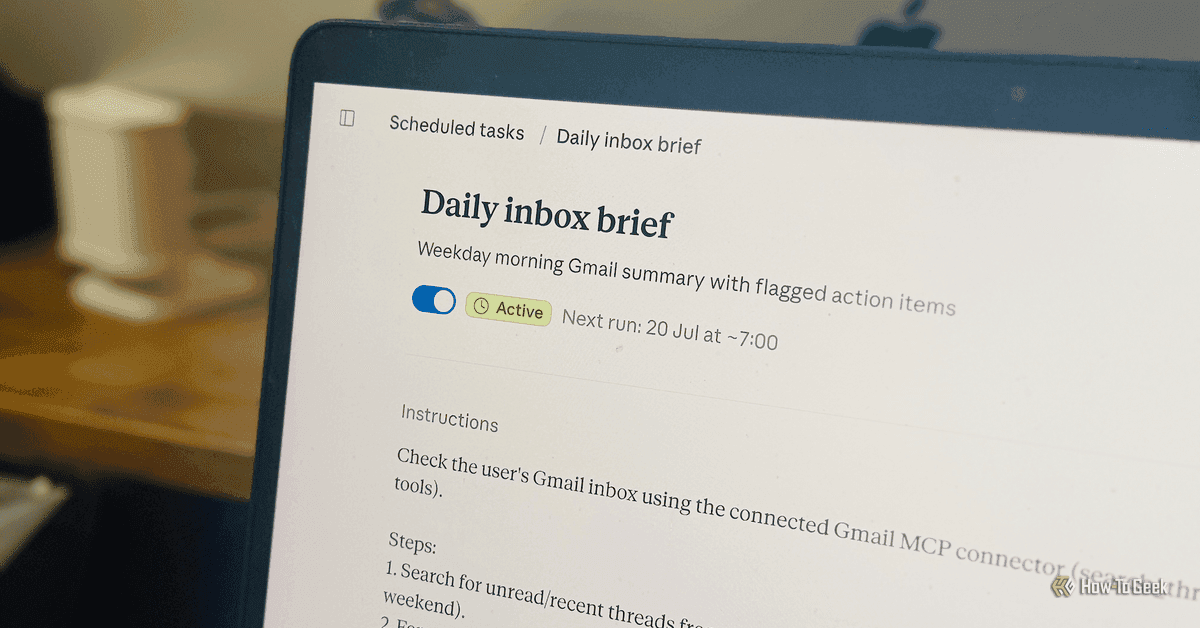
Source: How-To Geek
Scheduled tasks in Claude Cowork run automatically at specified times, following custom instructions. Users can set up tasks to run at 7 AM daily, reading emails and providing summaries of important tasks without manual prompting
4
. The system can even create scheduled tasks based on conversational requests, automatically setting up connectors and writing clear instructions4
.Another innovative AI automation approach involves connecting Windows clipboard directly to Claude's API to process copied text automatically
2
. By installing pyperclip and the Anthropic SDK through pip, users can set up background scripts that monitor clipboard activity. The waitForNewPaste() function sits idle until new content appears, keeping CPU usage minimal2
. Claude 3.5 Sonnet works well for this continuous automation due to its speed and cost efficiency2
.Related Stories
While AI-driven tools offer substantial productivity gains, connecting Claude to personal data raises legitimate privacy concerns. Allowing Claude complete read access to Gmail means potentially sensitive email content gets processed by Anthropic's systems rather than remaining within Google accounts
4
. Users should limit such integrations to work accounts rather than personal email containing sensitive information4
.
Source: ZDNet
Clipboard automation presents similar risks since the clipboard is a system-level resource capturing everything copied, including passwords, account numbers, and API keys
2
. The recommended approach involves setting trigger prefixes so scripts only activate when copied text starts with specific symbols or keywords, preventing accidental exposure of private data and controlling token costs2
.Artifacts enable users to create interactive tools and applications directly within Claude's chat interface, which can be published and shared via links for seamless collaboration
5
. Spreadsheet integration cleans datasets, corrects formulas, and generates summaries, proving especially valuable for organizing complex information in Microsoft Office applications5
. Presentation creation transforms outlines into polished slideshows while maintaining brand consistency5
.Summarized by
Navi
[3]
[5]
08 Jul 2026•Technology

12 Jan 2026•Technology

10 Apr 2026•Technology

1
Science and Research

2
Technology

3
Technology