3 Sources
[1]
Quantinuum boosts IPO to $1.46B, targets $14.3B quantum valuation
Quantinuum boosted its IPO to $1.46 billion after double-digit oversubscription, raising the price range to $53-55 per share and targeting a $14.3 billion valuation. The Honeywell-backed quantum computing company reported $31 million in 2025 revenue and is set to begin trading Thursday. Quantinuum, the Honeywell-backed quantum computing company, has increased the size of its initial public offering to as much as $1.46 billion after demand from investors far exceeded the original allocation. The company is now offering 26.5 million shares at $53 to $55 each, up from a previous range of approximately 21 million shares at $45 to $50. At the top of the new range, Quantinuum would enter the public market with a valuation of $14.3 billion. The IPO drew orders for a double-digit multiple of the shares available, according to people familiar with the matter. Quantinuum is on track to price after the market closes in New York on Wednesday and begin trading on the Nasdaq Global Market under the symbol QNT on Thursday. It would be the first pure-play quantum computing hardware company to list on a major US exchange. The valuation question The numbers behind the $14.3 billion valuation are unusual even by the standards of frontier technology IPOs. Quantinuum reported $30.9 million in revenue for 2025, $79.3 million in bookings, and a net loss of $192.6 million. At the top of the IPO range, the company would be valued at roughly 462 times its last annual revenue, a multiple that only makes sense as a bet on quantum computing's commercial future rather than its present economics. The company develops trapped-ion quantum computers, a technology that uses individual ions held in electromagnetic fields as qubits. Quantinuum's System Model H2 is among the highest-performing quantum processors commercially available, and the company is building platforms for applications in chemistry, machine learning, cybersecurity, finance, and drug discovery. Governments worldwide are investing heavily in quantum computing, with France committing €500 million and launching the PROQCIMA initiative to develop fault-tolerant quantum machines. US government backing The Trump administration provided a direct catalyst for Quantinuum's IPO momentum. On 21 May, the government announced more than $2 billion in funding for nine quantum computing firms in the US, with Quantinuum set to receive $100 million in exchange for an equity stake. The announcement sent quantum-related stocks sharply higher and established a policy framework that treats quantum computing as a strategic national capability. IBM, which also received government funding under the programme, saw its shares surge on the news. The broader quantum computing sector has benefited from a shift in institutional sentiment, moving from speculative curiosity to a category that governments and large enterprises are actively funding. European governments are also pouring public funds into quantum technology, creating a global competition for quantum capability that benefits companies like Quantinuum regardless of which region leads. Honeywell's quantum play Quantinuum was formed in 2021 by merging Honeywell's quantum computing division with Cambridge Quantum, a UK-based quantum software company. Honeywell will retain approximately 48.1% of the combined voting power after the IPO, maintaining effective control of the company while giving it access to public market capital for the first time. The structure is notable because it means Quantinuum's largest shareholder is a $150 billion industrial conglomerate with deep pockets, not a venture capital firm looking for a quick exit. Honeywell's continued involvement provides both credibility and a built-in enterprise customer base, as the parent company can integrate quantum computing capabilities into its aerospace, building technologies, and industrial automation businesses. The company is headquartered in Broomfield, Colorado, and maintains significant operations in the UK, where Cambridge Quantum's team continues to develop quantum software and applications. Military and defence organisations across Europe and the US are among the early customers exploring quantum computing for cryptography, simulation, and optimisation problems that classical computers cannot efficiently solve. What the oversubscription signals The double-digit oversubscription is the most telling data point in the filing. Institutional investors are placing large orders for a company that lost six times more than it earned last year, in a technology category that is years away from broad commercial deployment. The willingness to pay 462 times revenue reflects a belief that quantum computing will follow the AI trajectory, moving from academic curiosity to transformative commercial capability faster than consensus expects. Whether that belief is warranted remains contested. Analysts project massive growth for the quantum sector, but the timeline for fault-tolerant quantum computers capable of solving commercially relevant problems at scale remains uncertain. Quantinuum's bookings growth, from $30.9 million in revenue to $79.3 million in bookings, suggests accelerating demand, but the gap between interest and revenue-generating deployment is still wide. The IPO will test whether the public market agrees with the private market's enthusiasm. If QNT trades well on Thursday, it will validate quantum computing as an investable category and likely accelerate IPO plans for other quantum firms. If it struggles, it will raise questions about whether frontier technology valuations have outrun the underlying science.
[2]
Honeywell's Quantinuum targets US$12.7 billion valuation in U.S. IPO
Honeywell's Quantinuum is targeting a valuation of up to US$12.7 billion in its U.S. initial public offering, it said on Tuesday, as it looks to capitalize on heightened investor attention around quantum computing. The Broomfield, Colorado-based company is planning to raise up to US$1.05 billion by selling about 21.05 million shares at US$45 to US$50 apiece. It raised funds at a $10 billion valuation in its latest funding round in September. Investors have been backing listings from sectors viewed as strategically important, including AI infrastructure, defense and critical technologies, despite geopolitical uncertainty. The move also comes just days after the Trump administration said it will take US$2 billion in equity stakes across nine quantum-computing companies in a push to secure U.S. leadership in the emerging technology, including a US$100 million grant for Quantinuum. The race to accelerate the development of quantum computing technology, which promises to solve complex problems exponentially faster than classical supercomputers, has drawn investor interest. But technical challenges remain, including high error rates that limit practical performance. Quantinuum, formed in 2021 after a separation from Honeywell and a merger with Cambridge Quantum, is chaired by the industrial giant's CEO, Vimal Kapur, and led by Intel veteran Rajeeb Hazra. Honeywell, which will own about 49.1 per cent of the combined voting power in the company, is expected to remain a customer and partner post-IPO, Quantinuum said in the filing. The company reported a net loss of US$192.6 million on revenue of US$30.9 million in 2025, compared with a net loss of US$144.1 million on revenue of US$23 million a year earlier. J.P. Morgan and Morgan Stanley are the joint lead active book-running managers. Quantinuum will list on the Nasdaq under the symbol "QNT."
[3]
Honeywell's Quantinuum targets $12.7 billion valuation in US IPO
May 26 (Reuters) - Honeywell's Quantinuum is targeting a valuation of up to $12.7 billion in its U.S. initial public offering, it said on Tuesday, as it looks to capitalize on heightened investor attention around quantum computing. The Broomfield, Colorado-based company is planning to raise up to $1.05 billion by selling about 21.05 million shares at $45 to $50 apiece. It raised funds at a $10 billion valuation in its latest funding round in September. Investors have been backing listings from sectors viewed as strategically important, including AI infrastructure, defense and critical technologies, despite geopolitical uncertainty. The move also comes just days after the Trump administration said it will take $2 billion in equity stakes across nine quantum-computing companies in a push to secure U.S. leadership in the emerging technology, including a $100 million grant for Quantinuum. The race to accelerate the development of quantum computing technology, which promises to solve complex problems exponentially faster than classical supercomputers, has drawn investor interest. But technical challenges remain, including high error rates that limit practical performance. Quantinuum, formed in 2021 after a separation from Honeywell and a merger with Cambridge Quantum, is chaired by the industrial giant's CEO, Vimal Kapur, and led by Intel veteran Rajeeb Hazra. Honeywell, which will own about 49.1% of the combined voting power in the company, is expected to remain a customer and partner post-IPO, Quantinuum said in the filing. The company reported a net loss of $192.6 million on revenue of $30.9 million in 2025, compared with a net loss of $144.1 million on revenue of $23 million a year earlier. J.P. Morgan and Morgan Stanley are the joint lead active book-running managers. Quantinuum will list on the Nasdaq under the symbol "QNT." (Reporting by Utkarsh Shetti in Bengaluru; Editing by Sahal Muhammed)
Share
Copy Link
Quantinuum upsized its IPO to $1.46 billion following double-digit oversubscription, raising its price range to $53-$55 per share and targeting a $14.3 billion valuation. The Honeywell-backed quantum computing company reported $31 million in 2025 revenue and a $192.6 million net loss, yet institutional investors are betting heavily on quantum's commercial future as the firm prepares to debut on Nasdaq.
The Quantinuum IPO has been dramatically upsized to $1.46 billion after investor demand exceeded the original allocation by a double-digit multiple
1
. The Honeywell-backed quantum computing company is now offering 26.5 million shares at $53 to $55 each, up from approximately 21 million shares at $45 to $501
. At the top of this new range, the Quantinuum valuation would reach $14.3 billion when it begins trading on the Nasdaq listing under the symbol QNT on Thursday1
. This marks the first pure-play quantum computing hardware company to list on a major US exchange, signaling a pivotal moment for the sector.

Source: BNN
The numbers behind this US IPO are striking. Quantinuum reported $30.9 million in revenue for 2025, $79.3 million in bookings, and a net loss of $192.6 million
1
2
. This compares to a net loss of $144.1 million on revenue of $23 million a year earlier2
, showing revenue growth but widening losses. At the top of the IPO range, the company would be valued at roughly 462 times its last annual revenue1
. The massive investor interest in quantum computing reflects institutional belief that the technology will follow AI's trajectory from academic curiosity to commercial necessity faster than expected.The Trump administration's announcement on May 21 provided direct momentum for the offering. The US government funding commitment includes more than $2 billion in equity stakes across nine quantum computing firms, with Quantinuum receiving $100 million
1
2
. This policy framework treats quantum computing as a strategic national capability1
, establishing technological leadership as a national priority. The announcement sent quantum-related stocks sharply higher and transformed sector sentiment from speculative to strategically critical. France has committed €500 million and launched the PROQCIMA initiative for fault-tolerant quantum machines1
, creating global competition that benefits all quantum players.Related Stories
Quantinuum was formed in 2021 by merging Honeywell's quantum computing arm with Cambridge Quantum, a UK-based quantum software company
1
3
. Honeywell will retain approximately 48.1% to 49.1% of the combined voting power after the IPO1
2
, maintaining effective control while providing access to public market capital. The company raised funds at a $10 billion valuation in its latest funding round in September2
. Honeywell's CEO Vimal Kapur chairs the company, while Intel veteran Rajeeb Hazra serves as CEO2
. This structure means the largest shareholder is a $150 billion industrial conglomerate with deep pockets, not a venture firm seeking quick returns.Source: Market Screener
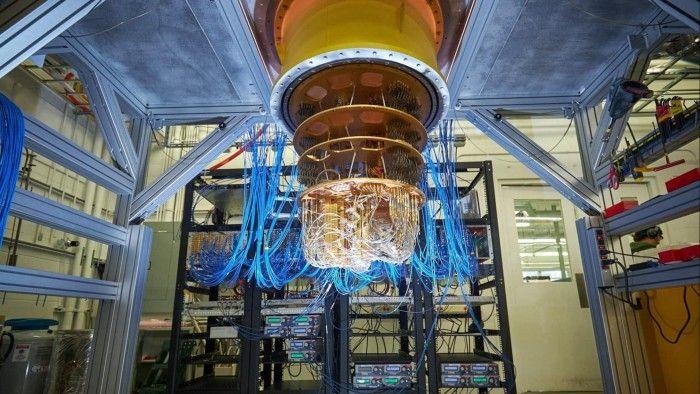
The Broomfield, Colorado-based company develops trapped-ion quantum computers, which use individual ions held in electromagnetic fields as qubits
1
. Quantinuum's System Model H2 ranks among the highest-performing quantum processors commercially available, targeting applications in chemistry, machine learning, cybersecurity, finance, and drug discovery1
. Military and defense organizations across Europe and the US are exploring quantum computing for cryptography, simulation, and optimization problems that classical computers cannot efficiently solve1
. Yet technical challenges persist, including high error rates that limit practical performance2
. Investors are betting these obstacles will be overcome as governments and enterprises actively fund quantum development, shifting the sector from speculative to strategically essential. J.P. Morgan and Morgan Stanley are serving as joint lead active book-running managers for the offering2
.Summarized by
Navi
[3]
09 Jul 2025•Technology

09 Jun 2025•Technology

11 Jan 2025•Technology

1
Startups

2
Policy and Regulation

3
Policy and Regulation