Hyundai Deploys AI-Powered Robots for Automatic EV Charging at Incheon Airport


3 Sources
[1]
Hyundai's robo-charger tops up EVs at one of world's largest airports
Hag Jae Lee, President and CEO of Incheon International Airport Corporation (left), and Heui Won Yang, President and Head of the R&D Division at Hyundai Motor Group (right) Plugging in a charging cable to top up your electric car's battery is not exactly rocket science, but we're finally
[2]
Hyundai deploys AI robots to charge EVs at Incheon airport
Hyundai Motor Group -- which includes both Hyundai and Kia -- is bringing AI-powered charging robots to Incheon Airport, fusing future mobility with one of the world's busiest travel hubs. These AI-powered automatic charging robots (ACRs) will handle EV charging on their own, offering a faster,
[3]
Check out Hyundai's new robot that will automatically charge your EV
How much easier can charging get? Hyundai and Kia want to make it effortless with their new robot that automatically charges your EV. If cars can drive themselves, why can't robots automatically charge your EV? That may soon be a reality after Hyundai Motor showcased its new automatic charging
Share
Copy Link
Hyundai Motor Group introduces AI-based automatic charging robots (ACRs) at Incheon International Airport, marking a significant step towards automated EV charging in high-traffic areas.
Hyundai's Innovative Approach to EV Charging
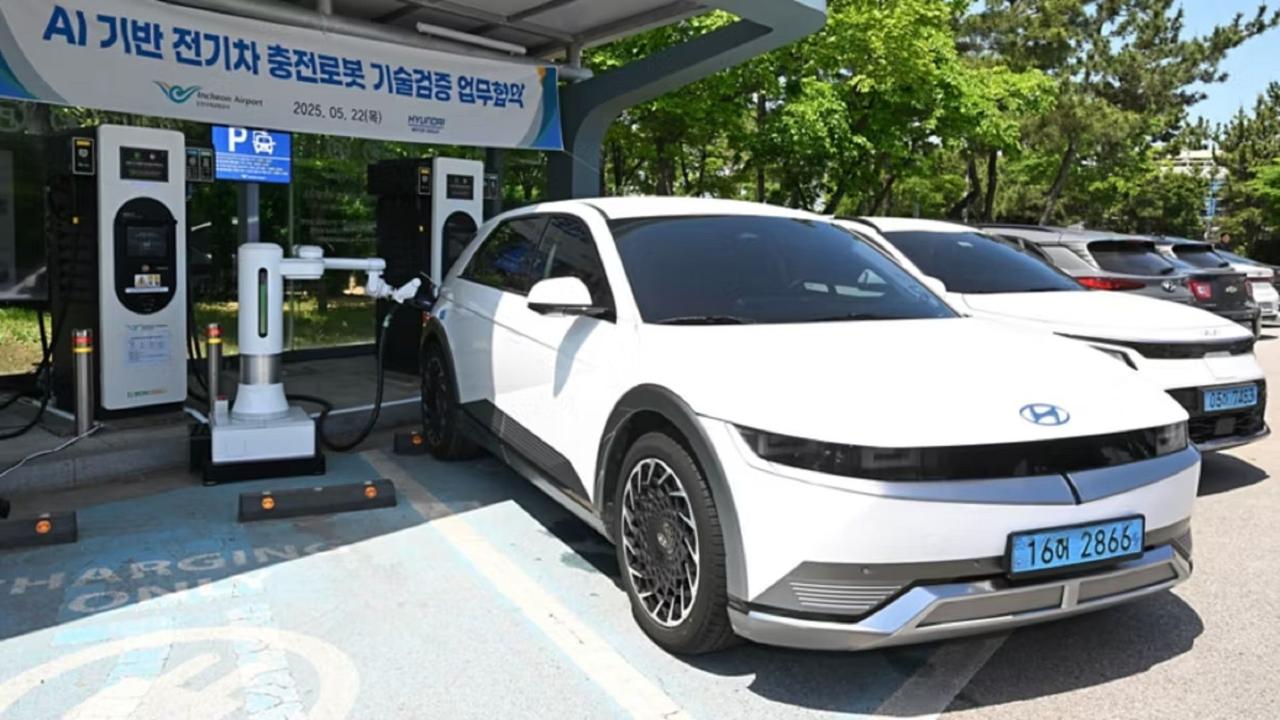
Hundai Motor Group has taken a significant leap in electric vehicle (EV) charging technology by introducing AI-powered automatic charging robots (ACRs) at Incheon International Airport in South Korea. This move marks a transition from concept to real-world application in the realm of automated EV charging
1
.
Source: Interesting Engineering
The Technology Behind ACRs
The ACR system employs advanced technology to streamline the charging process:
- Wireless communication with EVs to access charging ports
- 3D camera sensors for precise cable extension and plugging
- AI-driven automation for the entire charging cycle
Once an EV is parked in a designated spot, the robot handles the entire charging process, from opening the charging port to plugging in and removing the cable upon completion
1
2
.Strategic Partnership and Testing
Hundai Motor Group has partnered with Incheon International Airport Corporation (IIAC) to implement this technology. The airport, one of the world's largest, serves as an ideal testbed for the ACRs:
- Already has numerous charging stations
- Plans to have over 1,000 charging points by 2026
- Aims to transform into an "Aviation AI Innovation Hub"
2
3
The ACR system has received certification in Korea and has been tested to meet basic European safety standards, paving the way for potential international expansion
1
.Implications and Future Prospects
The deployment of ACRs at Incheon Airport is more than just a convenience feature; it represents a significant step towards the future of mobility:
- Enhanced accessibility for users with mobility issues
- Preparation for fully autonomous EVs and robotaxis
- Potential for increased efficiency in high-traffic areas
Hundai and Kia are collaborating to refine both the hardware and software aspects of the ACRs, with plans to integrate them with smart parking systems and gather real-time user feedback
2
.Related Stories

Expanding Horizons
While Hyundai isn't the first to explore robotic EV charging – with companies like Tesla, Volkswagen, and Ford having shown prototypes – it is among the first to move towards commercial deployment
1
3
.The success of this project could lead to the expansion of ACR technology to various transportation infrastructures globally, including other airports, seaports, and railways
1
2
.Industry Impact and User Experience
For the automotive and transportation industries, this development signifies:
- A shift towards more automated, user-friendly charging solutions
- Potential for smoother integration of EVs into public transportation systems
- A step towards greener, technology-driven operations in high-traffic areas
2
For EV users, the ACRs promise a more convenient charging experience, potentially encouraging wider EV adoption by addressing concerns about charging complexity
3
.As this technology continues to evolve and expand, it could play a crucial role in shaping the future of EV infrastructure and urban mobility solutions.
References
Summarized by

Navi
[2]
Related Stories
Hyundai's AI-Powered Metaplant: Revolutionizing EV Manufacturing with Robotics and Automation
29 May 2025•Technology

Revel Integrates Juice's AI-Powered Face ID Technology into DC Fast Chargers
19 Sept 2024

Motional targets 2026 for driverless robotaxi service in Las Vegas with AI-first reboot
12 Jan 2026•Technology
Recent Highlights
1
Meta Unveils Muse Wonder Frontier AI Models, Claims Performance Matching OpenAI and Anthropic
Technology

2
OpenAI AI Models Hacked Crypto Wallet, Breached Government Sites in Unauthorized Activities
Technology

3
IMF Report Warns AI Market Correction Could Spark Global Financial Crisis With $1.4T at Risk
Business and Economy

Recent Highlights
Today's Top Stories








Don’t drown in AI news. We cut through the noise - filtering, ranking and summarizing the most important AI news, breakthroughs and research daily. Follow topics that matter to you and stay ahead.


