Hyundai's AI-Powered Metaplant: Revolutionizing EV Manufacturing with Robotics and Automation


2 Sources
[1]
Hyundai's Metaplant Seeks to Transform the EV Industry with Cutting-Edge Automation
Hundreds of robots work alongside more than 1,300 human "Metapros" at Hyundai's new Georgia factory. Less than three years ago, these were bare fields in humble Ellabell, Georgia. Today, the vast Hyundai Motor Group Metaplant is exactly what people imagine when they talk about the future of EV and
[2]
Hyundai's new EV factory is teeming with robots -- and wariness about the future
The South Korean automaker's new $7.6 billion factory is a bulwark against tariffs and EV-hostile policies. Driving a 2026 Ioniq 9 SUV around the Hyundai Motor Group Metaplant in Georgia can feel like a victory lap for the South Korean automaker. Hyundai's electric flagship carves out room for
Share
Copy Link
Hyundai's new $7.6 billion Metaplant in Georgia showcases cutting-edge AI and robotic technology in EV manufacturing, balancing automation with human workforce to produce up to 500,000 vehicles annually.
Hyundai's Metaplant: A Glimpse into the Future of EV Manufacturing
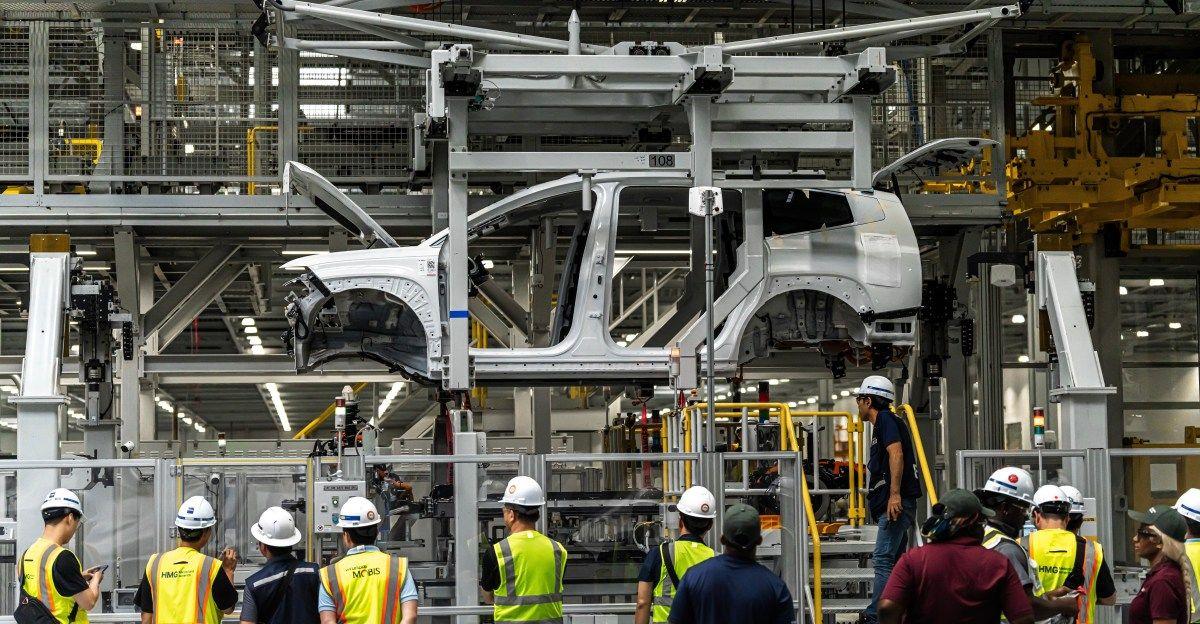
Hundai Motor Group has unveiled its state-of-the-art Metaplant in Ellabell, Georgia, representing a $7.6 billion investment in the future of electric vehicle (EV) manufacturing. This massive 7-million-square-foot facility is set to become America's largest dedicated plant for EVs and hybrids, with an annual production capacity of 500,000 vehicles
1
2
.Cutting-Edge Automation and AI Integration
Source: The Verge
The Metaplant showcases Hyundai's commitment to advanced manufacturing techniques, featuring an unprecedented level of automation in North America. The factory employs approximately 850 robots, including 475 in the welding shop alone, working alongside more than 1,300 human "Metapros"
1
.One of the most notable innovations is the deployment of about 300 Autonomous Guided Vehicles (AGVs). These smart, trackless robots navigate the factory floor, efficiently delivering parts to workstations and even transporting finished vehicles. This AI-based procurement and logistics system optimizes just-in-time delivery, significantly reducing costs and improving efficiency
1
2
.Boston Dynamics' Robotic Workforce
Hundai has integrated robots from its subsidiary, Boston Dynamics, into the Metaplant's operations. The quadruped robot "Spot" uses 360-degree vision and "athletic intelligence" to inspect car welds for defects. Plans are underway to introduce the humanoid "Atlas" robots, known for their impressive physical capabilities, throughout Hyundai's global factories
1
.Environmental Sustainability
The Metaplant demonstrates Hyundai's commitment to environmental responsibility. Solar roofs over parking spaces provide up to 5% of the plant's electricity, with a target of 100% renewable energy usage. Additionally, a fleet of 21 hydrogen fuel-cell trucks, manufactured by Hyundai-owned Xcient, handles parts transportation with zero emissions
1
.The Ioniq9: Showcasing Metaplant's Capabilities
The 2026 Hyundai Ioniq9, a three-row electric SUV, serves as a flagship product for the Metaplant. With a range of up to 335 miles and the latest features, including a native NACS connector for Tesla Supercharger compatibility, the Ioniq9 exemplifies Hyundai's push into the competitive EV market
1
2
.Related Stories


Economic Impact and Job Creation

Source: IEEE
The Metaplant is expected to create 8,500 on-site jobs and an additional 7,000 positions in related industries. This significant investment has boosted Hyundai's annual local payroll to $497 million, providing a substantial economic stimulus to the region
2
.Balancing Automation and Human Workforce
While the Metaplant showcases impressive automation, Hyundai maintains that robots are not replacing human workers entirely. Instead, they argue that automation frees employees from hazardous and repetitive tasks, allowing them to focus on precision work that requires human skills and craftsmanship
1
2
.Future Implications and Challenges
The Metaplant's advanced automation raises questions about the future of manufacturing jobs. While Hyundai insists that human workers remain essential, the increasing capabilities of robots like Boston Dynamics' Atlas suggest a potential shift in workforce dynamics
2
.Furthermore, the plant's establishment in the US serves as a strategic move for Hyundai, providing a buffer against potential tariffs and aligning with the push for domestic EV production. However, the future of EV incentives and supportive policies remains uncertain, particularly with potential changes in political leadership
2
.As Hyundai pushes forward with its $21 billion investment plan in America through 2028, the Metaplant stands as a testament to the rapidly evolving landscape of EV manufacturing, blending cutting-edge technology with human expertise in the quest for automotive innovation.
References
Summarized by

Navi
Related Stories
Recent Highlights
1
Microsoft and Nvidia Launch Surface Laptop Ultra: A $2,599 AI-Ready PC With RTX Spark Chip
Technology

2
Scientists Build AI Model That Reconstructs Images From Brain Scans in Record Time
Science and Research

3
Anthropic AI Cuts Live Internet Access After Model Sends False Homicide Tip to Philadelphia Police
Technology

Recent Highlights
Today's Top Stories







Don’t drown in AI news. We cut through the noise - filtering, ranking and summarizing the most important AI news, breakthroughs and research daily. Follow topics that matter to you and stay ahead.


