India tops IBM's digital sovereignty index, but only a third can prove control


2 Sources
[1]
Digital Sovereignty Index: India leads in IBM's Digital Sovereignty Index, but faces challenges in proving control over AI and data
India proudly topped IBM's Digital Sovereignty Index with an impressive score of 79, surpassing the global average of 74. However, numerous Indian organisations struggled to establish control over artificial intelligence and technological dependency, with 63 percent reporting sovereignty
[2]
India Tops Global Digital Sovereignty Index (79/100), Yet Only 35% of Enterprises Can Prove Sovereign Control: IBM Study
A new report from IBM, Proof, Not Promises: The Digital Sovereignty Index, reveals that Indian organizations achieved the highest overall Digital Sovereignty Index score among the markets surveyed, at 79.0 out of 100 compared with the global average of 74.0, while also reporting substantial
Share
Copy Link
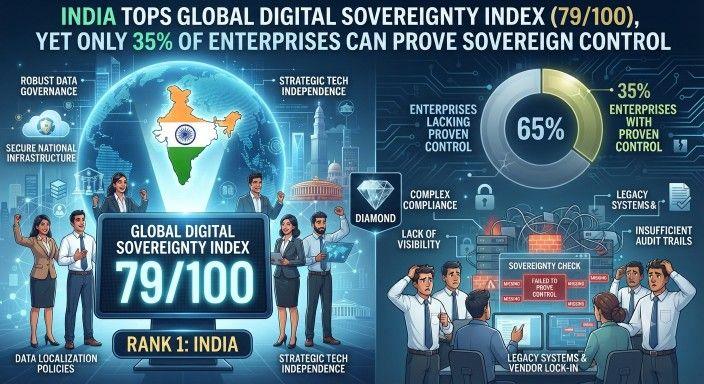
India scores highest among the markets International Business Machines surveyed in its new Digital Sovereignty Index, yet only about a third of Indian organizations can actually prove they hold sovereign control over their technology and data
2
1
.
Source: CXOToday
Confidence on paper, thin evidence in hand
The study, 'Proof, Not Promises: The Digital Sovereignty Index', is a new IBM report covering multiple markets
2
. It defines digital sovereignty as keeping control of critical AI, technology, operations and data, and being able to show credible evidence of that control. 70% of Indian respondents said this matched their own understanding2
1
.On the evidence half, India's numbers fall away. 88% of Indian organizations say they are highly confident they could demonstrate sovereign control, but only 35% meet the study's 'Leading' threshold for evidence maturity, its bar for organizations that can show proof rather than assert it
2
1
. Only 35% still leads the markets surveyed. The report itself frames the finding as a gap between perceived readiness and evidence maturity2
.When control gets tested
Sovereignty gets tested often. In the survey's self-reported figures, 97% of Indian organizations reported at least one situation that tested it over the past three years
2
1
. 90% of those said the situation required formal evidence of control, whether through an external request or an internal review2
1
. Few handled it cleanly. Only 36% kept control and resolved things without material disruption, and 13% had to change a provider, an architecture, an AI use case or a data practice2
1
. Barriers also ran higher in India than elsewhere, at 61% versus 51% globally2
.The obstacles are mostly about paperwork held by other people. 66% said relying on outside providers for evidence or records made proving control difficult
2
1
. Another 64% reported that third-party evidence arrived incomplete, delayed or not at all2
1
. Inside their own walls, 62% pointed to incomplete logs and audit trails, 62% to legacy systems or inconsistent standards, and 53% to unclear ownership of the job2
1
.AI is the soft spot
On self-reported figures, 63% of Indian organizations reported an AI-related sovereignty issue, against 44% globally
2
1
. On the index, India's ability to intervene in AI systems, to override, halt or reverse them, scores 64.52
1
. That is below the global average of 68.1 and below its own scores elsewhere2
1
. Its own scores on technology, operations and data sit above 81, so the weakness is specific to AI rather than general2
1
.Related Stories

From compliance to capability
There is a counterweight. 45% of Indian organizations test sovereign control continuously or as part of regular governance, against 33% globally
2
1
. Among organizations globally, those the study classes as 'Leading' test far more often than those still 'Establishing', 63% against 23%2
. The study presents this as an association between regular testing and stronger maturity2
.Rishi Aurora, who leads IBM Consulting in India and South Asia, said: "India's digital sovereignty maturity is encouraging, but the real test is whether that control holds when businesses come under pressure"
2
. He put what comes next in similar terms: "The next phase of sovereignty in India will be about making control an operational capability, not simply a compliance exercise."2
References
Summarized by

Navi
Related Stories
96% of Indian Government Leaders Actively Pursue Sovereign AI Through National Infrastructure
23 Jun 2026•Policy and Regulation

India Leads in AI-Driven Sustainability Initiatives, IBM Report Reveals
28 Nov 2024•Technology

India's AI Investment Jumps 119% While AI Governance Lags at 22%: ServiceNow Report
08 Sept 2026•Business and Economy

Recent Highlights



Recent Highlights
Today's Top Stories









Don’t drown in AI news. We cut through the noise - filtering, ranking and summarizing the most important AI news, breakthroughs and research daily. Follow topics that matter to you and stay ahead.


