2 Sources
[1]
Cables and cooling bring AI windfall to Indian suppliers
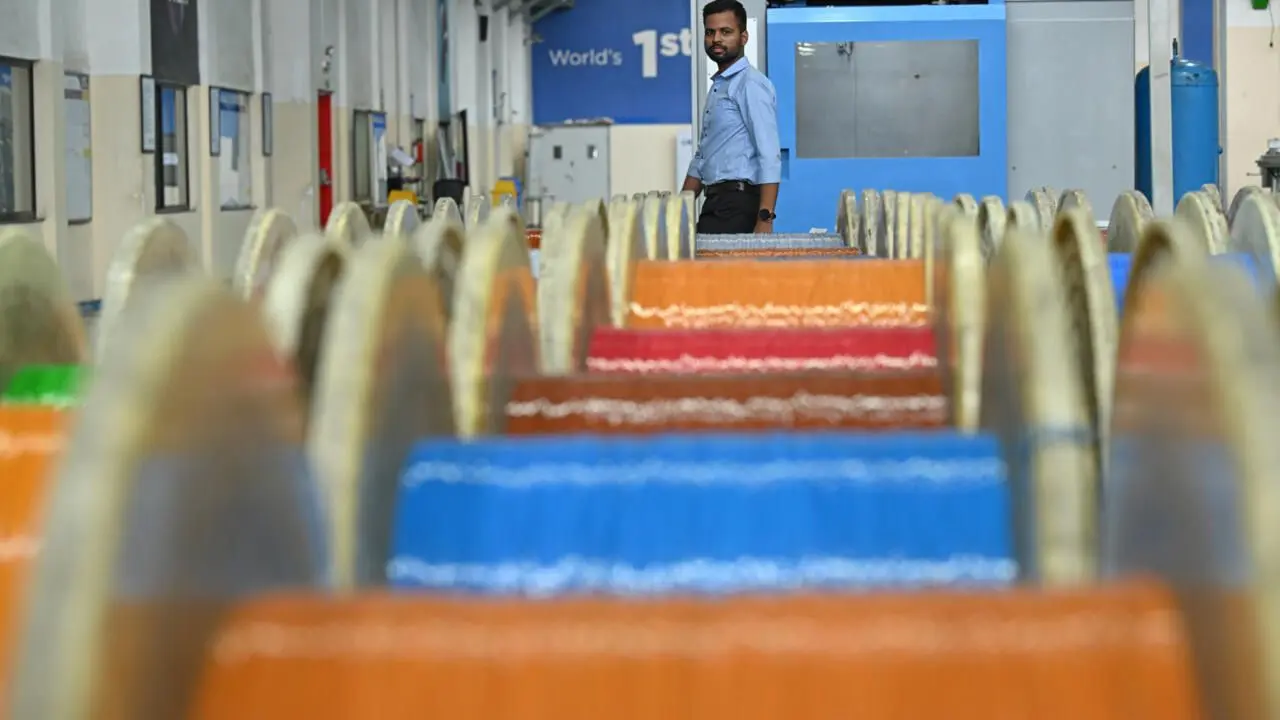
Mumbai (India) (AFP) - At a bustling factory in western India, technicians work around the clock to turn glass into hair-thin fibre-optic strands destined for data centres powering the global artificial intelligence boom. Indian manufacturers are cashing in on the AI infrastructure buildout by supplying cables, power systems and cooling equipment -- even as investors worry the country is falling behind in the race to develop the technology. Analysts at Nomura describe it as a classic "picks and shovels" trade, a riff on how selling tools during a gold rush can earn people more than searching for the precious metal. For Ankit Agarwal, managing director of Sterlite Technologies, serving the world's biggest tech companies is a dramatic shift for his firm, once known mainly as a supplier to telecoms networks. "This is a once in a lifetime opportunity," Agarwal told AFP in Mumbai. "This is a kind of entire new network." India has enthusiastically adopted AI but has yet to produce globally competitive models and remains dependent on imported advanced semiconductors. Investors also fear that generative AI could disrupt the country's $315-billion IT services industry by automating tasks long outsourced to India, such as customer service and app maintenance. These worries have weighed on markets, with the benchmark Nifty 50 down around seven percent this year and foreign investors pulling over $27 billion from Indian equities. 'Tsunami' The data centre boom is generating windfall gains for companies largely overlooked by investors, offering a bright spot in a market rattled by concerns over AI's impact on India's export-oriented tech sector. "India doesn't need to make the chip or train the model to benefit," Prateek Nigudkar, a fund manager at Shriram AMC, told AFP. "Every data centre needs switchgear, transformers, cables, cooling systems and grid connectivity, and Indian manufacturers are already in that supply chain." Fibre-optic cable producers have been among the biggest beneficiaries. Strong demand for networks linking data centres has helped manufacturers secure contracts once considered out of reach. Sterlite earlier this year announced a $1.1-billion multi-year order from a US hyperscaler -- a term meaning a large-scale cloud service provider -- helping drive its shares up 400 percent this year. Telecom equipment maker HFCL reported its strongest-ever April-June quarter, with revenue more than doubling on AI demand. Founder Mahendra Nahata said he was going all out to scale up production. "We used to increase capacity probably once in three years, once in five years. Nowadays, it's become a daily routine," he told AFP, comparing the buildout to a "tsunami". The gains extend beyond fibre cables. Shares in TD Power Systems have jumped 68 percent on expectations of rising demand from AI facilities, while MTAR Technologies has benefited from demand for power units used in fuel-cell systems serving big-tech operators. 'Big investments' Analysts, however, warn valuations have become stretched, while growing opposition to energy-guzzling data-centre projects also poses a risk. Data Center Watch, a tracker run by AI intelligence firm 10a Labs, says at least 75 US projects worth some $130 billion were delayed or blocked in the first quarter of 2026. Indian executives acknowledge the risks could hurt near-term sentiment but argue domestic demand would eventually offset any slowdown abroad. India hosts nearly a fifth of the world's data, but accounts for less than five percent of global data-centre capacity -- leaving much room for growth. An AFP review of funding announcements shows US hyperscalers have committed some $57 billion in new Indian capacity over the past year, while conglomerates Adani and Reliance have pledged $100 billion towards digital and infrastructure projects. Unlike in parts of the United States and Europe, data centre development in India has faced limited resistance so far. "Opposition is probably in a very nascent stage," said Sharad Agarwal, chief executive of data centre operator Sify Infinit Spaces. He said operators had adopted technologies such as closed-loop water cooling systems to reduce pressure on local resources. Sify, which operates 16 data centres and has nearly a dozen more under development, is considering an IPO that would make it India's first listed data-centre operator. "We are talking about big investments. If I need to be a one-gigawatt company, I need $5 billion," Agarwal said. A computing power capacity of one gigawatt is often referred to as "hyperscale". "Then only we can go and grow."
[2]
No chips, no models, no problem: Indian manufacturers strike gold in AI's infrastructure gold rush
At a bustling factory in western India, technicians work around the clock to turn glass into hair-thin fibre-optic strands destined for data centres powering the global artificial intelligence boom. India hosts nearly a fifth of the world's data, but accounts for less than five percent of global data-centre capacity -- leaving much room for growth. Mumbai: At a bustling factory in western India, technicians work around the clock to turn glass into hair-thin fibre-optic strands destined for data centres powering the global artificial intelligence boom. Indian manufacturers are cashing in on the AI infrastructure buildout by supplying cables, power systems and cooling equipment -- even as investors worry the country is falling behind in the race to develop the technology. Also read: India's AI boom is rewarding engineers more than coders Analysts at Nomura describe it as a classic "picks and shovels" trade, a riff on how selling tools during a gold rush can earn people more than searching for the precious metal. For Ankit Agarwal, managing director of Sterlite Technologies, serving the world's biggest tech companies is a dramatic shift for his firm, once known mainly as a supplier to telecoms networks. "This is a once in a lifetime opportunity," Agarwal told AFP in Mumbai. "This is a kind of entire new network." India has enthusiastically adopted AI but has yet to produce globally competitive models and remains dependent on imported advanced semiconductors. Investors also fear that generative AI could disrupt the country's $315-billion IT services industry by automating tasks long outsourced to India, such as customer service and app maintenance. These worries have weighed on markets, with the benchmark Nifty 50 down around seven percent this year and foreign investors pulling over $27 billion from Indian equities. Tsunami The data centre boom is generating windfall gains for companies largely overlooked by investors, offering a bright spot in a market rattled by concerns over AI's impact on India's export-oriented tech sector. "India doesn't need to make the chip or train the model to benefit," Prateek Nigudkar, a fund manager at Shriram AMC, told AFP. "Every data centre needs switchgear, transformers, cables, cooling systems and grid connectivity, and Indian manufacturers are already in that supply chain." Fibre-optic cable producers have been among the biggest beneficiaries. Strong demand for networks linking data centres has helped manufacturers secure contracts once considered out of reach. Sterlite earlier this year announced a $1.1-billion multi-year order from a US hyperscaler -- a term meaning a large-scale cloud service provider -- helping drive its shares up 400 percent this year. Telecom equipment maker HFCL reported its strongest-ever April-June quarter, with revenue more than doubling on AI demand. Founder Mahendra Nahata said he was going all out to scale up production. Also read: Indian employees AI-ready, but enterprise workflows holding them back: Report "We used to increase capacity probably once in three years, once in five years. Nowadays, it's become a daily routine," he told AFP, comparing the buildout to a "tsunami". The gains extend beyond fibre cables. Shares in TD Power Systems have jumped 68 percent on expectations of rising demand from AI facilities, while MTAR Technologies has benefited from demand for power units used in fuel-cell systems serving big-tech operators. Big investments Analysts, however, warn valuations have become stretched, while growing opposition to energy-guzzling data-centre projects also poses a risk. Data Center Watch, a tracker run by AI intelligence firm 10a Labs, says at least 75 US projects worth some $130 billion were delayed or blocked in the first quarter of 2026. Indian executives acknowledge the risks could hurt near-term sentiment but argue domestic demand would eventually offset any slowdown abroad. India hosts nearly a fifth of the world's data, but accounts for less than five percent of global data-centre capacity -- leaving much room for growth. An AFP review of funding announcements shows US hyperscalers have committed some $57 billion in new Indian capacity over the past year, while conglomerates Adani and Reliance have pledged $100 billion towards digital and infrastructure projects. Unlike in parts of the United States and Europe, data centre development in India has faced limited resistance so far. "Opposition is probably in a very nascent stage," said Sharad Agarwal, chief executive of data centre operator Sify Infinit Spaces. He said operators had adopted technologies such as closed-loop water cooling systems to reduce pressure on local resources. Sify, which operates 16 data centres and has nearly a dozen more under development, is considering an IPO that would make it India's first listed data-centre operator. "We are talking about big investments. If I need to be a one-gigawatt company, I need $5 billion," Agarwal said. A computing power capacity of one gigawatt is often referred to as "hyperscale". "Then only we can go and grow."
Share
Copy Link
Indian manufacturers are securing massive contracts supplying fibre-optic cables, power systems and cooling equipment to data centers powering the AI boom. Sterlite Technologies landed a $1.1-billion order from a US hyperscaler, while HFCL doubled revenue. Despite lacking AI chips or competitive AI models, Indian suppliers are capitalizing on the infrastructure buildout as US hyperscalers commit $57 billion to Indian capacity.
Indian manufacturers are reaping substantial gains from the global AI infrastructure boom by supplying essential components like fibre-optic cables, power systems, and cooling equipment to data centers worldwide
1
2
. At a bustling factory in western India, technicians work around the clock turning glass into hair-thin fibre-optic strands destined for data centers powering artificial intelligence systems. This economic windfall comes even as investors worry India is falling behind in developing competitive AI models and remains dependent on imported AI chips. Analysts at Nomura describe this as a classic "picks and shovels" trade—selling tools during a gold rush often proves more lucrative than searching for gold itself.
Source: France 24
Fibre-optic cable producers have emerged as the biggest beneficiaries of the AI infrastructure boom. Sterlite Technologies, once known primarily as a telecoms network supplier, announced a $1.1-billion multi-year order from a US hyperscaler earlier this year, driving its shares up 400 percent
1
. "This is a once in a lifetime opportunity," said Ankit Agarwal, managing director of Sterlite Technologies. "This is a kind of entire new network." Telecom equipment maker HFCL reported its strongest-ever April-June quarter, with revenue more than doubling on AI demand2
. Founder Mahendra Nahata compared the buildout to a "tsunami," noting that capacity expansion has shifted from a once-every-three-to-five-years occurrence to a daily routine.The gains extend well beyond fibre-optic cables to encompass the full spectrum of data center infrastructure. Shares in TD Power Systems have jumped 68 percent on expectations of rising demand from AI facilities, while MTAR Technologies has benefited from demand for power units used in fuel-cell systems serving big-tech operators
1
. "India doesn't need to make the chip or train the model to benefit," explained Prateek Nigudkar, a fund manager at Shriram AMC. "Every data center needs switchgear, transformers, cables, cooling systems and grid connectivity, and Indian manufacturers are already in that supply chain." This infrastructure buildout offers a bright spot in a market rattled by concerns over AI's impact on India's $315-billion IT services industry, where generative AI could automate tasks long outsourced to India.Related Stories
India hosts nearly a fifth of the world's data but accounts for less than five percent of global data center capacity, leaving substantial room for growth
1
2
. An AFP review of funding announcements shows US hyperscalers have committed approximately $57 billion in new Indian capacity over the past year, while Indian conglomerates Adani and Reliance have pledged $100 billion towards digital and infrastructure projects. Sify Infinit Spaces, which operates 16 data centers with nearly a dozen more under development, is considering an IPO that would make it India's first listed data center operator. "If I need to be a one-gigawatt company, I need $5 billion," said Sharad Agarwal, chief executive of Sify Infinit Spaces, highlighting the scale of investments required.Despite the optimism, analysts warn that stretched valuations and growing opposition to energy-guzzling data center projects pose risks to continued growth. Data Center Watch, a tracker run by AI intelligence firm 10a Labs, reports that at least 75 US projects worth approximately $130 billion were delayed or blocked in the first quarter of 2026
1
. These worries have already weighed on markets, with the benchmark Nifty 50 down around seven percent this year and foreign investors pulling over $27 billion from Indian equities. However, unlike in parts of the United States and Europe, data center development in India has faced limited resistance so far. Operators have adopted technologies such as closed-loop water cooling systems to reduce pressure on local resources, with opposition remaining in a "very nascent stage" according to industry executives. Indian executives acknowledge these risks could hurt near-term sentiment but argue that domestic demand would eventually offset any slowdown abroad, positioning Indian suppliers to continue benefiting from the AI infrastructure buildout regardless of global headwinds.Summarized by
Navi
06 Feb 2026•Business and Economy

27 May 2026•Business and Economy

01 Jul 2026•Technology