Intel XeSS 3 Multi-Frame Generation Brings AI Upscaling to Laptops and Gaming Handhelds


3 Sources
[1]
Intel's Panther Lake CPUs Make the Best Case for 'Fake Frames' in Gaming
The new Core Ultra Series 3 chips and XeSS 3 AI upscaler can juice up frame rates on laptops, but handhelds may benefit the most. If your gaming machine isn't rendering any frames itself, what's the point of having a costly computer at all? I know some of you out there are mumbling resentments,
[2]
I tested Intel's XeSS 3 multi-frame generation on my Core Ultra X9 388H laptop, and Nvidia should be worried about the future of gaming laptops
Just when I thought Intel Core Ultra Series 3 couldn't get any better, Team Blue just dropped XeSS 3 multi-frame generation in a new graphics driver. And after testing it on my Asus Zenbook Duo with Intel Core Ultra X9 388H, my mind is blown. Nvidia should be nervous because integrated graphics
[3]
Turns out Intel's XeSS 3 upscaling works on MSI Claw handhelds, so I'd pop it on your portable ASAP for Multi-Frame Generation tomfoolery
I'm not entirely surprised to hear Intel's XeSS 3 works on more than just Panther Lake chipsets, as support for B580 GPUs has already been confirmed. However, impatient fans have already sussed out how to get multi-Frame generation working on more devices ahead of schedule, and it could make all
Share
Copy Link
Intel launched XeSS 3 with multi-frame generation technology, enabling ultraportable laptops to achieve frame rates previously reserved for dedicated GPUs. Testing on the Asus Zenbook Duo showed Cyberpunk 2077 jumping from 67 FPS to 217 FPS with the AI-powered upscaling technology. The feature also works on MSI Claw handhelds, potentially reshaping the future of gaming laptops and portable gaming.
Intel XeSS 3 Brings Multi-Frame Generation to Lightweight Gaming Devices
Intel has released Intel XeSS 3, an AI upscaling technology that introduces multi-frame generation capabilities to its Core Ultra Series 3 processors and Arc B580 GPUs. The technology allows gaming laptops and handhelds to generate up to three additional frames for every single frame rendered by the GPU, dramatically improving perceived performance without requiring expensive dedicated graphics hardware
1
. Unlike Nvidia's DLSS 4.5 and AMD's FSR Redstone, which are locked to proprietary hardware, Intel's approach is device agnostic, though it delivers particular advantages on Intel machines1
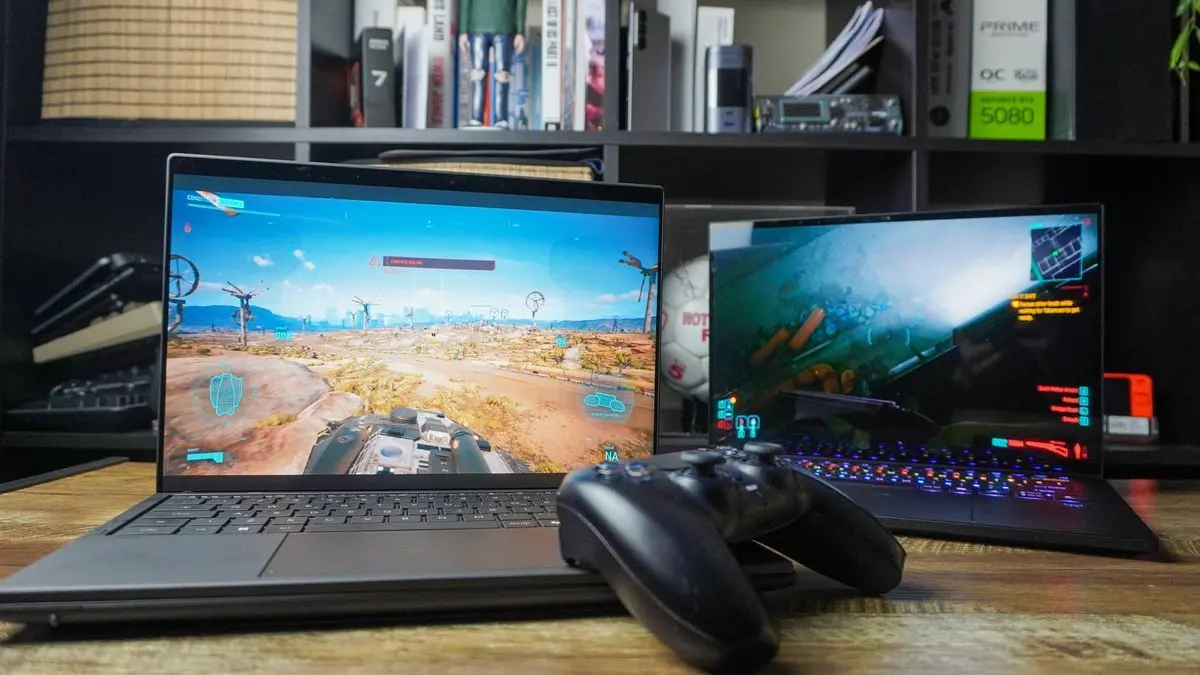
.Testing on the Asus Zenbook Duo equipped with Intel's Core Ultra X9 388H processor revealed remarkable performance gains. In Cyberpunk 2077, the system achieved 67.1 FPS with XeSS 2, but this number jumped to 217 FPS when multi-frame generation was enabled through XeSS 3
2
. What makes this particularly impressive is that the Zenbook Duo operates at just 45 watts of total power, compared to gaming laptops with dedicated GPUs like the Acer Predator Triton 14 AI with RTX 5070, which consumes up to 140W2
.
Source: Tom's Guide
How AI-Powered Upscaling Technology Works and Why It Matters
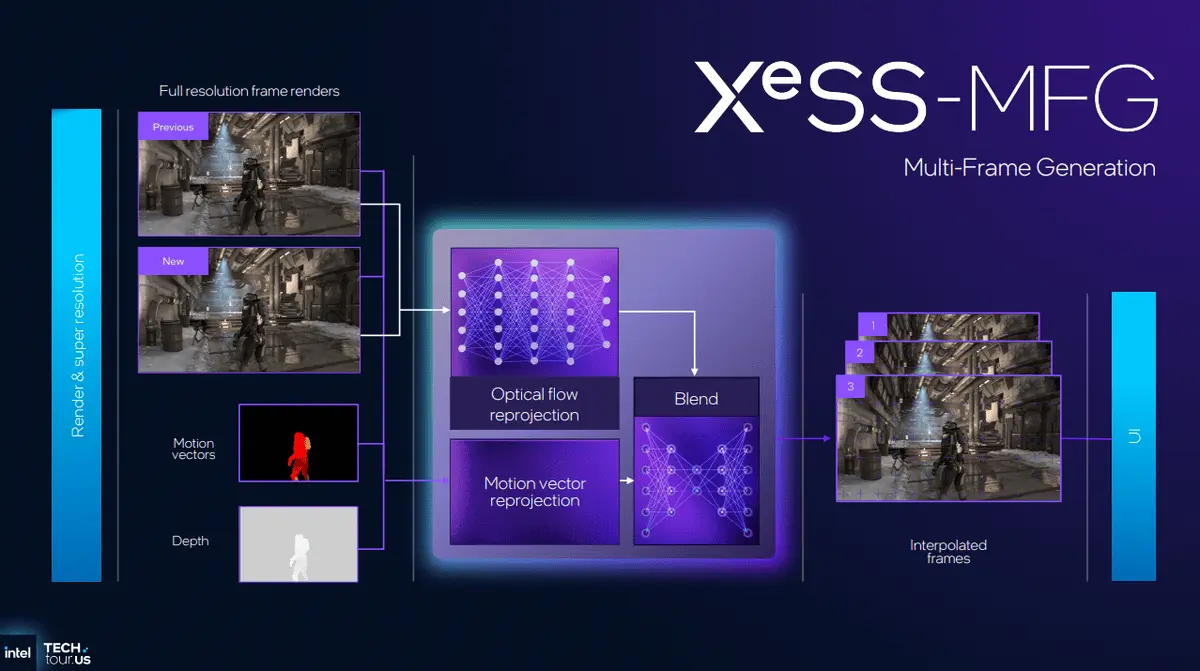
The Intel XeSS 3 system combines two key technologies to boost gaming frame rates. Multi-frame generation uses AI to inspect game scenes and create multiple interpolated frames between two fully rendered frames, offering 2x, 3x, or 4x frame generation options
1
. Super Resolution renders games at lower resolutions to conserve power, then uses AI to upscale images to the desired display resolution2
.This approach addresses a fundamental challenge in mobile gaming: delivering smooth performance without draining battery life or requiring bulky cooling solutions. Intel's head of Arc graphics, Tom Petersen, emphasized that the technology focuses on creating a general sense of smoothness by cutting down on CPU timings to eliminate in-game stuttering
1
. For ultraportable devices and integrated graphics gaming scenarios, this represents a significant shift in what's possible without dedicated GPU hardware.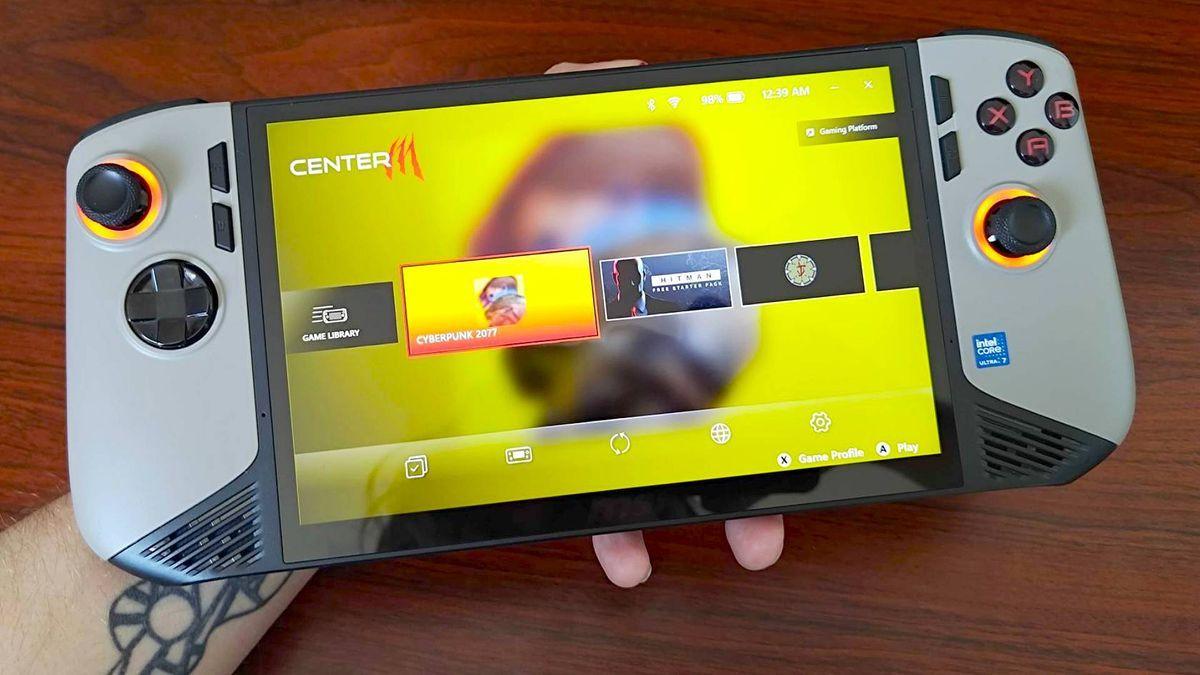
Source: GamesRadar
Addressing Concerns About Fake Frames in Gaming and Visual Quality
The concept of fake frames in gaming remains controversial among PC enthusiasts who question the value of AI-generated content versus natively rendered frames. Testing revealed that while multi-frame generation delivers impressive frame rate numbers, it does introduce trade-offs. At 4x frame generation, games can feel noticeably "floatier" due to increased latency, and rapid camera movements can produce ghostly artifacts
1
.Latency measurements show Intel XeSS 3 averaging around 44ms in 4x mode, compared to DLSS 4's 42ms
2
. For single-player gaming, this latency remains imperceptible to most players, though competitive multiplayer enthusiasts may prefer disabling the feature. Visual quality comparisons between native rendering and XeSS 3 upscaling showed minimal perceptible differences, with artifacts largely absent during normal gameplay2
.Related Stories
MSI Claw Handhelds Gain Early Access Through Community Modifications
While Intel's Panther Lake CPUs and Arc B580 GPUs officially support XeSS 3, enthusiasts have discovered methods to enable the technology on additional devices ahead of official rollout. Users on r/IntelArc shared that extracting two DLL files from the latest driver update and reinstalling using the extracted folder enables multi-frame generation on MSI Claw handhelds and other Intel-based portable devices
3
.This development positions Intel as the only company actively delivering multi-frame generation technology for handheld gaming purposes, even as Nvidia and AMD focus primarily on desktop and laptop GPUs. The ROG Ally X, powered by AMD hardware, currently relies on FSR 3 and driver-level "Fluid Motion Frames" technology, but lacks the specific multi-frame generation capabilities that XeSS 3 provides
3
. For handheld gaming devices with inherently limited specs, AI upscaling tools offer the most significant potential performance gains.What This Means for the Future of Gaming Laptops and Portable Devices
The implications for integrated graphics gaming extend beyond immediate performance numbers. Intel's Core Ultra series chips, particularly the X7 and X9 variants with their 12Xe3 GPU cores based on Arc B390 microarchitecture, deliver gaming capabilities that challenge the traditional dominance of Nvidia and AMD in the laptop gaming market
1
. With rumors suggesting AMD may remain on RDNA 3.5 iGPU architecture until 2029, Intel could maintain a substantial technical advantage in the ultraportable gaming segment for years2
.For consumers weighing gaming laptop purchases, XeSS 3 suggests that integrated graphics solutions can now deliver playable frame rates in demanding titles like Cyberpunk 2077 with ray tracing enabled, something previously impossible without discrete GPUs. The technology's ability to maintain 45-60 FPS base performance before applying frame generation ensures latency remains manageable for most gaming scenarios. Watch for broader game support as developers integrate XeSS 3 into upcoming titles, and monitor whether Nvidia and AMD respond with similar device-agnostic solutions for their competing technologies.References
Summarized by

Navi
Related Stories
Intel Unveils XeSS 3 with Multi-Frame Generation: A Game-Changer in AI-Powered Graphics
09 Oct 2025•Technology

Intel Unveils XeSS 2: A Major Leap in AI-Driven Gaming Performance
04 Dec 2024•Technology

Intel's XeSS 2 AI-Powered Graphics Technology Expands to More Games, Boosting Performance and Reducing Latency
07 May 2025•Technology

Recent Highlights



Recent Highlights
Today's Top Stories













Don’t drown in AI news. We cut through the noise - filtering, ranking and summarizing the most important AI news, breakthroughs and research daily. Follow topics that matter to you and stay ahead.


