Intel Unveils AI-Powered Tool for Real-Time Gaming Image Quality Assessment


3 Sources
[1]
Intel releases new tool to measure gaming image quality in real time -- AI tool measures impact of upscalers, frame gen, others; Computer Graphics Video Quality Metric now available on GitHub
New dataset and companion AI model chart a new path forward for objectively quantifying image quality from modern rendering techniques Intel is potentially making it easier to objectively evaluate the image quality of modern games. A new AI-powered video quality metric, called the Computer
[1]
Intel releases new tool to measure gaming image quality in real time -- AI tool measures impact of upscalers, frame gen, others; Computer Graphics Video Quality Metric now available on GitHub
New dataset and companion AI model chart a new path forward for objectively quantifying image quality from modern rendering techniques Intel is potentially making it easier to objectively evaluate the image quality of modern games. A new AI-powered video quality metric, called the Computer
[3]
Intel's fancy new AI tool measures image quality in games in real time, so upscaling artifacts and visual nasties have nowhere to hide
Image quality perception, I've often found, varies massively from person to person. Some can't tell the difference between a game running with DLSS set to Performance and one running at Native, while others can easily ignore the blurriness of a poor TAA implementation while their peers are busy
Share
Copy Link
Intel has released a new AI-powered tool called Computer Graphics Visual Quality Metric (CGVQM) to objectively evaluate image quality in modern games, addressing issues arising from upscaling and frame generation techniques.
Intel's Innovative Approach to Gaming Image Quality Assessment
Intel has unveiled a groundbreaking AI-powered tool designed to objectively evaluate image quality in modern video games. The Computer Graphics Visual Quality Metric (CGVQM), now available on GitHub as a PyTorch application, aims to address the challenges posed by contemporary rendering techniques
1
[2]3
.The Need for Advanced Image Quality Metrics
Modern games rarely render frames natively, instead relying on techniques such as upscalers (like DLSS) and frame generation. These methods can introduce various image quality issues, including ghosting, flickering, and aliasing. While these problems are often discussed qualitatively, assigning objective measurements has been challenging
1
[2].Existing metrics like peak signal-to-noise ratio (PSNR) have limitations when applied to real-time graphics output. To overcome these constraints, Intel researchers developed a two-pronged approach:
- Creation of a new video dataset (CGVQD) showcasing various image quality degradations.
- Training of an AI model (CGVQM) to rate image quality based on these distortions
1
[2].
The CGVQM Model: A Technological Breakthrough
The CGVQM model utilizes a 3D convolutional neural network (CNN) architecture, specifically a 3D-ResNet-18 model. This choice allows the network to consider both spatial and temporal pattern information, crucial for high-performance image quality evaluation
1
[2].Key features of the CGVQM model include:
- Outperforms other image quality evaluation tools on the researchers' dataset
- Generalizes well to videos outside its training set
- Provides per-pixel error maps and attempts to identify the cause of artifacts
1
[2]3

Source: Tom's Hardware
Related Stories

Human-Aligned Performance and Real-World Applications
To ensure the AI model's observations aligned with human perception, researchers conducted a study with 20 participants. These human observers rated various distortions in video sequences, establishing a baseline for the AI model
1
[2]3
.The CGVQM tool's ability to predict human judgment of visual distortions makes it valuable for:
- Optimizing quality and performance trade-offs in upscalers
- Providing smarter reference generation for training denoising algorithms
- Evaluating engine updates and new upscaling techniques
3
Future Developments and Limitations
While the current version of CGVQM shows promise, there's room for improvement:
- Potential use of transformer neural network architecture for enhanced performance
- Incorporation of optical flow vectors to refine image quality evaluation
- Ongoing work to include saliency, motion coherence, and semantic awareness
1
[2]3

Source: PC Gamer
The tool's reliance on reference videos currently limits some applications. However, Intel's researchers are working to expand CGVQM's capabilities, making it more robust for real-world scenarios
3
.References
Summarized by

Navi
Related Stories
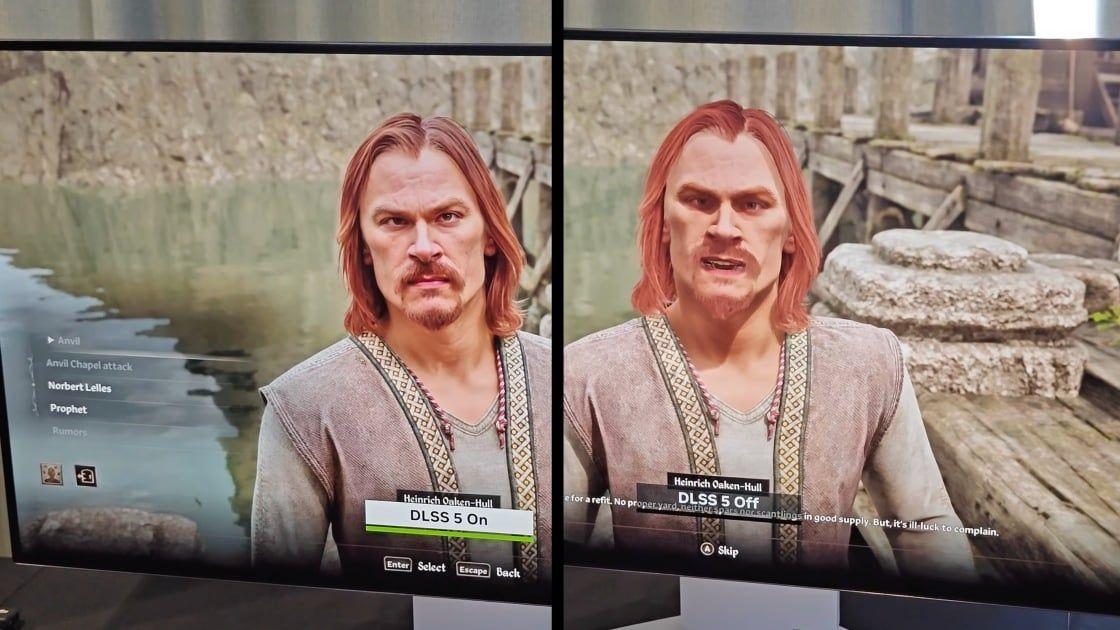
Nvidia's DLSS 5 AI tool sparks fierce backlash over beauty filter effects on game characters
25 Mar 2026•Technology
Intel brings XeSS 3.0 frame generation to older Arc GPUs, but keeps code proprietary
11 Mar 2026•Technology
Nvidia unveils three AI models for DLSS 5, promises developers control over artistic intent
21 Jul 2026•Technology

Recent Highlights



Recent Highlights
Today's Top Stories



Don’t drown in AI news. We cut through the noise - filtering, ranking and summarizing the most important AI news, breakthroughs and research daily. Follow topics that matter to you and stay ahead.


