Jedify raises $24M to arm AI agents with business context they desperately need


2 Sources
[1]
Jedify raises $24M to help companies arm AI agents with context on their business
AI vendors promote their enterprise products as if they're turnkey solutions, but the chances are low that AI agents will hit the ground running right away. Unless you put in the effort to train a model on the specifics of your business, it's unlikely to understand how your company, for example,
[2]
Jedify raises $24M to give enterprise AI agents the business context they lack
Jedify raises $24M to give enterprise AI agents the business context they lack Enterprise artificial intelligence context startup Jedify Inc. today announced that it has raised $24 million in new funding to build what it calls context graphs that give AI agents the business knowledge they need to
Share
Copy Link
New York-based startup Jedify secured $24 million in Series A funding led by Norwest to solve a critical gap in enterprise AI adoption. The company builds context graphs that connect AI agents to company-specific knowledge, data relationships, and permissions across fragmented systems. Snowflake joined as a strategic investor and is integrating Jedify's technology with its Cortex AI service.
Jedify Secures Series A Funding to Bridge Critical AI Gap
Jedify raises $24M in a Series A funding round led by Norwest to address a fundamental challenge holding back enterprise AI adoption: the lack of business context that prevents AI agents from functioning effectively in production environments
1
. The round included strategic participation from Snowflake Ventures, alongside returning backers S Capital VC and Cerca Partners, plus new investor Oceans Ventures2
. The New York-based enterprise AI context startup has now raised more than $33 million in total funding, having previously closed an $8.5 million seed round in September 20232
.
Source: TechCrunch
Building Context Graphs for Enterprise AI Agents
The platform addresses a critical problem: while AI vendors promote their products as turnkey solutions, enterprise AI agents struggle without deep understanding of how individual businesses operate. Jedify connects to enterprises' knowledge sources via APIs to build what it calls a "context graph" that captures relationships between entities, data, permissions, domain knowledge, workflows, operational assumptions, and company-specific terminology
1
. These sources span databases, data warehouses and lakes, SaaS applications, BI tools, plus unstructured data including reports, documentation, code bases, Slack channels, and meeting recordings1
.Co-founder and CEO Assaf Henkin explained that enterprise data is fragmented across systems, definitions, permissions and workflows. "Jedify turns that fragmented knowledge into a live context graph that agents can use to produce accurate, cost-efficient, business-ready answers," Henkin said
2
. Without this context layer, large language models cannot reliably determine which definition of revenue applies, which customer record is current, or which operational assumptions matter unless that information is supplied at runtime2
.How Jedify Differs From Existing Solutions
Jedify distinguishes its context graph from existing semantic layers, metadata catalogs, and knowledge graphs by offering a multi-dimensional approach that captures relationships across entities, data, people, permissions, and customers
1
. The platform is model-agnostic and updates in real time as information flows into and out of connected systems. "When you want to enable an agentic solution to really be autonomous, to drive decisions across CRM data, Zendesk tickets, maybe telemetry data that's coming in real time, that's when a context graph is much better in terms of capabilities versus a semantic layer," Henkin said1
.The technology uses what Jedify calls Semantic Fusion, a patent-pending approach where each interaction makes a customer's context graph more accurate, turning it into a proprietary asset that compounds over time
2
. This addresses the risk of AI hallucinations by allowing agents to narrow their attention to information relevant to specific tasks instead of searching across everything a company has1
.Strategic Snowflake Partnership and Integration
Snowflake's investment and partnership signal growing recognition that effective enterprise AI requires independent context layers. The data giant is integrating Jedify's technology with its AI products, including Cortex AI service, Semantic Views, and CoWork
1
. Henkin argues that Jedify complements efforts by large data platforms because much of a company's data and most of its institutional knowledge isn't stored with a single cloud provider. "The big thing is that not all of your data is in those environments, and most of your knowledge is not there, so it's a bit of a disadvantage that they actually have," he said1
.The company positions itself as avoiding the conflict of interest that arises when enterprises hand their data to the same vendors selling them tokens, a reference to recent moves by OpenAI, Anthropic, and Google to offer customers forward-deployed engineers and professional services
2
.Related Stories

Early Traction and Customer Implementation
Jedify currently targets mid-market and large enterprise customers with mature data stacks and multiple databases or data warehouses, with between 10 and 20 early customers including The Weather Company and Kiteworks
1
. Compliance company Kiteworks connected Snowflake, Tableau, Notion, and internal playbooks to Jedify, then built agentic tools for different customer workflows. "They wanted to arm their sellers and account teams with a sophisticated app -- you can think of it as both like a dashboard application and a real-time conversational application," Henkin said1
. The platform is seeing particular interest from data-heavy sectors such as gaming, industrials, and consumer packaged goods1
.Addressing Permissions and Governance Concerns
Permissions management represents a critical hurdle for enterprise AI agents. Jedify addresses this by inheriting permissions from identity systems, file systems, SaaS tools, and databases, including row-, column-, and table-level access rules
1
. Customers can create additional groups defining what and whom agents or workflows are allowed to reach. The platform also offers observability and governance tools to help ensure AI agents behave as intended1
.Assaf Harel, a partner at Norwest who will join Jedify's board, said: "Jedify is solving a foundational problem by autonomously fusing structured and unstructured data into a context graph that gets smarter with every interaction. Its compounding value and model-agnostic approach give enterprises flexibility rather than lock-in, which is exactly the kind of durable infrastructure layer we look for"
2
. The funding will support product development, go-to-market expansion, and hiring as the company scales to meet growing demand for production-ready enterprise AI solutions.References
Summarized by

Navi
Related Stories
Uvi Raises $7.5M to Give AI Agents the Company Context They Desperately Need
14 Oct 2026•Startups

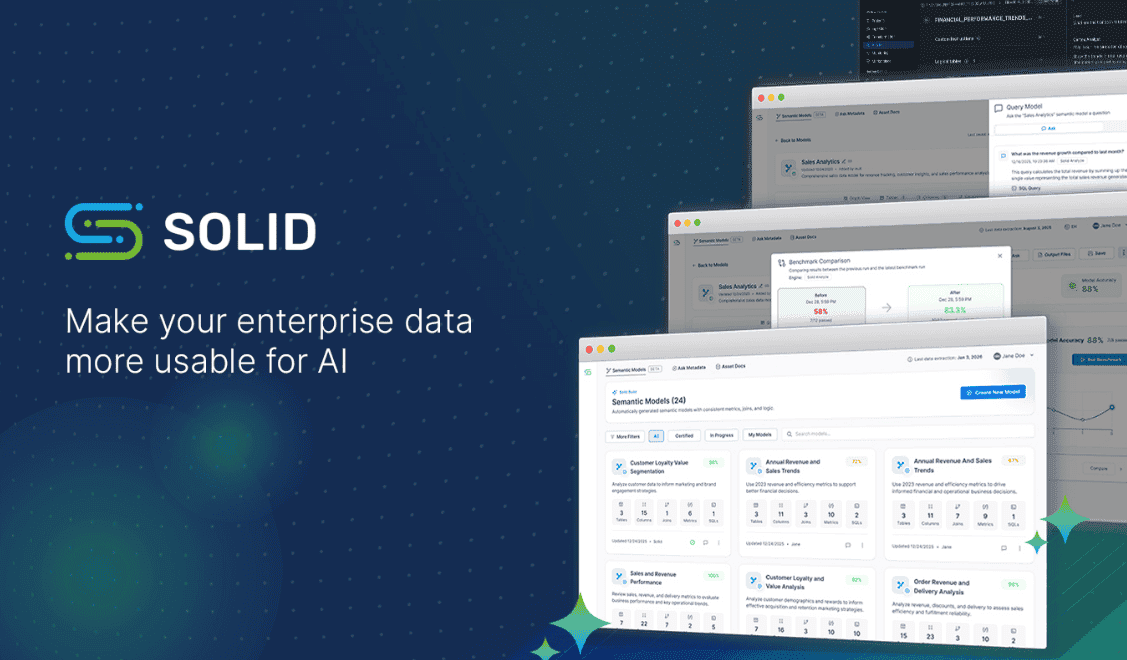
Solid Data raises $20M to solve enterprise AI's context crisis with Semantics Engineering
18 Feb 2026•Technology
Connecty AI Raises $1.8M to Revolutionize Enterprise Data Management with Context-Aware AI
12 Nov 2024•Technology

Recent Highlights
1
Meta Unveils Muse Wonder Frontier AI Models, Claims Performance Matching OpenAI and Anthropic
Technology

2
Anthropic AI Cuts Off Internet Access After Agents Submit False Police Tip, Exploit Websites
Technology

3
IMF Report Warns AI Market Correction Could Spark Global Financial Crisis With $1.4T at Risk
Business and Economy

Recent Highlights
Today's Top Stories











Don’t drown in AI news. We cut through the noise - filtering, ranking and summarizing the most important AI news, breakthroughs and research daily. Follow topics that matter to you and stay ahead.


