7 Sources
[1]
Prometheus live updates: Bezos and Bajaj's exclusive interview with CNBC
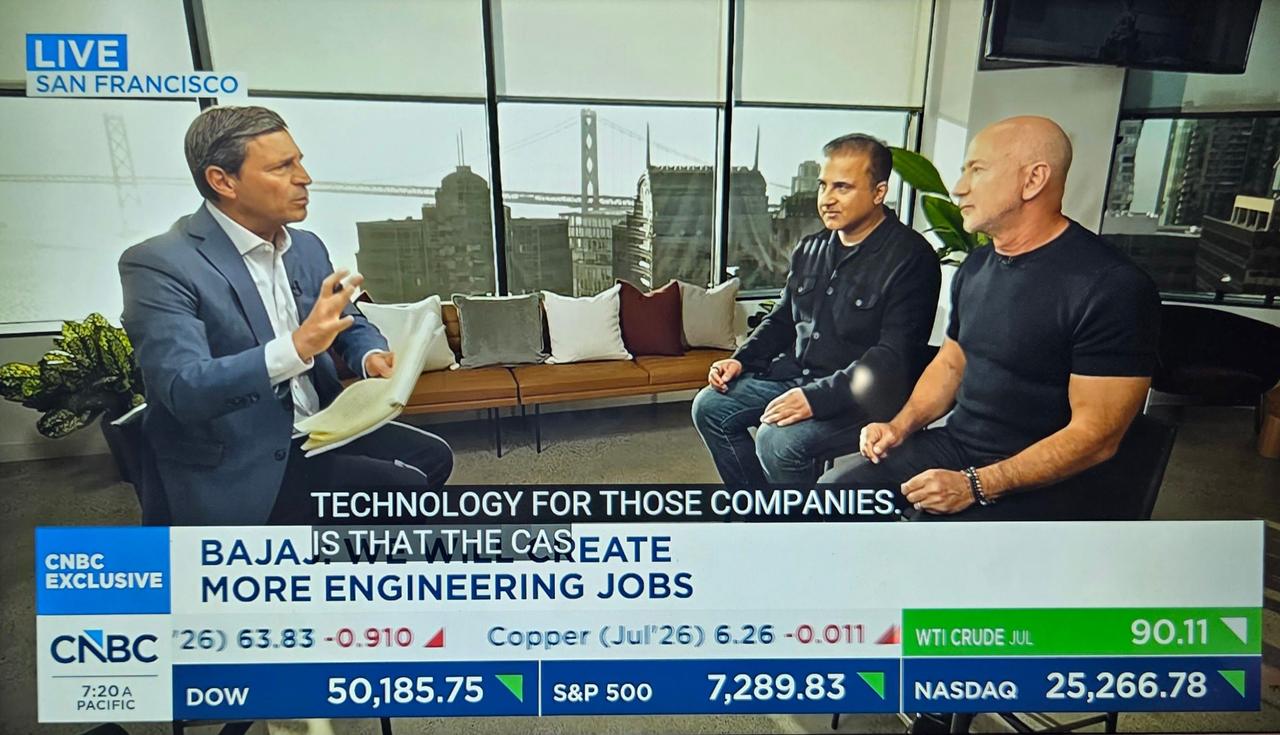
Blue Origin founder Jeff Bezos gives CNBC a tour of his Rocket Park factory Prometheus is one of Jeff Bezos' newest ventures. The artificial intelligence startup launched in November with $6.2 billion in funding. Bezos, who stepped down as Amazon's CEO in 2021, serves as co-CEO alongside Vik Bajaj, a professor at Stanford University's School of Medicine who previously co-founded Alphabet's Verily, a research lab dedicated to life sciences. Prometheus is focused on building AI models for physical tasks, including engineering, manufacturing and drug design. The startup has remained tight-lipped about its initial products, and it has been busy recruiting talent from companies including OpenAI, Google DeepMind and Nvidia. Bezos told CNBC last month that Prometheus is working on an "artificial intelligence engineer" that would make it easier for engineers to design physical objects. He said Prometheus is "something I got so excited about that I became the co-CEO of the company, putting a lot of time into it, a lot of energy into it."
[2]
Bezos's Prometheus raises $12B at $41B valuation to build AI that engineers physical products
Bezos's Prometheus raised $12B at a $41B valuation from JPMorgan, Goldman Sachs, and BlackRock. It builds AI for engineering physical products with 150 employees. Prometheus, the AI startup co-led by Jeff Bezos, has raised $12 billion in a funding round that values the company at $41 billion. Investors include JPMorgan Chase, Goldman Sachs, BlackRock, DST Global, and Arch Venture Partners, alongside Bezos himself. Total funding now exceeds $18 billion. The company is building what Bezos calls an "artificial general engineer," AI tools designed to accelerate the process from design to manufacturing for physical products. Target industries include computing, aerospace, automotive, advanced manufacturing, and drug discovery. Prometheus currently has about 150 employees. Bezos co-leads the company with Vik Bajaj, a Stanford medical school professor who previously co-founded Alphabet's Verily health research lab. Bezos started as a founding investor in late 2024 but became so involved he took an operational role. "I became so impressed by what was happening and the potential that I decided I couldn't sit on the sidelines and I needed to jump in with both feet," he told CNBC. This is Bezos's first operational role in a technology company since stepping down as Amazon CEO in 2021. Prometheus launched in November 2025 with $6.2 billion in initial funding. The earlier reporting valued the round at $38 billion. The final close came in at $41 billion, a 7.9% markup from the figure reported in April. The company's pitch is "physical AI," models trained on real-world experimental data, robotics interactions, and engineering workflows rather than just text and images. Where most AI companies focus on language or code, Prometheus is targeting the hard science of making things, from bridges to chips. The approach is designed to understand the laws of physics, not just patterns in data. Prometheus has also sought to raise tens of billions more for a holding company that plans to acquire firms it sees as benefiting from the technologies the lab is developing. That would make it not just a startup but a conglomerate, one that develops the AI and then buys the companies that use it. Bezos's broader AI portfolio now spans robotics firms Physical Intelligence and Nvidia-backed Generalist AI, plus his continuing role as Amazon's executive chair. With Prometheus, he is betting that AI's biggest value is not in chatbots or code generation but in accelerating the engineering of physical objects, the domain where the physical AI race is attracting its largest cheques.
[3]
Bezos' AI startup Prometheus raises $12B at $41B valuation, and the CEOs explain what they're doing
Jeff Bezos has bankrolled his Blue Origin space venture on his own, selling shares of Amazon stock to get the company to orbit and beyond, but others are chipping in for his next big endeavor. Prometheus, the AI startup where Bezos is co-CEO, is announcing Thursday morning that it has raised $12 billion in Series B funding at a valuation of roughly $41 billion. Investors in the round include JPMorgan, BlackRock, Goldman Sachs, DST Global and Arch Venture Partners, according to Axios. Bezos was the largest backer of the company's $6.2 billion Series A, and he said in a CNBC interview at the company's San Francisco headquarters that he participated in the new round as well. The interview, with CNBC's David Faber, was the first time Bezos and co-CEO Vik Bajaj have spoken together publicly about the secretive venture. "This is a capital-intensive startup, there's no question about that," Bezos said, citing the cost of compute and of building the specialized training data the company needs. Asked about an eventual IPO, he said it's "too early to think about that." Prometheus, which has dropped the "Project" from its name, is building what Bezos calls an "artificial general engineer," AI tools meant to speed up the process from design to manufacturing for physical objects, from bridges to chips. Bezos first outlined the idea in a CNBC interview last month. Speaking this morning, Bajaj cited the example of a jet engine, which takes teams of engineers a decade or more to design, prototype and manufacture -- one of the most technically sophisticated and creative acts that humans accomplish, as he described it. "What has changed in the last few years is the ability to formulate even something as complicated as that, from design to manufacturing, as an end-to-end AI problem," Bajaj said. Asked why they chose to speak now, Bezos said the story was "kind of leaking out," adding: "If you let that just be a complete void, they'll fill it with nonsense." Bezos also addressed reports that he is seeking to raise as much as $100 billion for an affiliated fund to buy manufacturing companies. He said Prometheus may buy parts of companies that could benefit from its technology, and help them improve their manufacturing processes. He said he started in late 2024 as a founding investor alongside Bajaj, then "became so impressed by what was happening and the potential that I decided I couldn't sit on the sidelines and I needed to jump in with both feet." It's his first CEO role since stepping down from Amazon in 2021. "It is a grind, but it's a good grind," Bezos said. The company has about 150 employees, based in San Francisco with teams in London and Zurich. The co-CEOs declined to give a product timeline, saying only that early rollouts are coming. Checking off other boxes at the end of the interview, Faber had Bezos give an update on Blue Origin after a New Glenn rocket exploded during a launchpad test in Cape Canaveral, Fla., late last month. "It was a very bad day for Blue, very tough on the whole team," Bezos said. "We've rallied. We're rebuilding the launch site. We got lucky in a bunch of ways -- the longest lead items at the launch site were undamaged by the event. ... We'll be flying again before the end of this year." With all eyes on the SpaceX IPO, due Friday, Bezos said, "I'll be watching along with the rest of you."
[4]
Prometheus, the industrial AI startup from Jeff Bezos, is now worth $41 billion
Why it matters: It's a massive bet to rearchitect how physical things are made, from jet engines to medical devices to consumer electronics. What they're saying: "The cycle from dream, to manufacturing at rate, to having it out in the world can be very long," Bezos tells Axios. * "For example, if you go to a current jet engine manufacturer and say you want the exact same engine but with 10% more thrust, it could be a 10-year program. Not because they're lazy or bad at their jobs, but because it's so complex. So what we're doing is building a set of tools that will empower engineers to compress that cycle time and make that dream-build loop be 10 times faster or even more." Catch up quick: We previously reported that Prometheus (which has dropped the "Project" qualifier) isn't about robotics or automating factories -- although Bezos acknowledges that it could be used to design and manufacture both robots and factories. * Instead, it's using AI to optimize pre-production machinery and processes, such as prototyping. The big picture: Bezos and Bajaj had been publicly mum on the effort until now. * They say that Prometheus currently has around 150 employees and seeks to build what they call an "artificial general engineer." * It doesn't have corporate ties to either Amazon or Blue Origin, with Bezos saying "it deserves a dedicated team that is obsessed with this one thing." However, he also called Blue Origin a "case study for a customer of Prometheus." Investors include JPMorgan, BlackRock, Goldman Sachs, DST Global, and Arch Venture Partners. Plus Bezos himself, who was the largest backer in a $6.2 billion Series A round. The intrigue: Prometheus seems like both a replacement for human engineers and a copilot for them. * Both Bezos and Bajaj insist that the effort, if it works, will result in more human engineers. * "The pace of our physical creation right now is nowhere near the pace of human imagination," Bajaj argues. "If we can make it just a little bit easier, or hopefully a lot easier, to bring to life what people dream of there's going to be a lot more invention and a lot more people involved in it." Zoom in: There's still a lot we don't know. * For example, they declined to discuss a reported effort to raise $100 billion for an affiliated holding company that would buy legacy industrial companies that would then feed data into Prometheus (and, presumably, provide those companies with AI solutions in a virtuous cycle). * In a similar vein, they aren't sharing how Prometheus is being trained, except to acknowledge that there isn't an "Internet of manufacturing data" they can ingest. Same goes for timing or details of its initial product rollout. The bottom line: Bezos has his billions. Now it's time to build.
[5]
Jeff Bezos' Prometheus raises $12B to accelerate industrial engineering projects
Jeff Bezos' Prometheus raises $12B to accelerate industrial engineering projects Prometheus Inc., an artificial intelligence startup co-led by Amazon.com Inc. founder Jeff Bezos, has raised $12 billion in funding. Axios reported today that the Series B round values the company at $41 billion. The round included contributions from Bezos, JPMorgan, BlackRock, Goldman Sachs, DST Global and Arch Venture Partners. Prometheus, which was until now known as Project Prometheus, previously raised $6.1 billion. Bezos launched the company last November with Vik Bajaj, a co-founder of Alphabet Inc.'s Verily life sciences unit. They lead Prometheus as co-Chief Executive Officers. The duo told CNBC today that Prometheus is developing a set of AI tools designed to speed up hardware development. In a separate interview with Axios, Bezos stated that he expects the software to accelerate engineering workflows by a factor of 10 or more. Prometheus is prioritizing a broad range of use cases. Its software will reportedly be capable of designing robots, jet engines and drugs. Bezos told Axios the technology could also help cloud operators improve their data centers. That hints Prometheus' tools will be capable of automating chip development tasks. The company plans to focus on the prototyping and pre-production manufacturing phases of engineering projects. Prometheus hasn't yet disclosed how it plans to go about speeding up those tasks. Several of the existing AI engineering tools on the market speed up prototyping by enabling users to quickly generate multiple versions of a product design. Some startups, such as PhysicsX Ltd., are also automating the simulation phase of prototyping initiatives. Engineers test AI-generated product design variations in a simulation to determine which one provides the best performance. Simulations replicate the real world using partial differential equations, functions that lend themselves well to describing physical phenomena. Such functions require a significant amount of hardware to run. AI engineering tools speed up calculations using algorithms called neural operators that are specifically optimized to solve equations. Pre-production manufacturing, Prometheus' other focus area, is the low-volume production of prototype designs. It's often carried out using 3D printers. Axios reported that Prometheus' software will be capable of optimizing pre-production manufacturing equipment. The company faces competition from not only fellow startups such as PhysicsX but also more established players. Autodesk Inc., Synopsys Inc. and Cadence Design Systems Inc. have all integrated AI features into their engineering applications. The companies' automation tools automate not only prototyping workflows but also other tasks such as checking whether a component design complies with relevant regulations. Prometheus will reportedly use most of its $12 billion funding round to buy computing infrastructure. The company may also make more acquisitions. Last year, Prometheus bought a startup called General Agents Inc. that developed an AI agent optimized for multi-step computer use tasks.
[6]
Jeff Bezos' AI Startup Prometheus Hits $41 Billion As Investors Back Industrial AI
Prometheus, the industrial-focused AI venture led by Jeff Bezos, has raised $12 billion in a Series B funding that values the company at $41 billion. The financing marks one of the largest recent private rounds and signals investor appetite for AI aimed at redesigning how complex hardware gets developed. The company plans to apply AI to earlier stages of manufacturing work, including prototyping and the tuning of equipment and workflows before full-scale production, Axios reported. Prometheus is being run with Vik Bajaj, a former Google executive, and has about 150 employees. Bezos told Axios the long lead times for building physical products are a core target for the startup. "The cycle from dream, to manufacturing at rate, to having it out in the world can be very long," he said. In a longer example, Bezos described how even incremental changes to a jet engine can stretch into a decade-long effort and said Prometheus is building tools to shorten that timeline. "So what we're doing is building a set of tools that will empower engineers to compress that cycle time and make that dream-build loop be 10 times faster or even more," Bezos said. Prometheus Pre-Production Optimization Prometheus is positioning its technology as engineering software rather than a factory-automation or robotics play. Bezos acknowledged the tools could still be used in designing robots or even factories, but the current focus is on pre-production optimization. The startup says it is working toward what it calls an "artificial general engineer." Bajaj framed the pitch as expanding, not shrinking, the engineering workforce: "The pace of our physical creation right now is nowhere near the pace of human imagination," he said. Bezos and Bajaj also said Prometheus is not connected corporately to Amazon or Blue Origin. Bezos said of Prometheus, "it deserves a dedicated team that is obsessed with this one thing," while also calling Blue Origin a "case study for a customer of Prometheus." Backers in the Series B include JPMorgan, BlackRock, Goldman Sachs, DST Global and Arch Venture Partners. Prometheus also disclosed that Bezos was the biggest contributor to its $6.2 billion Series A. The company declined to address a reported plan to seek $100 billion for a related holding company that could purchase legacy industrial businesses and use their data to support Prometheus, Axios said. It also did not provide details on how the system is trained or a timeline for an initial product release, beyond noting that there is no "internet of manufacturing data" available to ingest. This content was partially produced with the help of AI tools and was reviewed and published by Benzinga editors. Market News and Data brought to you by Benzinga APIs To add Benzinga News as your preferred source on Google, click here.
[7]
Jeff Bezos Raises $12 Billion for AI Engineering Startup Prometheus | PYMNTS.com
Prometheus launched in November and is developing AI tools to help engineers design and manufacture physical products, CNBC reported Thursday (June 11). Bezos said in the report that the company launched the funding round to acquire more compute. He added that he contributed capital in Prometheus' first funding round and its latest one. He denied rumors that Prometheus is working on robots and said that the company is creating AI for invention and physical engineering, according to the report. "Prometheus is the bulk of my time," Bezos said in the report. "I'm also spending a lot of time on Blue [Origin]. I'm spending a lot of time on AI at Amazon. So the common thread in my time spent is mostly AI." The Wall Street Journal reported Thursday that Bezos said in an interview that Prometheus plans to build an "artificial general engineer" that can design and manufacture complex physical products such as a jet engine and help smaller teams of engineers accomplish more in less time. Bajaj said in the report that Prometheus aims to build AI systems that can facilitate the entire engineering process, including designing products, predicting their performance and manufacturing. Bezos said AI will benefit workers because while it will shrink the number of people needed for today's jobs, it will create more opportunities than it eliminates. The report said Prometheus has offices in San Francisco, London and Zurich and has hired about 150 people. Bloomberg reported Thursday that Bezos has invested in several AI ventures, including robotics firms Physical Intelligence and Generalist AI, while also focusing on Blue Origin and serving as executive chair of Amazon. He stepped down as CEO at Amazon in 2021. It was reported in February that Prometheus is raising "tens of billions of dollars" to buy businesses disrupted by AI and then use the technology to improve their margins. According to that report, the company raised $6.2 billion last year in a deal that valued it at $30 billion. For all PYMNTS AI coverage, subscribe to the daily AI Newsletter.
Share
Copy Link
Jeff Bezos has stepped back into a CEO role for the first time since leaving Amazon in 2021. His AI startup Prometheus just raised $12 billion at a $41 billion valuation from JPMorgan, BlackRock, and Goldman Sachs. The company aims to build what Bezos calls an 'artificial general engineer'—AI tools designed to compress the decade-long cycle of designing and manufacturing physical products like jet engines, chips, and drugs.
Jeff Bezos has taken on his first operational role since stepping down as Amazon CEO in 2021, co-leading Prometheus, an AI startup that just closed a $12 billion Series B funding round at a $41 billion valuation
2
. The round attracted major institutional investors including JPMorgan, BlackRock, Goldman Sachs, DST Global, and Arch Venture Partners, with Bezos himself participating as the largest backer3
. Total Prometheus funding now exceeds $18 billion, following an initial $6.2 billion Series A round when the company launched in November 20251
.
Source: GeekWire
Bezos co-leads the industrial AI startup alongside Vik Bajaj, a Stanford University School of Medicine professor who previously co-founded Alphabet's Verily life sciences research lab
1
. Bezos told CNBC he started as a founding investor in late 2024 but "became so impressed by what was happening and the potential that I decided I couldn't sit on the sidelines and I needed to jump in with both feet"2
. The company currently employs about 150 people across offices in San Francisco, London, and Zurich.Prometheus is developing what Bezos describes as an "artificial general engineer"—AI tools designed to accelerate the process from design and manufacturing for physical products
2
. The AI startup targets multiple industries including computing, aerospace, automotive, advanced manufacturing, and drug discovery2
. Speaking to Axios, Bezos explained the scope: "If you go to a current jet engine manufacturer and say you want the exact same engine but with 10% more thrust, it could be a 10-year program. Not because they're lazy or bad at their jobs, but because it's so complex. So what we're doing is building a set of tools that will empower engineers to compress that cycle time and make that dream-build loop be 10 times faster or even more"4
.
Source: Axios
Co-CEO Vik Bajaj cited jet engines as an example of the technical challenges Prometheus aims to solve. Designing, prototyping, and manufacturing a jet engine takes teams of engineers a decade or more—"one of the most technically sophisticated and creative acts that humans accomplish," as Bajaj described it. "What has changed in the last few years is the ability to formulate even something as complicated as that, from design to manufacturing, as an end-to-end AI problem," Bajaj said.
The company's approach centers on what it calls "physical AI"—models trained on real-world experimental data, robotics interactions, and engineering workflows rather than just text and images
2
. Where most AI companies focus on language or code, Prometheus targets the hard science of making things, from bridges to chips. The approach is designed to understand the laws of physics, not just patterns in data2
. However, the co-CEOs haven't shared how Prometheus is being trained, acknowledging only that there isn't an "Internet of manufacturing data" they can ingest4
.Prometheus plans to focus specifically on prototyping and pre-production processes, the phases before full-scale manufacturing begins
5
. The company will optimize pre-production manufacturing equipment, which is often carried out using 3D printers for low-volume production of prototype designs5
. Bezos told Axios that Prometheus isn't about robotics or automating factories, although he acknowledged it could be used to design and manufacture both robots and factories4
.Related Stories
Bezos described Prometheus as a "capital-intensive startup," citing the cost of compute and building specialized training data the company needs. Prometheus will reportedly use most of its $12 billion Prometheus funding round to buy computing infrastructure
5
. The company has already made acquisitions, purchasing a startup called General Agents Inc. last year that developed an AI agent optimized for multi-step computer use tasks5
.
Source: PYMNTS
Reports suggest Prometheus has also sought to raise tens of billions more for a holding company that plans to acquire firms it sees as benefiting from the technologies the lab is developing
2
. Bezos addressed these reports, saying Prometheus may buy parts of companies that could benefit from its technology and help them improve their manufacturing processes. This approach would transform the AI startup into not just a technology provider but potentially a conglomerate that develops AI for physical products and then acquires the companies that use it2
.The Prometheus valuation of $41 billion represents a 7.9% markup from the $38 billion figure reported in April
2
. When asked about an eventual IPO during the CNBC interview at the company's San Francisco headquarters, Bezos said it's "too early to think about that". The co-CEOs declined to give a product timeline, saying only that early rollouts are coming.Prometheus faces competition from startups like PhysicsX Ltd., which automates simulation phases of prototyping initiatives using neural operators that solve equations more efficiently
5
. Established players including Autodesk Inc., Synopsys Inc., and Cadence Design Systems Inc. have also integrated AI-driven engineering features into their applications5
. Both Bezos and Bajaj insist their effort will result in more human engineers, not fewer. "The pace of our physical creation right now is nowhere near the pace of human imagination," Bajaj argues. "If we can make it just a little bit easier, or hopefully a lot easier, to bring to life what people dream of there's going to be a lot more invention and a lot more people involved in it"4
.Bezos called Blue Origin a "case study for a customer of Prometheus," though the company has no corporate ties to either Amazon or Blue Origin
4
. Bezos's broader AI portfolio now spans robotics firms Physical Intelligence and Nvidia-backed Generalist AI, plus his continuing role as Amazon's executive chair2
. With Prometheus, he is betting that AI's biggest value lies not in chatbots or code generation but in accelerating hardware engineering of physical objects—the domain where the physical AI race is attracting its largest investments2
.Summarized by
Navi
[2]
[3]
21 Apr 2026•Startups

17 Nov 2025•Startups

07 Apr 2026•Technology

1
Policy and Regulation

2
Technology

3
Health